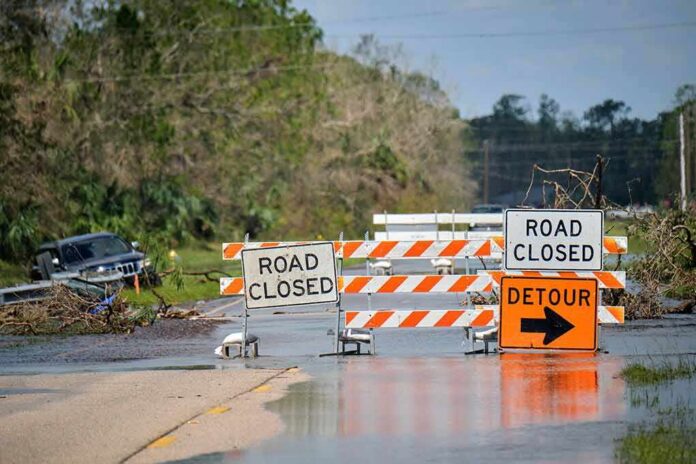
Flash flooding killed three people near Newcomb, New Mexico, after a surge of monsoon moisture and a passing disturbance turned night rain into a deadly wall of water.
Story Highlights
- Police found two adults and one juvenile dead after floodwaters swept them away near Newcomb.
- National Weather Service warned of heavy rain and flash flooding across northern and central New Mexico.
- Forecasters tied the danger to rich monsoon moisture boosted by a disturbance in the Four Corners.
- The event marked one of the most active and dangerous monsoon days in the region this year.
Deadly Overnight Flooding On The Navajo Nation
Navajo Nation police responded around 12:30 a.m. near Newcomb after reports that three people were swept away by rising water. Officers later found two adults and one juvenile, who were pronounced dead at the scene, according to reports citing the Navajo Police Department. The area sits in northwest New Mexico, about 40 miles east of the Arizona line. The location and timing match a burst of overnight flooding that hit the Four Corners region hard.
Authorities have not publicly identified the victims. Police said the investigation continues. Local and national outlets described the fatalities as part of a broader flood threat that flared across the Southwest the same day. The storm impacts reached from New Mexico into Arizona, where additional warnings and watches were posted. The concentration of danger near Newcomb tracked with the most intense rainfall overnight and the fast water that followed.
Forecasts Flagged Flash-Flood Risk Before Storms Hit
The National Weather Service in Albuquerque said a surge of rich monsoon moisture would spread across northern and central New Mexico. Forecasters warned that a disturbance rotating around a West Coast trough would sweep through the Four Corners and raise the risk of locally heavy rain and flash flooding into Wednesday night. Flood watches went up for several zones ahead of the event. The language pointed to an amplified monsoon setup with a clear flash-flood signal.
Meteorologists often see the worst flash floods when deep monsoon moisture meets a passing disturbance. That pairing can turn slow storms into rain producers that overwhelm dry washes and low crossings in minutes. The pattern on this date fit that mold. Rain arrived over saturated spots and terrain that channels water fast. In those conditions, small creeks rise quickly, and nighttime timing leaves drivers and walkers with little margin to react.
Why The Four Corners Is So Vulnerable In Monsoon Season
Studies and federal hazard materials show the North American monsoon drives most damaging flash-flood events in the Southwest. Research tied over 60 percent of damaging flash-flood events and nearly 30 percent of flood damages in the region to monsoon systems. New Mexico sees injuries, deaths, and property losses from monsoon storms every year. When storms linger over canyons, burn scars, or arroyos, water gains speed and force, often with little warning for people nearby.
Officials urge simple, proven steps during monsoon bursts: avoid low-water crossings, never drive into moving water, and move to higher ground fast. Night storms hide flooded dips and washes. A few inches of fast water can knock a person down. A foot of water can carry a car. Forecasters issue alerts, but local judgment still matters most in that critical first minute. Families in flood-prone areas should plan routes, set phone alerts, and keep a go-bag ready.
What Comes Next For The Region
Emergency crews on the Navajo Nation and across New Mexico will review response timelines and local flood points. The National Weather Service will analyze radar, rain gauges, and storm reports to refine future warnings. Regional outlets reported that the broader flood threat remained elevated for parts of Arizona and New Mexico as moisture stayed in place. As the wet season continues, officials stress that one more slow-moving cell can trigger new flash floods in the same vulnerable spots.
Sources:
nypost.com, sunstar.com.ph, azcentral.com, newsweek.com