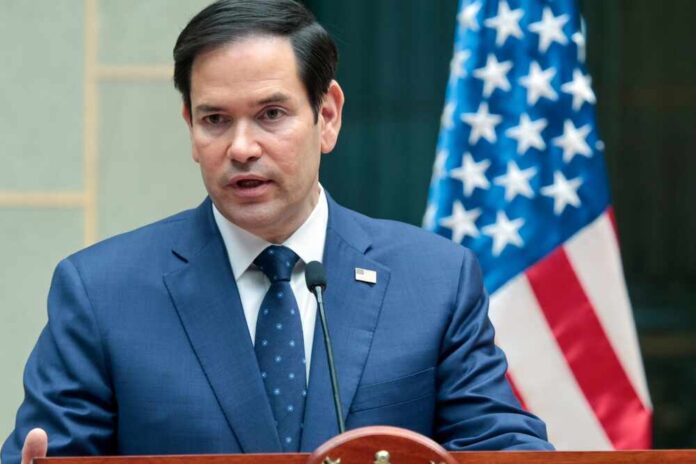
Secretary of State Marco Rubio warns that NATO’s betrayal in denying U.S. bases during the Iran war forces America to re-examine a one-sided alliance, validating long-held Trump skepticism.
Story Snapshot
- Rubio blasts NATO allies like Spain for refusing base access at Rota and Morón, calling their conduct “deeply disappointing.”
- U.S. shoulders massive NATO burden yet faces denial of support in critical Iran operations to reopen the Strait of Hormuz.
- President Trump labels NATO “cowards” and a “paper tiger,” echoing calls for post-war alliance review.
- Rubio, once a NATO defender, now demands reciprocity or justification for continued U.S. participation.
- War expected to end in weeks, shifting focus to reforming NATO’s unfair demands on American taxpayers.
Rubio’s Direct Criticism of NATO Allies
Secretary of State Marco Rubio delivered sharp criticism on March 31, 2026, during an Al Jazeera interview. He targeted Spain for denying U.S. access to Rota and Morón bases in Andalusia, along with airspace clearance. Rubio described this refusal as “deeply disappointing,” especially as NATO expects American defense of Europe under Article 5. Spain openly boasted about the denial, highlighting alliance hypocrisy. This stance blocks U.S. logistics in the ongoing Iran conflict.
Timeline of Base Denials and U.S. Response
U.S. and Israel strikes on Iran prompted threats to close the Strait of Hormuz, disrupting global shipping. NATO allies rejected requests for support in restoration efforts. Pre-March 31 denials solidified when Rubio spoke out. On April 1, his department released the transcript, and he reiterated on Fox News the need to “re-examine” NATO. President Trump preceded this by calling allies “cowards.” The war persists but Rubio anticipates conclusion in weeks.
Trump Administration’s Shift on NATO Commitments
President Trump’s second term revives his long-standing critique of NATO free-riders. The U.S. funds and mans the alliance disproportionately since 1949. Rubio, a former Senate NATO supporter, now aligns fully. He stated that defending Europe while denied Middle East aid makes continued participation “hard to justify.” This marks a pragmatic turn toward conditional partnership. Without U.S. strength, Rubio emphasized, NATO ceases to exist.
Allies prioritize non-Article 5 neutrality, driven by domestic anti-war politics. Spain’s firm ban persists with no concessions. U.S. pursues alternative coalitions for Hormuz reopening.
Implications for American Interests and Isolationism
Short-term, base denials strain U.S. Iran operations, hiking logistics costs and delaying strait access. Long-term, expect U.S. troop reductions, funding cuts, or reform demands. Global oil markets suffer from Hormuz blockade volatility. Politically, transatlantic trust erodes, fueling American isolationism. Defense sectors question NATO utility amid energy crises. Communities near Spanish bases face indirect U.S. leverage impacts. Rubio eyes a post-war “fix” for mutual benefit.
Sources:
Rubio Warned That the U.S. Could Reconsider Its Relationship With NATO After Iran War Bases
Rubio: US may reconsider NATO due to limited support
US Sec. of State Rubio: Will have to reexamine NATO alliance