
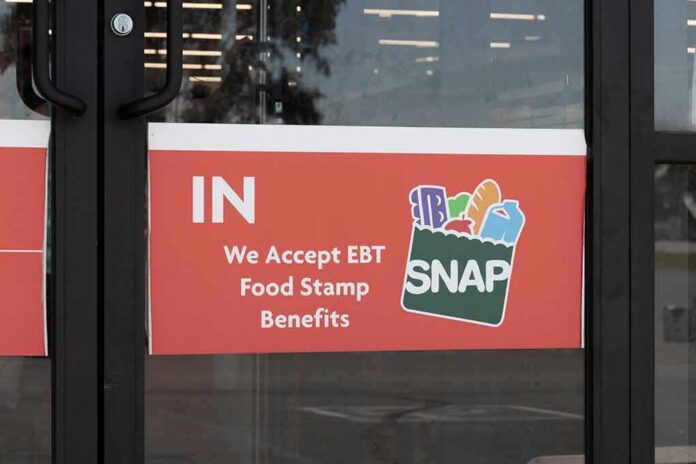
Federal prosecutors say a Hollywood, Florida store owner joined a yearslong plot to flip taxpayer SNAP benefits for cash and merchandise worth more than $500,000.
Story Highlights
- Federal complaint charges two conspiracies tied to SNAP benefits and wire fraud.
- Investigators allege Electronic Benefit Transfer cards were bought for about half value.
- Alleged scheme ran from October 2023 to March 2026 at a Hollywood convenience store.
- Undercover exchange allegedly moved about $64,388 in benefits for $29,474 cash.
Federal Charges Outline Alleged Half-Price EBT Buying Scheme
The United States Attorney’s Office for the Southern District of Florida charged Al Amin with two conspiracy counts tied to the misuse of Supplemental Nutrition Assistance Program benefits and to wire fraud. Prosecutors say Amin and others bought Electronic Benefit Transfer cards from recipients for about half their value in cash, then used the cards to buy bulk goods. The complaint cites 18 United States Code Section 371 and 18 United States Code Section 1349 as the charging statutes.
Prosecutors allege the cards funded bulk buys from retailers. They say those goods stocked Amin’s Hollywood convenience store and were also resold to other stores. This kind of trafficking harms taxpayers and families who need help buying food. It also tilts the market against honest shop owners who follow the rules and compete on price, not scams. Federal court reporting echoes the government’s account of how the merchandise moved.
Timeline, Location, and The Undercover Test
The alleged plot ran nearly three years. Court records place it from October 2023 through March 2026 and tie it to Kwik Stop 72 in Hollywood, Florida. That window suggests repeat activity, not a one-off event. Investigators often look for patterns like repeated card redemptions, odd purchase timing, or concentrated use at certain stores to show trafficking. Local reporting identified the store and the time span from the federal complaint.
An undercover step is described as a key proof point. According to reports based on court filings, an investigator provided cards that held about $64,388 in benefits and received $29,474 in cash in return. That ratio matches the “half-off” style common in benefit trafficking. Undercover operations test whether a retailer will trade cash for benefits, which is illegal. The detailed dollar figures come from coverage of the case materials.
Penalties, Due Process, and A Wider Fight Against SNAP Trafficking
The law carries real penalties. Conspiracy involving unauthorized SNAP use can bring up to five years in prison. Conspiracy to commit wire fraud can bring up to twenty years if convicted. These are maximums and depend on the facts and the judge. Amin is charged, not convicted, and will have a chance to contest the allegations in court. Early reports highlight the exposure to stress the stakes in this kind of fraud case.
The case lands as South Florida launches a federal initiative against SNAP fraud. Officials selected the region as a pilot site to push back on schemes that drain public funds and erode trust in safety-net programs. That push uses data checks and undercover work to spot trafficking and to protect honest families and retailers. Media reports connect the Amin charges with that broader enforcement effort now underway in the area.
Why This Matters to Taxpayers and Rule-Following Retailers
Trafficking in SNAP hurts two groups at once. Taxpayers see their dollars diverted. Families who play by the rules face stigma and tighter checks. Small shops that follow the law lose business to operators who bend it. Studies by the United States Department of Agriculture have found that a share of benefits gets trafficked each year, with higher risks at smaller stores. The 2015 to 2017 estimate put retailer trafficking around 1.6 percent of benefits nationwide.
Hollywood Convenience Store Owner Charged in Alleged $500,000 SNAP Fraud Scheme https://t.co/HS0k7gun16
— Marlow62 (@Marlow3456) November 2, 2026
Conservative readers want a fair system that helps people in need and punishes fraud fast. President Trump’s administration is pressing that goal by charging alleged offenders and pushing focused enforcement. If the government proves its case, this is the kind of clean-up that saves money, protects honest work, and keeps help flowing to the right people. If it cannot, the court will say so. Either way, clear rules and strong policing guard the public purse.
Sources:
townhall.com, justice.gov, cbsnews.com, sun-sentinel.com, storage.courtlistener.com, cibercuba.com