
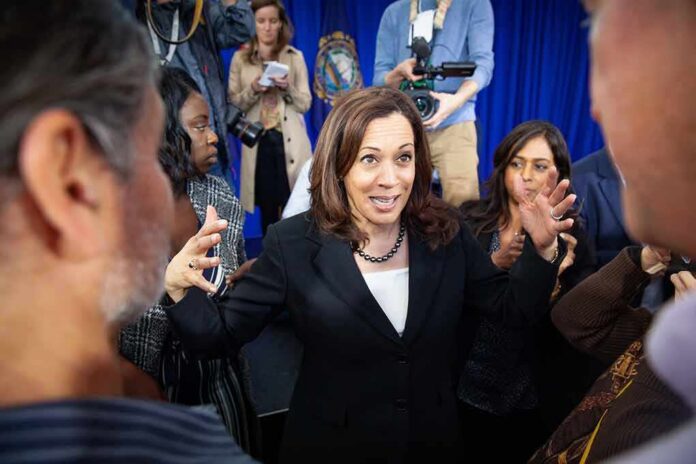
Vice President Kamala Harris said she “might” run for president in 2028 and is “thinking about it,” putting a new Democratic push on the table.
Story Highlights
- Kamala Harris told a civil rights audience she is considering a 2028 presidential run.
- National outlets reported her remarks as a clear signal of interest, not a denial.
- Recent polls show Harris leading many hypothetical Democratic fields, though results vary.
- No formal campaign or filings exist; her comments reflect consideration, not a launch.
Harris Signals 2028 Interest On The Record
Vice President Kamala Harris told the National Action Network on April 10 that she “might” run in 2028 and is “thinking about it.” She tied her answer to doing “the best job” for the American people and said she would keep people posted. The Associated Press, NBC News, and The New York Times all described the exchange as a signal that she is weighing a new bid. Harris also joked about a future lunch and said she would be “more involved than ever before in 2028”.
Harris did not announce a campaign, set a date, or name staff. She offered no early-state plan or fundraising details. Her words were conditional and stopped short of a formal step. That leaves open whether she aims to run, shape the field, or rally the base from the sidelines. The distinction matters for voters who want clarity. For now, her message was simple: she is considering options and believes her White House experience shows what the job requires.
Polling Shows Attention, But Not Certainty
Multiple polls show Harris with early support among Democrats. A Focaldata survey reported by the Financial Times put her near 30 percent in a possible field. A Center Square Voters’ Voice series found her around that level as well. A Harvard/Harris survey later showed 50 percent support among Democrats, with a clear rise from earlier months. Other reporting showed a much lower figure and many undecided voters, underscoring how fluid this stage remains.
These polls test name recognition before a full field forms. Question wording, timing, and lists of rivals can swing results. Early frontrunner stories often build fast, then fade when new candidates jump in. That pattern has marked many primaries in both parties. For readers, the bottom line is simple: Harris gets attention now, but outcomes shift once real campaigns start and voters see debates, policy plans, and travel in early states.
What A Harris Bid Would Mean For 2028
A Harris run would try to revive policies many conservatives opposed in recent years, from bigger federal programs to softer border ideas. Her potential platform would likely clash with President Trump’s push for energy independence, lower taxes, and firm borders. That contrast could decide the race for voters worried about inflation, high fuel bills, school overreach, and crime. Harris’s promise to be “more involved than ever” signals renewed organizing on the left heading into the next cycle.
Conservative readers should watch for three markers. First, Federal Election Commission filings would show real steps toward a campaign. Second, travel and hiring in South Carolina, Nevada, New Hampshire, and Iowa would point to a ground game. Third, policy speeches on the border, energy, crime, and parental rights would reveal whether she doubles down on the old agenda or trims to the middle. Until then, her on-record “might” is a live signal, not a done deal.
Sources:
facebook.com, yahoo.com, thehill.com, pdclarion.com, nytimes.com, apnews.com, kentucky.com