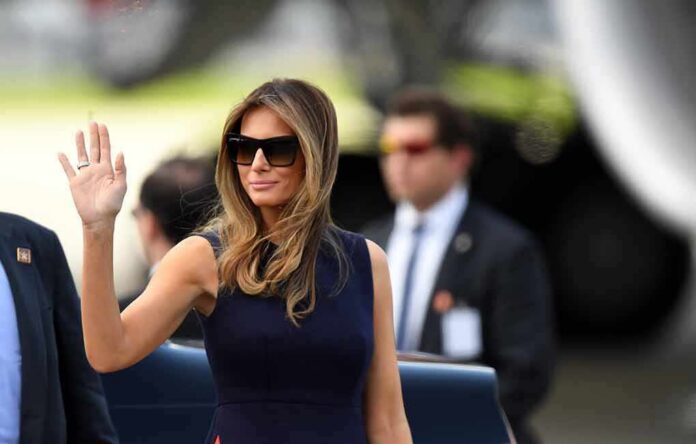
Melania Trump’s office says a localized cease-fire will open a safe corridor in war-torn Oleshky so aid can reach families and civilians can evacuate by choice.
Story Highlights
- White House says Russia and Ukraine agreed to pause fighting in Oleshky for aid and evacuation.
- Plan includes a safe route and lets residents choose evacuation destination.
- News reports say Ukrainian and Russian officials acknowledged the plan’s timing, though dates differ.
- Pope Leo XIV publicly backed a humanitarian pause and evacuations for Oleshky.
What the White House Announced About the Oleshky Pause
The White House announced that Russia and Ukraine agreed to stop military action in Oleshky to allow aid delivery and prepare a civilian evacuation. The statement set a start date and described a designated safe passageway. It framed the deal as a humanitarian step for a front-line city short on medicine, food, clean water, and power. The White House credited First Lady Melania Trump with securing the agreement, calling it a localized cease-fire focused on helping trapped civilians.
The plan outlines a pause to let relief reach people at risk and to move families to safety. It is not a broader peace deal or a shift in the battlefield outside the city. The administration positioned this as a narrow measure with clear goals: get aid in, cut danger for civilians, and set up a controlled, voluntary evacuation process. This scope matches past examples where tightly drawn pauses have worked best on the ground when all sides cooperate.
How the Evacuation and Safe Passage Would Work
The White House said the arrangement includes a safe corridor for civilians and coordinated transport. Residents who want to leave would be able to select their destination, with reported options including Ukraine or Russia under the plan. That choice matters for family unity and safety, given mixed control lines and mined roads. Reports stressed that the city has faced steady attacks and lacks basic supplies, raising the stakes for a pause that protects aid workers and evacuees alike.
Wire services echoed the humanitarian focus and the promise of movement under guard. Agence France-Presse reported that evacuees could choose where to go, showing the plan centers on consent and clear routing. For people in a contested zone, the ability to decide their endpoint reduces fear of forced transfers and lowers friction at checkpoints. That design aims to prevent clashes during the pause and to speed aid handoffs once the corridor opens.
Timing Confusion and What Officials in Kyiv and Moscow Said
Major outlets reported a discrepancy over the start date, with the White House marking October 29 while other statements pointed to October 27. Cable reporting cited announcements from Russia’s defense ministry and Ukrainian officials with earlier timing claims. This gap creates uncertainty about the rules of the road during the first hours. It also shows why clear written terms and synchronized orders are vital when troops and civilians must share limited roads under strict time windows.
Reporters noted that Ukrainian, Russian, and United States negotiators reached a deal for the city, lending weight beyond a single source. Yet they also flagged that early accounts were based on official statements before operations began. That means success still depends on commanders passing orders down the line, demining critical segments, and preventing local spoilers from firing during the pause. Those steps will decide if trucks roll and families board buses safely.
Melania Trump’s Role and the Vatican’s Humanitarian Push
The White House credited Melania Trump as the exclusive intermediary and highlighted her focus on aid and evacuations. Her office linked the effort to dire conditions in Oleshky and the need for a narrow, life-saving pause. Coverage also documented Pope Leo XIV’s public support for a humanitarian window to deliver food and medical help and to allow safe, voluntary evacuation. The Holy See’s statement adds moral pressure for compliance and keeps the focus on protecting civilians, not politics.
⚡**U.S. First Lady Melania Trump has not ruled out a possible visit to Ukraine.**
When asked by a journalist about a potential visit, she said, "We'll see."
U.S. President Donald Trump also added that such a visit could happen. pic.twitter.com/lp6QmkEH8M
— Gianl1974 (@Gianl1974) October 24, 2026
Some reporting emphasized the unusual public role for a first lady in foreign talks, given normal diplomatic channels. That novelty invites questions about process but does not change the test that matters: whether the pause lets aid in and families out without coercion or fire. As the date approaches, officials will face calls to release the written terms, identify monitors, and share post-operation results, including delivery manifests and evacuation counts that verify success.
What to Watch Next: Proof on the Ground
Americans should look for simple proof points. Aid trucks should enter Oleshky under escort. Medical teams should operate safely. Families who choose to leave should reach their stated destinations, with names checked against lists. Independent groups should confirm that firing stopped during the window. If those facts line up, the pause worked. If not, leaders must fix gaps fast or call out violators. The mission is modest but urgent: save lives and honor free choice amid war.
Sources:
nypost.com, whitehouse.gov, apnews.com, bbc.com, people.com, washingtonpost.com