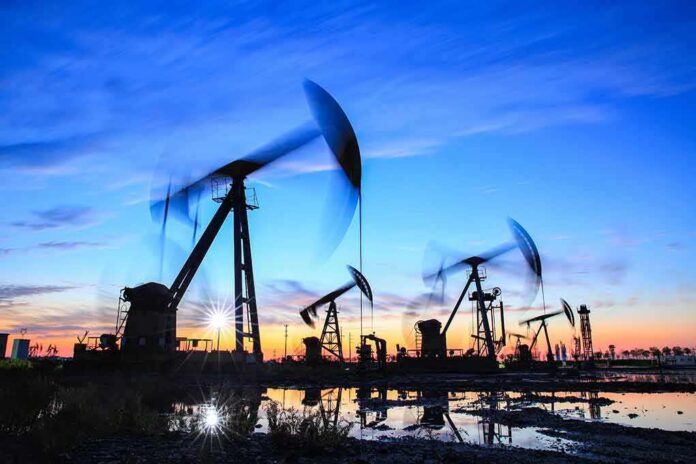
President Trump says the United States secured majority control of 65 billion barrels of Venezuelan oil reserves to boost supply and lower prices, with no cost to taxpayers.
Story Highlights
- Trump announced a deal for majority U.S. control over 65 billion barrels of Venezuelan oil reserves.
- Talks focused on private companies developing productive Venezuelan fields for long-term supply.
- Oil from the deal is slated to help refill the Strategic Petroleum Reserve.
- Analysts say price relief could take time as Venezuela ramps production.
White House Announces Control Over Massive Oil Reserves
President Trump publicly said the United States, working with private partners, secured majority control of more than 65 billion barrels of Venezuela’s proven oil reserves. He credited Secretary of State Marco Rubio and Secretary of War Pete Hegseth, and said the pact came at no cost to taxpayers. The announcement followed months of engagement with Venezuela’s interim leadership. The White House framed the move as a major step to expand supply, reduce dependence on hostile sources, and support lower fuel prices.
Reuters reported the administration had been discussing an ownership stake in Venezuela’s resources before the public statement. Officials described a structure centered on more than a dozen productive fields where private companies would invest and operate. The plan envisioned revenue for Venezuela while delivering barrels linked to U.S. interests and markets. The approach matches President Trump’s energy-security push to bring stable supplies home and cut costs for American families and small businesses.
Strategic Petroleum Reserve And Fuel Price Goals
Trump said oil from the Venezuela deal would help refill the U.S. Strategic Petroleum Reserve (SPR). He called the supply a gift from Venezuela to the American people. Using outside barrels to rebuild the reserve aims to protect the homeland from shocks and hurricanes. The administration also links the deal to long-term price relief at the pump by growing available heavy crude that fits U.S. Gulf Coast refineries, easing pressure on diesel and gasoline markets.
Policy aides and allies argue the deal can reduce reliance on unstable sources and help break the cycle of high energy costs. Earlier this year, the administration outlined plans for Venezuelan oil shipments to U.S. ports, setting the stage for today’s larger move. Supporters say steady flows can backfill inventories and smooth supply chains. That can strengthen American energy independence while shielding consumers from global disruptions and cartel gamesmanship.
Operational Reality: What Comes Next In Venezuela
Reuters noted that negotiations focused on active fields and private investment to lift output over time. Building production usually requires field repairs, drilling programs, and reliable export logistics. Industry analysts say Venezuela’s system must climb back from years of neglect. That means the timeline for barrels reaching the U.S. in scale could span months to years as contractors mobilize, services arrive, and pipelines and ports stabilize operations.
ABC News and other outlets reported analysts expect any broad price impact to take time as production ramps. That view fits oil-market math. New supply must be steady, sizable, and refined into fuels Americans use daily. The United States already has complex Gulf Coast refineries built for heavy crude. As more compatible barrels arrive, plants can run more efficiently. That helps diesel, jet, and gasoline output, which can support lower prices for truckers, farmers, and families.
Legal Structure, Sovereignty Claims, And Transparency Calls
The reporting shows the core claim: majority U.S. control tied to proven reserves and private development. Venezuela’s interim authorities have asserted continued sovereignty over resources, which creates pressure to clearly define “control” versus “ownership” in final documents, according to coverage cited in the research set. Some legal experts have asked for more contract transparency, which is common for cross-border resource deals of this scale.
🚨 JUST IN: President Trump is currently gearing up for a blockbuster White House meeting with OIL REFINERS and gas RETAILERS today — to drop prices nationwide
47 has cemented himself as the KING of oil after striking a 65 billion barrel oil deal with Venezuela 🔥 https://t.co/17ZDW50lEF
— Purser (@Purseri6tx) September 2, 2026
Conservatives will watch two tracks now. First, execution: Do companies enter the fields, boost output, and move oil to U.S. buyers and the Strategic Petroleum Reserve on schedule? Second, durability: Do the terms hold under Venezuelan law and international practice so the barrels keep flowing? The administration’s stated goals are clear: secure supply, lower costs, and strengthen national security. The next milestones are company deployments, shipment logs, and reserve-fill updates.
Sources:
theguardian.com, cnbc.com, abcnews.com, reuters.com, bbc.com, politico.com