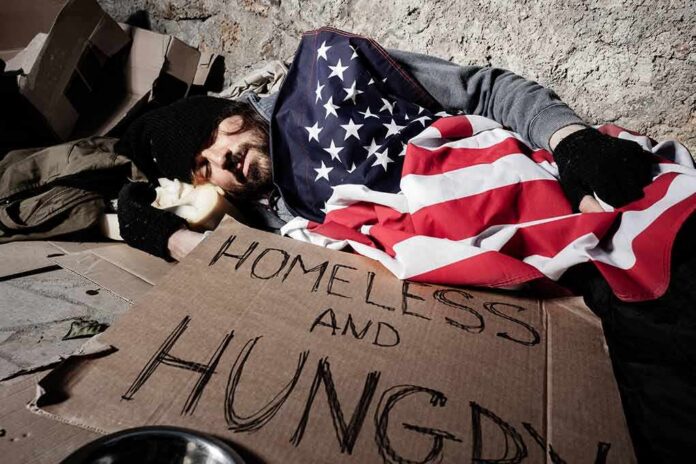
California’s own state auditor says the state failed to track billions in homelessness spending while Governor Gavin Newsom vetoed bills that would have increased transparency.
Story Highlights
- State audit found California failed to consistently track homelessness spending and outcomes.
- Governor Gavin Newsom vetoed a bill requiring annual evaluation of a key homelessness program.
- Report cited billions in programs where effectiveness could not be measured due to missing data.
- Later law ordered statewide reporting, confirming the original transparency gap mattered.
Audit Findings Show Major Tracking Failures
The California State Auditor reported in April 2024 that the state failed to consistently track spending and outcomes across more than 30 homelessness programs. The audit could assess cost‑effectiveness for only two programs because most agencies did not provide complete data. The report also faulted the California Interagency Council on Homelessness for not verifying the accuracy of data submitted by local governments and for lapses since 2021. These failures left taxpayers without a clear picture of results or value for money.
Associated Press coverage of the same audit said the five programs reviewed carried a combined $13.7 billion in funding. The report said the oversight council had not tracked spending or whether programs were working since June 2021. That gap matters because people paying record taxes deserve basic answers: what was bought, what results followed, and which efforts worked. Without sound tracking, lawmakers cannot fix broken programs or demand refunds when vendors overpromise and underdeliver.
Newsom Rejected Added Oversight After the Audit
Three months after the audit, Governor Gavin Newsom vetoed Assembly Bill 2570. The bill would have required the Department of Housing and Community Development to run an annual evaluation of the Homeless Housing, Assistance and Prevention program and include it in the department’s yearly report. Newsom’s veto message called the bill redundant and an unnecessary ongoing workload. That defense admitted the bill aimed at more transparency, but he chose not to add the requirement anyway.
News reports show Newsom also rejected another 2024 measure that would have required detailed, public reports on costs and outcomes for each state homelessness program. Supporters argued that the audit made clear the need for better reporting and verified results. The vetoes came even as coverage highlighted that the state had not tracked broad homelessness spending well over recent years, leaving no reliable way to judge what worked and what failed at scale.
Scale of Spending and Why It Resonates Nationally
The audit and contemporaneous reporting placed the scope in the tens of billions across recent years, with $13.7 billion tallied for five programs and roughly $24 billion discussed across the broader system. The firm point is mismanagement of data and oversight, not a proven theft case. The core risk to taxpayers is simple: without tracking and verified outcomes, the state cannot show whether massive funding improved lives or reduced street encampments in any measurable way. That is governance failure, plain and simple.
Stanford’s policy brief reached the same bottom line: California did not consistently track spending and outcomes across its many homelessness programs. As a result, analysts could evaluate cost‑effectiveness for only two out of 30 programs. That finding should disturb anyone who values limited government and wise use of public funds. Programs without proof of results become permanent money pits, while families and small businesses bear the costs through taxes and declining public safety.
Later Reforms Admit the Gap Existed
The California State Auditor’s 2025 high‑risk report notes that in September 2024 the Governor signed Assembly Bill 799. That law directs the interagency council to publicly report fiscal and outcome data, and the report ties this mandate to the 2024 audit’s findings. In other words, state leaders later acted to build the very transparency that earlier vetoes failed to provide. Even defenders who cite redundancy now concede the system needed a stronger, public reporting backbone.
Comedy hosts Dana Carvey and David Spade tapped into this frustration by blasting the California political class over the homelessness mess. Their critique lands because the facts back a simple truth: Sacramento spent big, tracked little, and fought added sunlight until public pressure mounted. Accountability is not a partisan wish. It is the minimum standard for any government that spends other people’s money. California’s audit trail shows what happens when that standard slips.
What Accountability Should Look Like Now
Lawmakers should demand program‑level ledgers, vendor invoices, and outcome audits before any new funding. The state should claw back unearned funds when providers miss targets. Public dashboards should show dollars, services, and results by county and city. Independent auditors must test samples of contracts and verify that spending matches services delivered. These are basic guardrails in the private sector. Taxpayers deserve the same discipline from government programs that claim to help the most vulnerable.
Sources:
twitchy.com, washingtontimes.com, siepr.stanford.edu, enewspaper.latimes.com, apnews.com, washingtonexaminer.com, pacificresearch.org