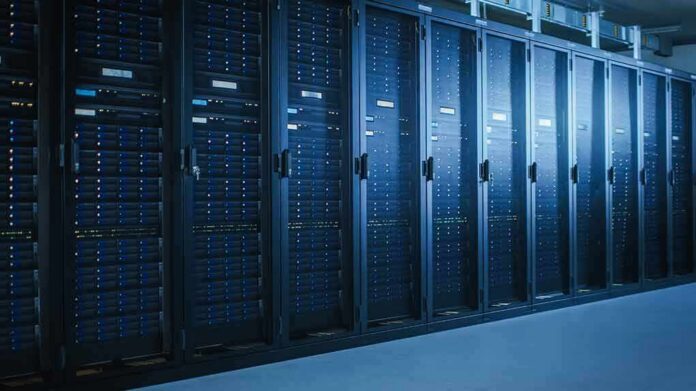
AI data centers are gulping billions of gallons of water each year — and two-thirds of the new ones are being built in areas already running low on water.
At a Glance
- U.S. data center water use tripled from 21 billion liters in 2014 to 66 billion liters in 2023, and is projected to hit 73 billion gallons annually by 2028.
- Two-thirds of new U.S. data centers built since 2022 sit in high water-stress zones, competing directly with farms, towns, and private wells.
- Amazon, Microsoft, and Google have 38 operating data centers in water-stressed regions, with 24 more under construction.
- No federal law requires data centers to report how much water they use, leaving local communities in the dark with little legal protection.
How Much Water Are We Talking About?
A single large AI data center can use up to 5 million gallons of water every day — the same amount used by 50,000 people. That water mainly cools the massive computer systems running AI tools. U.S. data centers used 66 billion liters of water in 2023, up from just 21 billion liters in 2014. By 2028, that number is expected to jump to 73 billion gallons per year — a more than fourfold increase in just five years.
Texas alone shows how fast things can spiral. Data centers in that state are projected to use 49 billion gallons of water in 2025. By 2030, that figure could reach 399 billion gallons. Texas is already prone to drought. Piling that kind of demand on top of an already stressed water supply puts farmers, ranchers, and rural homeowners in a very difficult spot.
Big Tech Is Building in the Wrong Places
An investigation by the Guardian and SourceMaterial found that Amazon, Microsoft, and Google have 38 operating data centers in water-stressed regions — plus 24 more being built. Microsoft reported that 42% of its water in 2023 came from water-stressed areas. Google said 15% of its water came from regions with high water scarcity. These are not fringe operations. They are massive facilities drawing from the same aquifers that supply local wells and irrigation systems.
Research published on arXiv found that data centers impose water burdens on local utilities ranging from 0.2% to as high as 134% of the host community’s total capacity across ten U.S. sites. That upper end is not a rounding error — it means one facility could demand more water than an entire town currently uses. Local governments, eager for tax revenue and jobs, often approve these projects before fully understanding the water cost.
No Federal Rules, No Transparency
Here is where things get frustrating for everyday Americans: no federal law forces privately owned AI data centers to report how much water they use. Some states — Minnesota, Virginia, and California — have passed their own rules requiring water reporting or aquifer testing. But most states have nothing. That means communities in drought-prone areas have no way to know how much water a new data center next door is pulling from the ground.
Forbes reports that local governments and state regulators are struggling to keep up with the pace of AI infrastructure growth. Permitting systems were not built with this kind of water demand in mind. Tech giants, meanwhile, have a clear information advantage. They know exactly how much water their facilities use. The public does not. Some policy groups have proposed water-use limits per unit of computing power and credit for using recycled water, but these are voluntary ideas — not law. Until real rules are in place, rural well owners and small-town water systems are left hoping for the best.
The Claim That Wells Are Going Dry
Social media posts have claimed that AI data centers are literally drying up private wells. That framing captures a real concern, but the direct proof is still thin. Researchers have documented massive regional water stress and skyrocketing consumption. What is harder to find is a named family, a specific well, and a confirmed link to a nearby data center. Hydrological studies that track groundwater levels before and after a data center opens — at specific sites — have not been widely published. That gap in evidence does not make the concern wrong. It means the full damage may not be visible yet.
The pattern is familiar. Bottling plants and mining operations in the American West have sparked the same fights — communities notice their wells dropping, regulators move slowly, and by the time studies confirm the damage, the aquifer is already hurt. AI data centers are the new version of that old problem. The water math is real. The regulatory gaps are real. Americans who depend on wells in drought-prone states have every reason to demand answers now, before the damage is done.
Sources:
bloomberg.com, planet-keeper.org, theguardian.com, lincolninst.edu, arxiv.org, eenews.net, reddit.com, nixonpeabody.com