China is blasting President Trump’s Russia sanctions plan as “unilateral bullying,” even as a sweeping bipartisan bill aims to hit Beijing where it hurts—its Russian energy lifeline.
Story Snapshot
- Sanctioning Russia Act of 2025 lets Trump slap huge tariffs on countries buying Russian energy, including China.
- Trump has already approved the revised bill, which still allows tariffs up to 200% on Russian energy buyers.
- China says these U.S. sanctions have “no basis in international law” and threaten global trade and supply chains.
- The clash puts America’s push to choke off Kremlin war money against Beijing’s drive to protect cheap Russian oil.
Trump-backed sanctions bill puts Russian energy buyers on notice
The Sanctioning Russia Act of 2025 is a major bipartisan effort in Congress to cut off money flowing to Moscow’s war machine by targeting the countries that keep buying Russian energy. The bill, authored by Republican Senator Lindsey Graham and Democrat Senator Richard Blumenthal, has support from more than eighty senators and over one hundred fifty House members, showing strong agreement across party lines. It focuses on buyers of Russian oil, natural gas, and other key exports, and is built on the fact that Russia still refuses to negotiate peace in Ukraine.
The original version of the bill allowed tariffs up to five hundred percent on imports from nations that continued to buy Russian oil and gas, a level designed to make that trade simply not worth it. After pushback from some partners, lawmakers revised the plan, cutting the headline tariff threat on top buyers like China and India from five hundred percent down to one hundred percent on their Russian oil purchases. Even with that change, the bill still gives President Trump the power to go as high as two hundred percent in tariffs on countries that ignore warnings and keep importing Russian energy.
How the bill targets China and other Russian energy buyers
The legislation names China, India, Slovakia, Hungary, and Azerbaijan among the top buyers of Russian oil, signaling that these countries would be in the crosshairs if they do not curb purchases. It authorizes steep tariffs on goods coming from nations that continue to do large energy deals with Russia, turning access to the U.S. market into leverage against governments helping fund the Kremlin. The bill also zeroes in on Russian financial hubs and big gas projects such as Yamal liquefied natural gas and Arctic liquefied natural gas, aiming to cut the revenue streams that feed Russia’s war budget.
To avoid hammering allies that are already cutting back, the bill builds in waiver rules for European countries and gas buyers that import less than fifteen percent of their supply from Russia while moving to reduce that share. These exceptions are meant to show the sanctions are targeted, not random, and focus on the worst offenders that keep buying at high levels. At the same time, the bill leaves some enforcement details open, especially on how secondary sanctions would be applied to countries like China and India beyond tariffs on their exports.
China blasts U.S. move as ‘unilateral bullying’
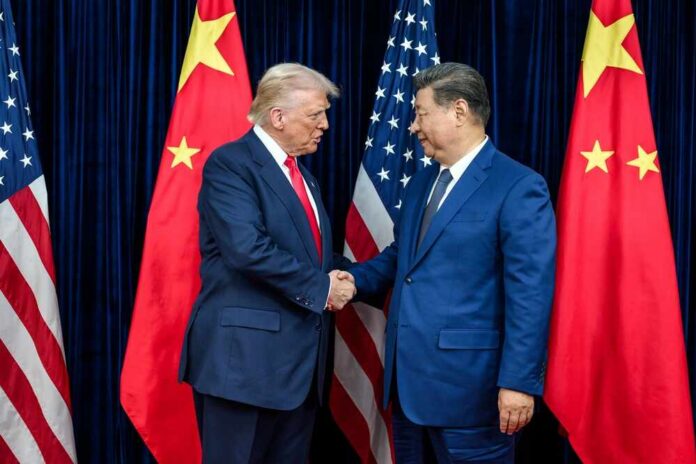
China’s government is loudly rejecting the Trump-backed sanctions push, claiming that Washington is abusing its economic power and breaking global rules. A Foreign Ministry spokesperson said China “consistently opposes unilateral sanctions that have no basis in international law and are not authorised by the United Nations Security Council,” arguing that only the United Nations can legitimize this kind of pressure. Another spokesperson slammed the U.S. actions as “typical of unilateral bullying and economic coercion,” warning that they threaten the stability of global industry and supply chains that everyday people depend on.
Putin set out to prove Russia could defy the West and stand as China’s equal. Instead he turned himself into Beijing’s most expensive client state.
Four years of war and sanctions have boxed Moscow into one main lifeline: China. Trade data show Beijing is now the top buyer of…
— WAR (@War__Alerts) July 15, 2026
Beijing also insists its energy deals with Moscow are proper, legal, and nobody else’s business, stating that “normal economic, trade and energy cooperation with all countries—including Russia—is justified, legitimate and beyond reproach.” China has taken similar positions in past fights over U.S. sanctions on Chinese firms tied to Russia, repeatedly attacking what it calls American “long-arm jurisdiction” that reaches far beyond U.S. borders. What China has not done is offer detailed financial data showing that Russian energy money does not support the war in Ukraine, leaving Washington’s core claim about war funding largely unchallenged at the numbers level.
A high-stakes test of American leverage and global energy politics
This fight over Russian energy buyers fits a broader pattern where U.S. secondary sanctions clash with the energy needs of major non-Western powers. If Trump uses the full tariff power the bill allows, Chinese and Indian buyers could face costs high enough to force them to rethink Russian oil purchases or find new ways to dodge U.S. pressure, like using non-dollar payments and shadow fleets, as seen in earlier sanctions rounds. Analysts warn that China may answer with its own countermeasures, but they also note that a one hundred percent tariff from the United States is not easy for any trading nation to ignore.
For American readers, this showdown is about more than foreign policy talk. It is about whether the United States will let globalist trade habits and cheap foreign energy dictate policy while Russia wages a brutal war in Europe, or whether we will finally use our economic strength to defend basic security and stop helping pay for the Kremlin’s aggression. The Sanctioning Russia Act is one of the clearest attempts yet to put American leverage to work, even if China calls it “bullying”—and how this plays out will shape energy prices, supply chains, and our broader struggle against hostile powers for years to come.
Sources:
insiderpaper.com, timesofindia.indiatimes.com, reuters.com, nypost.com, rferl.org, youtube.com, bbc.com, english.scio.gov.cn, energynow.com