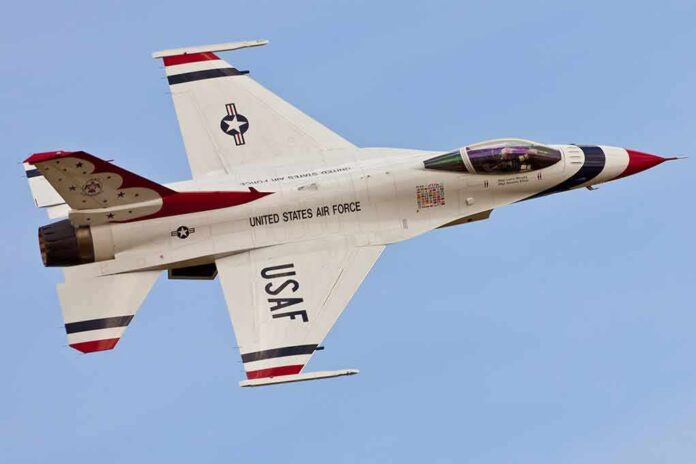
NORAD fighter jets have now scrambled multiple times over New Jersey as civilian pilots keep blundering into no-fly zones set up to protect President Trump and the World Cup final.
Story Snapshot
- NORAD F-16s intercepted several small planes that violated temporary flight restrictions over New York and New Jersey ahead of the World Cup final.
- At least one intercept involved flares and a “headbutt” maneuver to grab a pilot’s attention, while all intruding aircraft were safely escorted out.
- Military statements confirm more than a dozen violations in the New York–New Jersey region this month alone, including repeated breaches over Bedminster, where Trump stays.
- The pattern raises hard questions about pilot discipline, federal enforcement, and how seriously Washington is taking airspace security around high‑value targets.
World Cup final brings strict no-fly zone — and fresh violations
U.S. F-16 fighter jets from the North American Aerospace Defense Command intercepted a small civilian aircraft that broke into a temporary flight restriction zone over New York City on Friday afternoon, July 17, 2026, just two days before the World Cup final at MetLife Stadium. NORAD says the general aviation plane entered the restricted area at about 4:18 p.m. Eastern time, forcing fighters to close in and signal the pilot to leave. Flares were fired to catch the pilot’s eye, and the jet then escorted the aircraft safely out of the no‑fly zone.
These restrictions are not casual rules; they are special Federal Aviation Administration flight limits created to guard huge events and world leaders against sky‑borne threats. For the World Cup final between Argentina and Spain, temporary flight restrictions covered parts of New York and New Jersey from July 17–19. NORAD and its 177th Fighter Wing were on high alert around MetLife Stadium, with radar, satellites, and fighters prepared to move the instant a radar track crossed the line. Yet even with that warning, at least one pilot still crossed into the protected zone.
Multiple aircraft intercepted over New Jersey as violations pile up
While the World Cup incident grabbed headlines, NORAD reports show a wider pattern of repeated violations over New Jersey, especially near Bedminster and East Rutherford. On a recent Sunday, more than ten general aviation aircraft wandered into temporary flight restriction airspace in that corridor, and three of them had to be intercepted by F-16s. NORAD says every violator was escorted out safely, but the sheer number of breaches in a single day is alarming for anyone who cares about serious air security.
Another press release from NORAD on June 8, 2026, described an intercept of a general aviation aircraft that violated temporary flight restriction airspace near Bedminster at about 3:55 p.m. Eastern time. That incident was not isolated; it followed four other violations, bringing the total to fifteen unauthorized incursions into restricted airspace in just a few days. NORAD stressed that pilots who see a fighter on their wing must immediately switch to standard emergency frequencies, turn around, and wait for clear instructions. The message is simple: if you miss the NOTAMs and fly where you should not, expect a fighter jet in your window.
Safe but serious: flares, “headbutt” maneuvers, and Trump’s security
In at least one New Jersey incident, NORAD fighters went beyond simple close escort and used a “headbutt” maneuver, flying directly in front of the intruding aircraft to force the pilot to notice and change course. According to that report, the intercept near Bedminster was one of five temporary flight restriction breaches that day, and the fighter combined a headbutt with standard visual signals to draw the pilot’s attention before guiding the plane out of restricted airspace. These tactics are part of a layered defense meant to stop threats long before they reach a stadium or a presidential property.
NORAD F-16s intercept multiple aircraft violating temporary flight restrictions over New Jersey
………….On July 19, 2026, U.S. military F-16 fighter jets intercepted multiple civilian aircraft violating Temporary Flight Restrictions (TFRs) over Bedminster and East Rutherford,…
— JV (@joveg8) July 20, 2026
Officials emphasize that flares, which worried many people who saw them from the ground, are designed to be safe when used over populated areas. NORAD says the flares burn out quickly and completely and do not reach the ground in a dangerous form, even though they can look dramatic in the sky. At the same time, aviation experts explain that fighters do not deploy flares lightly; they are a loud, bright signal that the pilot has missed radio calls or visual cues and now must pay attention. For families living around Bedminster, that is both reassuring and unsettling — reassuring because jets are awake, unsettling because violations keep happening.
Rising violations show gaps in pilot discipline and federal enforcement
NORAD’s own numbers admit the problem is growing. In the first two weeks of June alone, the command confirmed more than a dozen general aviation aircraft had violated temporary flight restriction airspace in the New York and New Jersey region. A separate warning noted nine general aviation aircraft entered the temporary flight restriction covering Bedminster during one weekend, with all escorted out. That is not one careless student pilot; it is a pattern. When restricted zones protect President Trump’s movements, repeated lapses look less like harmless mistakes and more like a test of how firmly Washington is willing to enforce its own rules.
Conservative readers will recognize the familiar theme: federal agencies speak tough about fines and possible criminal charges but stay quiet about who, if anyone, actually pays a price. Documents available so far list no specific enforcement outcomes for those fifteen‑plus violations, even though the Federal Aviation Administration says penalties can reach tens of thousands of dollars per incident. That silence fuels public doubt about whether pilots who ignore clear warnings and threaten restricted airspace ever see real consequences. It mirrors the larger frustration many feel about border security and other areas where rules on paper do not always mean firm action.
Broader trend: more incursions near Trump’s homes and other protected sites
Security experts point out that what is happening over Bedminster and East Rutherford fits a broader trend around Trump’s Mar‑a‑Lago residence in Florida and other protected locations. Reports describe more than forty unauthorized entries into the temporary flight restriction zone around Mar‑a‑Lago in recent years, a sharp jump compared with older norms. In early March 2025, fighters were authorized to intercept several aircraft near that resort, including at least one case where flares were needed to grab a pilot’s attention before a safe escort out of the area.
Similar intercepts have happened near other presidents and high‑value targets, from President Biden’s California speech site to military exercises off Alaska. The difference now is scale and focus: violations appear to cluster around Trump’s properties and major events like the World Cup final. For many conservatives, that raises serious questions. Are these simply sloppy pilots who ignore the rule book, or is someone probing America’s defenses, counting on weak follow‑through from federal regulators? Until NORAD and the Federal Aviation Administration publish full logs, transcripts, and enforcement records, those questions will remain, and frustration with government oversight will continue to grow.
Sources:
nypost.com, dvidshub.net, aerotime.aero, ssj.news, ground.news, instagram.com, youtube.com, defconalerts.com, x.com, military.com, businessinsider.com, norad.mil, americanfaith.com, cbs12.com, msn.com