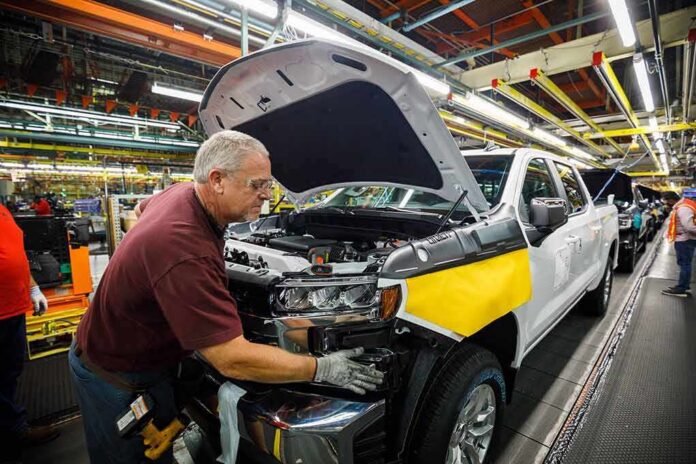
GM’s flagship EV plant cut over a thousand jobs, then rolled in robots—raising hard questions about who wins in America’s tech transition.
Story Snapshot
- GM added dozens of “collaborative” robots after more than 1,000 layoffs at Factory Zero [7].
- GM says robots boost safety and assist with repetitive tasks, not replace people [1].
- Union leaders filed grievances and say manpower is being stripped from the plant [8].
- Slower EV demand is cited by GM as the driver of cuts, not the robots themselves [6].
What GM Says Its New Robots Actually Do
GM spokesperson Kevin Kelly says the robots are meant to improve workplace safety and reduce strain from repetitive tasks. He says they work alongside employees, including on jobs like attaching body panels, and are part of a wider technology push to keep the company competitive. GM also confirmed some affected workers are on temporary layoff status, though it did not provide a return date. The company did not give a precise robot count, but confirmed “dozens” were added recently [1].
GM argues the layoffs are tied to softer electric vehicle demand, not the arrival of robots. A NewsNation report summarized that link, noting the company has not tied each job loss to automation. This framing fits a larger industry pattern where demand shifts and electrification drive staffing swings. It also helps GM avoid admitting a direct robot-for-worker swap. That claim will remain contested until GM releases plant-level data on output, safety, and recall rates [6].
Why Workers And Union Leaders Are Crying Foul
The United Auto Workers says the timing tells the real story. Local leaders filed grievances and warned that jobs and safety are at risk with new robot coworkers. UAW voices describe deep frustration about seeing robots arrive after more than 1,000 job cuts. They argue “manpower is being taken away” at Factory Zero and that the company’s assurances ring hollow on the floor. Union-aligned coverage amplified this sequence to show a direct hit to human jobs [8].
Ars Technica reported that GM installed robots after laying off about 1,300 workers at the Detroit EV plant. That outlet and others highlighted the same cause-and-effect picture pushed by union supporters. This narrative is powerful because it is simple and visual: fewer people, more machines. But the story still lacks plant-specific proof that robots, rather than output cuts or EV demand, drove the losses. That missing data keeps the debate hot and unresolved [7].
The Bigger Trend: EV Shifts, Automation, And Fewer Traditional Jobs
Across the auto industry, automation and the transition to electric power are reshaping work. Independent workforce analyses describe how robotics and digital tools increase precision and reduce some manual roles, while pushing demand for maintenance and tech skills. When demand softens, companies trim staffing, then use modernization to keep costs in check. Without robust retraining, workers get sidelined while new technical roles open for different skill sets [16].
Separate reporting tracks major white-collar and factory cuts across the Big Three as automakers chase software-defined cars and artificial intelligence. Those studies say companies are hiring for data and automation roles while reducing repetitive functions. None of that makes the immediate pain easier for the families behind these jobs. But it does explain why corporate leaders sell “assistive robots” as safety upgrades, even as payrolls shrink in older roles tied to past processes [15].
Where The Facts Are Solid—And Where They Are Thin
Several claims are clear. GM confirms the use of “collaborative” robots at Factory Zero to assist with repetitive tasks and improve ergonomics. GM also confirms some workers are on temporary layoff status without a return timeline. Union leaders filed grievances and publicly blasted the move. Media outlets documented that layoffs came before robot additions. What is not clear are hard numbers tying robots to net job losses, safety improvements, or productivity gains at this specific plant [1].
For readers who value free markets and strong families, two tests matter. First, does the technology make the product better and safer at a price people can afford? Second, do leaders level with workers and the public about tradeoffs? GM can settle key questions with data: plant injury rates before and after robots, unit-per-hour productivity, defect rates, and a firm timeline for any “temporary” layoffs. Until then, the trust gap at Factory Zero will stay wide [6].
What To Watch Next Under The Trump Economy
Market reality will drive the next moves. If electric vehicle demand stays soft, production cuts will continue, no matter the robot count. If demand stabilizes, the test becomes how many of those “temporary” layoffs come back. The Trump administration can keep pushing fair trade, energy abundance, and domestic industry so factories compete on value, not just headcount. But transparency from automakers is vital so American workers are not left guessing about their future [16].
Sources:
[1] Web – GM Replaces 1,000 Factory Zero Workers With 50 Robots
[6] Web – General Motors has expanded automation at its Factory Zero electric …
[7] YouTube – GM lays off 1,000 workers and adds robots to its assembly line
[8] Web – GM installs robots at flagship EV factory after laying off 1,300 …
[15] Web – GM lays off more than 1,000 workers, adds 50 robots at flagship …
[16] Web – AI Cuts 20,000 Jobs in the Automotive Industry – Viral Methods