A Boston 911 call meant to prevent violence instead exposed a hard truth: even “care-based” crisis responses can turn deadly in seconds.
Quick Take
- Boston Police and Boston EMS responded to a reported threat near Northeastern University, but officers found no armed group outside the apartment.
- After 35–45 minutes of talking through a closed door, responders concluded they were dealing with a mental health crisis—not an outside attack.
- The person inside suddenly opened the door and attacked first responders with a sword, stabbing an officer and knocking down an EMS clinician.
- Police used a Taser and gunfire; the attacker later died at a hospital, while multiple first responders suffered non-life-threatening injuries.
What Happened on Hemenway Street—and What the “Social Worker” Claim Gets Wrong
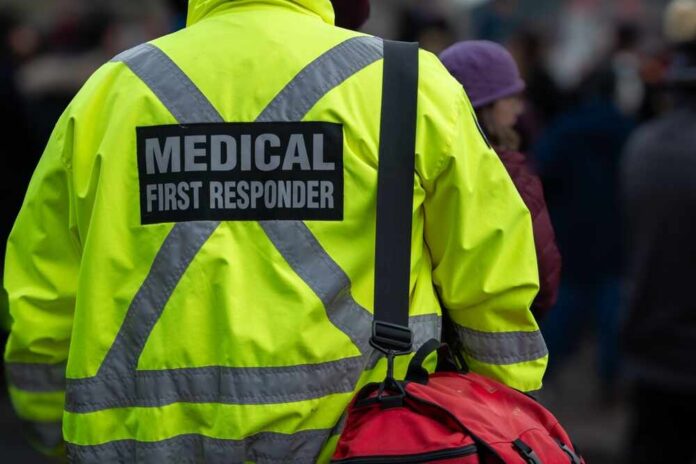
Boston police and EMS were dispatched Saturday morning, April 4, 2026, to an apartment building on Hemenway Street near Northeastern University after a 911 caller claimed four armed people were outside threatening him. Officers arrived, found no outside suspects, and began communicating with the person inside through the closed door. Reports often describe a “social worker” response, but available accounts specify an EMS or mental health clinician responding alongside police and EMS.
Officials said the conversation lasted roughly 35 to 45 minutes and increasingly pointed to a mental health emergency. Police requested additional support, including a clinician, consistent with the idea that some crisis calls can be stabilized without immediate force. The situation changed abruptly around midday when the person opened the door holding a sword. A police officer was stabbed in the arm, and the EMS clinician was knocked to the ground amid what authorities later described as a chaotic scene.
Why Police Used Force: Timing, Imminent Threat, and Split-Second Limits
Officers attempted less-lethal measures first, deploying a Taser as the attack unfolded, but gunfire was also used to stop the threat. The attacker was given medical aid at the scene and transported to a hospital, where he was pronounced dead. Multiple first responders were treated for injuries described as non-life-threatening. Suffolk County District Attorney Kevin Hayden said the scene was “very chaotic,” and the incident remained under investigation as of the initial reports.
The key point for the public isn’t a slogan about “police vs. social workers,” but the operational reality shown here: when a person in crisis becomes violent and produces a weapon, the margin for error collapses. De-escalation worked until it didn’t, and once the door opened, the threat was immediate. That sequence matters because it frames the use-of-force question around stopping an active assault, not punishing mental illness or escalating a peaceful encounter.
The Policy Fault Line: Co-Response Models Face the Safety Test
Boston and other cities have expanded co-response approaches that bring clinicians into certain calls, partly in response to years of political pressure to reduce traditional policing in mental health incidents. This case illustrates both why those models exist and where they hit a wall. Clinicians can help interpret behavior and slow situations down, but they are not armored against sudden violence, and they can’t replace the need for immediate physical protection when weapons appear.
What This Means for Taxpayers, Communities, and First Responders
Boston EMS emphasized that “no one should face violence for simply doing their job,” a statement that reflects a wider, bipartisan frustration: government systems ask front-line workers to absorb society’s hardest problems while bureaucracies argue over messaging. For conservatives, the incident reinforces the importance of public safety capacity and the limits of “soft” solutions. For liberals, it underscores the urgency of effective mental health intervention—paired with honest security planning.
As of the first-day, the attacker’s identity had not been released and no broader policy changes were announced. That leaves residents with an uncomfortable but necessary takeaway: shifting responsibilities among agencies does not eliminate danger, and it does not remove the need for well-trained, well-supported law enforcement when a crisis turns into an armed assault. The most productive next step is transparent investigation and practical reforms that prioritize responder safety.
Sources:
Person armed with sword fatally shot by police after attacking officers, EMS clinician in Boston
Sword-wielding man stabs Boston Police officer near Northeastern University