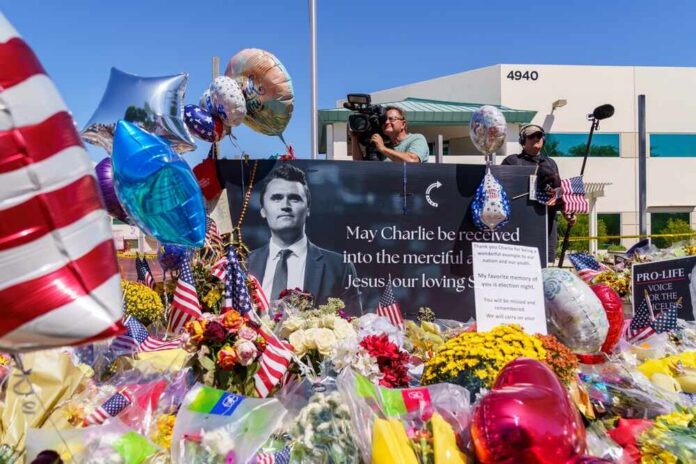
A single forensic gap—ATF analysts reportedly unable to match the fatal bullet to the rifle blamed for Charlie Kirk’s assassination—is now forcing hard questions about whether the system is chasing the right facts or just the fastest narrative.
Quick Take
- ATF testimony and filings described in recent coverage say the bullet that killed Charlie Kirk cannot be ballistically matched to the rifle recovered near the scene.
- Early claims that ammunition carried “trans/antifascist” engravings were later corrected, underscoring how fast-moving leaks can distort public understanding.
- Federal investigators have described a wide-ranging probe, including trajectory work and digital evidence, while prosecutors continue pursuing an aggravated murder case.
- The unresolved ballistic question complicates a death-penalty prosecution and risks deepening public distrust in federal law enforcement and the media pipeline.
ATF ballistic mismatch becomes the central courtroom problem
ATF forensic analysis discussed in recent reporting has introduced a major complication in the prosecution: investigators have not been able to link the bullet that killed Turning Point USA founder Charlie Kirk to the Mauser 98 .30-06 rifle recovered near the shooting scene. That does not prove the rifle was uninvolved, but it does weaken the clean, linear story many Americans were initially given—especially in a politically explosive case where prosecutors are seeking the death penalty.
Charlie Kirk was killed on September 10, 2025, during an outdoor “American Comeback Tour” event at Utah Valley University in Orem, Utah, where roughly 3,000 people attended. Reporting and investigative summaries describe a sniper-style attack: a single shot to the neck, with the shooter positioned about 142 yards away on the roof of the Losee Center. Authorities later recovered a rifle wrapped in a towel near the area, along with ammunition and at least one spent cartridge.
Early “ammo engraving” claims collapsed under basic verification
Initial reports circulated that the ammunition involved carried “trans/antifascist” engravings—an inflammatory detail that immediately shaped online assumptions about motive and networked ideology. Subsequent corrections, including an editor’s note referenced in coverage, walked back the transgender marking claim after investigators determined those specifics were not accurate as originally described. A senior law-enforcement official also warned that early leak-driven information can be a mix of accurate and inaccurate details in fast investigations, especially in high-profile political violence cases.
For conservative audiences, the lesson is practical rather than partisan: when federal cases move at headline speed, the public often receives conclusions before the underlying evidence is tested. That dynamic can cut both ways. It can fuel “deep state” theories when the facts later change, but it can also unfairly smear entire groups when a dramatic detail turns out to be wrong. In a constitutional system built on due process, “wait for the evidence” is not a luxury—it is the standard.
What investigators say they’re doing—and what remains unclear
Investigative updates described in reporting say the FBI has pursued a comprehensive approach: reconstructing bullet trajectory, reviewing visitor logs, tracing weapon transport, and analyzing phone and Discord data while asking the public for tips and advertising a reward. Authorities have not publicly confirmed accomplices, but the breadth of the inquiry signals they are not treating the case as “closed” simply because a suspect is in custody. The key limitation in public reporting is that the reason for the ballistic non-match remains unspecified.
Tyler James Robinson, 22, of Washington, Utah, surrendered on September 11, 2025, after a manhunt, and prosecutors later charged him with aggravated murder while seeking the death penalty. If the recovered rifle cannot be tied to the fatal projectile, prosecutors will likely need other strong evidence—digital trails, witness accounts, or additional forensic findings—to connect the suspect to the shot beyond reasonable doubt. Public summaries do not provide enough detail to evaluate the strength of that remaining evidence.
Why this case is turning into a trust test for federal institutions
When a politically symbolic figure is killed, Americans tend to demand instant certainty. But the justice system is supposed to do the opposite: slow down, test claims, and separate what’s provable from what’s popular. If the ballistic dispute persists, it could delay proceedings and intensify skepticism about whether federal agencies and prosecutors are prioritizing truth over closure. At the same time, the public’s desire for answers cannot override constitutional guardrails designed to prevent wrongful convictions.
For many conservatives already frustrated by years of elite incompetence and narrative management, the Kirk case is a reminder that political violence investigations must be handled with relentless transparency and discipline. Corrections matter. Chain-of-custody details matter. Forensic specificity matters. If the government cannot prove its case cleanly—especially while seeking the ultimate punishment—Americans have every right to demand higher standards, not lower ones, no matter how emotional the moment feels.
Sources:
Rifle in Charlie Kirk assassination had ammo with trans/antifascist engravings, sources say
Rifle in Charlie Kirk assassination had ammo with trans/antifascist engravings, sources say