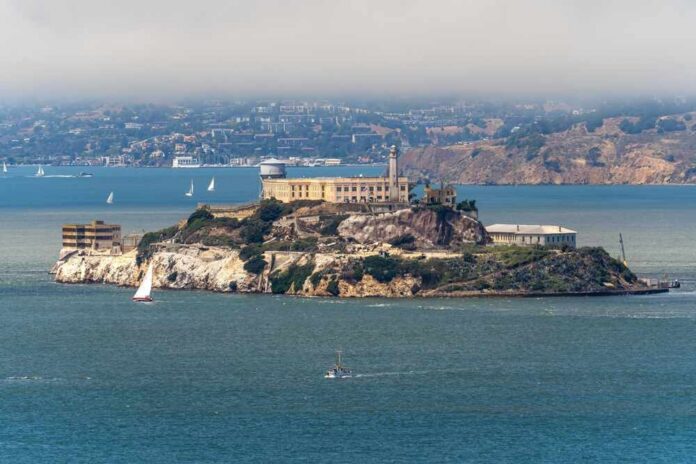
Trump’s plan to revive Alcatraz is colliding with a question many conservatives are asking in 2026: can Washington still deliver real law-and-order without blowing up the budget and rewarding blue-state dysfunction?
Quick Take
- The White House FY2027 budget requests $152 million to start reopening Alcatraz as a modern high-security federal prison.
- Alcatraz is currently a National Park Service tourist site that generates about $60 million a year, creating a direct tradeoff between tourism revenue and incarceration capacity.
- Major cost and timeline details remain unclear; outside estimates cited in reporting range from hundreds of millions to more than $2 billion.
- Congress must approve funding, and California Democrats and local leaders are publicly attacking the plan as wasteful and unrealistic.
What the White House Asked Congress to Fund
The Trump administration’s fiscal year 2027 budget proposal, released April 3, 2026, includes a $152 million request aimed at the first phase of reopening Alcatraz as a “state-of-the-art secure prison” for America’s “most ruthless and violent offenders.” The request does not settle the larger questions that typically decide projects like this—total cost, schedule, and operational plan—because it covers only an initial year of project expenses.
President Trump first pushed the idea publicly on May 4, 2025, directing federal law-enforcement and security agencies to pursue reopening and expansion. Attorney General Pam Bondi and Interior Secretary Doug Burgum later toured the site in July 2025, underscoring that the plan is not just rhetorical messaging but an active executive-branch initiative. Even so, the proposal remains a budget request, not an approved build, until Congress signs off.
Alcatraz’s Reality: Iconic Site, Aging Infrastructure, Different Mission
Alcatraz operated as a federal penitentiary from 1934 to 1963, holding notorious inmates and building a reputation for isolation and strict security. It closed in large part because operating and maintenance costs were high and the physical plant was deteriorating. Reporting on the current proposal points back to those basic constraints: converting an aging island complex into a modern “state-of-the-art” prison is fundamentally different from maintaining it as a historic site.
Since 1963, Alcatraz has functioned under the National Park Service as a historic landmark and tourist attraction. That status matters because the island is not simply “unused federal property.” It is an active revenue-generating public destination that draws visitors from around the world. Reporting places annual tourism revenue around $60 million, meaning any prison conversion could disrupt a working stream of economic activity while shifting the site’s identity from heritage and education to incarceration.
Cost, Oversight, and the Conservative “Show Me the Numbers” Test
The budget line item is $152 million, but multiple reports cite much larger price tags for a complete rebuild, with figures ranging from at least $250 million to more than $2 billion. Those gaps highlight what fiscal conservatives watch for: big federal projects that begin with a “starter” appropriation and later grow into a long-term spending commitment. The administration has not released a full public cost breakdown or timeline in the reporting provided.
That uncertainty pushes the fight to Congress, which holds the real leverage. Supporters can argue that violent offenders require secure capacity and that a symbolic facility signals consequences for brutal crime. Critics can argue that symbolism is not a substitute for a workable plan and a realistic accounting of construction, staffing, transport, and ongoing operations. With no final price and no schedule, lawmakers will be voting on a first down payment, not a completed blueprint.
California Pushback and a Familiar Federal-State Flashpoint
Democratic leaders in California have been blunt. Former House Speaker Nancy Pelosi has called the idea a waste of taxpayer dollars, and other Bay Area voices have questioned whether there is any realistic plan beyond a headline-grabbing gesture. State Sen. Scott Wiener has also criticized the concept, focusing on the multibillion-dollar estimate and the potential damage to a major tourist attraction. These statements reflect political hostility and practical objections.
The political optics are clear: a Republican White House proposes a high-profile prison in the heart of deep-blue San Francisco, and Democrats respond by framing it as reckless spending. But conservative voters are likely to judge the administration on two tracks at once—public safety and fiscal discipline. If the project is to be more than a talking point, the administration will need to show Congress how it avoids becoming another expensive federal boondoggle with no finish line.
REVIVING THE ROCK: The White House requested $152 million to begin reopening Alcatraz as a "state-of-the-art secure prison facility."
The prison, which once housed notorious criminals, including mob boss Al Capone, has been closed for decades because of high operating costs.… pic.twitter.com/81ETccUnin
— Fox News (@FoxNews) April 4, 2026
For now, the only settled fact is procedural: Congress decides whether the money moves. The debate is also a stress test for the broader “America First” promise of competent governance—secure borders, safer streets, and responsible spending. Conservatives who backed Trump to end waste and restore order will be watching whether this proposal comes with a hard plan, transparent numbers, and measurable results, not just a famous name and a fresh appropriation.
Sources:
Alcatraz could reopen as ‘state-of-the-art secure prison’ with Trump’s $152M budget request
Trump asks for $152 million to rebuild Alcatraz and reopen it as a prison
Trump seeking $152 million from Congress to reopen Alcatraz federal prison
Alcatraz: Trump budget defense spending