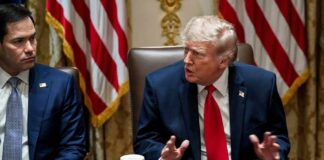
President Trump called on the Smithsonian to replace the abstract “Infinity” sculpture with a towering George Washington monument and launch a five-year exhibit honoring the first president.
Story Highlights
- Trump urged a 30-foot George Washington “Colossus” outside the National Museum of American History.
- He asked for an 11-foot Washington statue in Flag Hall and a five-year exhibit on Washington’s legacy.
- The push follows a White House report accusing the museum of ideological bias.
- Smithsonian leaders have defended their approach as accurate and fair.
Trump’s Call: Replace “Infinity” With Washington’s Image
President Trump said the Smithsonian should honor George Washington with a large outdoor statue and a long-running exhibit that starts now. He described the current abstract metal “Infinity” as out of step with national pride and urged a 30-foot “Colossus” of Washington at the museum’s Mall entrance, plus an 11-foot statue in Flag Hall. Reuters reported the specific requests and timing tied to Constitution Day, underscoring the administration’s focus on the Founders’ legacy.
The White House push builds on months of scrutiny of the National Museum of American History. A presidential fact sheet and executive action framed the museum as failing to present American history as a shared inheritance. The administration argues the museum has emphasized grievance over achievement, and it wants exhibits that spotlight Washington’s leadership and national unity. The official materials set a clear tone: restore trust, reduce ideology, and reaffirm core civic stories.
What “Infinity” Is — And Why It Matters In This Fight
Smithsonian records describe “Infinity” as a three-dimensional rendering of the infinity symbol, with a time capsule inside. The work by José de Rivera has stood at the museum since the late 1960s and is part of the National Mall’s early embrace of abstract public art. The institution’s catalog notes the form and purpose of the piece, which helps explain why some view it as art about ideas, not heroes or events in American history.
Supporters of Trump’s plan say a Washington statue would send a clear message to families and students about courage, duty, and the birth of our nation. They argue that public space at a history museum should spotlight figures who shaped the Republic, not symbols that leave visitors guessing. They see a concrete monument to Washington as a fix for years of curatorial choices that downplay patriotism and the greatness of the founders in favor of abstract themes.
Smithsonian Response And The Stakes For Independence
Smithsonian leadership has pushed back on the White House critique. Secretary Lonnie Bunch said the report mischaracterized the museum’s work and defended the staff’s commitment to accuracy and integrity. He stressed that curators aim to present complex history in full, not slogans. That defense highlights a wider debate: how much the federal government should influence exhibits at a publicly funded but uniquely structured cultural institution.
The dispute arrives amid broader political pressure on the Smithsonian. News reports detail threats to funding, attempts to replace leaders, and a formal campaign to reshape how the museums tell America’s story. The White House report “Saving America’s Story” argues the history museum is ideologically captured and needs a reset toward unifying narratives. Supporters of Trump’s call say the Washington statues and exhibit are a practical first step to that reset.
What Comes Next: Process, Precedent, And Public Voice
The Smithsonian’s governance and federal support mean change can be slow, but visible. Installing new monuments or reworking flagship spaces requires planning, permits, donor support, and trustee approvals. The administration’s request raises a core question for citizens and lawmakers: should America’s main history museum feature Washington front and center in stone and steel, or keep an abstract symbol at the door? Trump has made his answer clear; now the institution must decide its next move.
Sources:
goodmorningamerica.com, whitehouse.gov, reuters.com, usatoday.com, npr.org, theartnewspaper.com, theatlantic.com