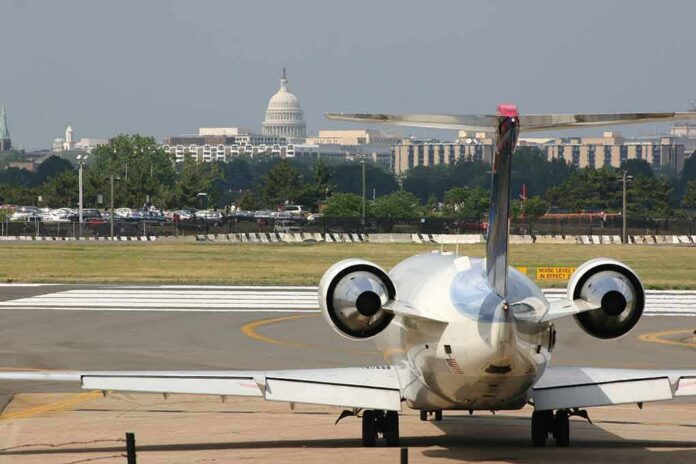
A Coast Guard jet carrying the Homeland Security Secretary landed on one engine at Reagan National after the pilot declared an emergency.
Story Highlights
- The pilot reported a right-engine failure and requested an immediate landing at Reagan National.
- The aircraft, a Coast Guard C-37A, landed safely with 14 people on board.
- No injuries were reported; a passenger praised the crew’s calm professionalism.
- The incident renews attention on aging Coast Guard aircraft and readiness.
Pilot Declares Emergency After Engine Failure Near Washington
Air traffic control audio captured a Coast Guard pilot reporting a right-engine failure and declaring an emergency while approaching Ronald Reagan Washington National Airport. The pilot requested an immediate landing and reported 14 people on board and adequate fuel. Controllers cleared the aircraft direct to the runway. Reporting from multiple outlets confirms the jet landed safely at the airport without injuries to anyone aboard the government transport flight carrying the Homeland Security Secretary and staff.
Airport officials stated the aircraft was inspected on the runway before being moved. Fire and rescue teams conducted a check of the jet, then allowed it to proceed off the runway, which helped restore normal airport operations. The plane was identified in reports as a C-37A, a military Gulfstream V used for senior officials. That airframe is designed to fly safely on a single engine, which aligns with how the crew handled the emergency and completed the landing.
Passenger Praise Underscores Crew Performance and Training
The Homeland Security Secretary publicly praised the pilots, saying they made the single‑engine landing feel routine and showed no panic, only professionalism. He later added the pilots told him it was a first-time experience for them, a detail that highlights both the rarity of such failures and the value of standard training for engine-out procedures. While praise reflects a passenger view, the safe outcome tracks with documented emergency protocols and cockpit discipline reported by multiple outlets.
Public attention surged because a Cabinet official was on board and the landing occurred steps from the nation’s capital. Media coverage focused on the human moment, yet the verified points remain simple: an engine failed, the pilot declared an emergency, controllers prioritized the approach, and everyone walked away safely. This straight chain of actions and results is supported by contemporaneous reporting and the acknowledged air traffic control exchange captured in coverage.
Fleet Age and Readiness Questions Return to the Forefront
This episode also revives a policy issue that conservatives have pressed for years: aging federal aircraft and lagging readiness. Government Accountability Office findings show the Coast Guard struggled to meet aircraft availability targets in recent years, limiting mission flexibility. The Department of Homeland Security has also described a command-and-control jet as more than 20 years old with avionics obsolescence, prompting calls for recapitalization. Modern, reliable equipment supports mission success and protects crews and passengers alike.
A Coast Guard jet carrying Homeland Security Secretary Markwayne Mullin and other DHS officials made an emergency landing outside Washington, D.C., after an engine failed on Wednesday.https://t.co/K1mRGuVNw4
— ABC 7 Amarillo (@ABC7Amarillo) September 3, 2026
The Coast Guard has begun recapitalizing command-and-control aircraft to address unplanned maintenance and aging systems. That effort aligns with common-sense conservative priorities: maintain strong borders, secure skies, and equip frontline units with dependable tools. When a high-profile emergency exposes a weak link, quick action to modernize is not waste; it is core stewardship that saves money over time and safeguards lives while keeping missions on schedule.
Sources:
feedpress.me, kfoxtv.com, wcvb.com, koco.com, news9.com, foxnews.com, fox17.com, facebook.com, nypost.com