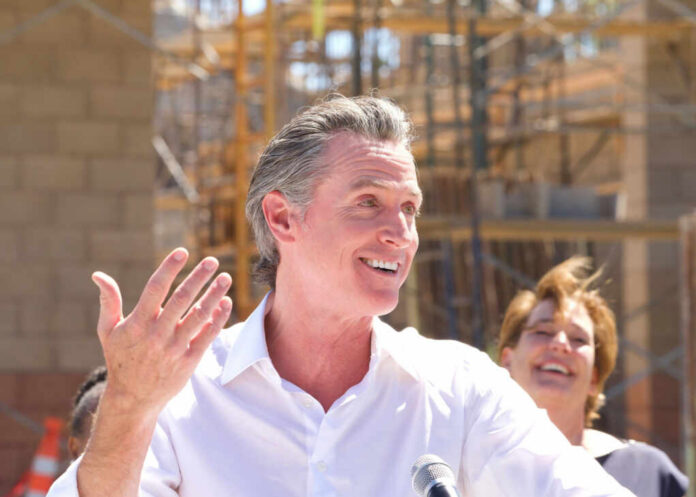
Gavin Newsom’s political committee reportedly spent $1.56 million buying tens of thousands of copies of his own memoir—turning campaign cash into a “bestseller” pipeline that’s legal on paper but hard to square with public trust.
Quick Take
- Campaign finance filings show Newsom’s PAC spent $1,561,875 to buy and distribute 67,000 copies of his memoir.
- Sales tracking data cited in reports indicate the PAC purchase accounts for roughly two-thirds of the book’s total print sales (about 97,000–97,400 copies).
- The PAC listed the expense as “books at cost” through Porchlight Book Company, and the books were used as donor incentives.
- Newsom’s team says donations exceeded the cost of the books and that Newsom received no royalties—an important claim that outside reporting has not fully documented.
What the filings show: $1.56 million for 67,000 books
Campaign finance disclosures reviewed by multiple outlets indicate Gavin Newsom’s political action committee, the Campaign for Democracy Committee, spent $1,561,875 on 67,000 copies of his memoir, Young Man in a Hurry: A Memoir of Discovery. The purchase was routed through Porchlight Book Company and described as “books at cost.” Reports place the book’s release on Feb. 24, 2026, with the bulk-buy details emerging publicly in mid-April.
The size of the purchase matters because it was not a small promotional run; it was reportedly the PAC’s largest expenditure so far in 2026. In practical terms, it means a political committee controlled by the author functioned as the dominant customer for the author’s commercial product. That’s why critics frame the episode as more than marketing: it tests whether campaign fundraising rules can be used to manufacture public-facing “success” metrics.
How the purchases reportedly shaped sales totals and visibility
Sales numbers cited in coverage—drawn from Circana BookScan data—place total print sales around 97,000 to 97,400 copies by mid-April. If the PAC bought 67,000 copies, that’s roughly two-thirds of all tracked print sales. For a political figure, those numbers can translate into media attention, perceived momentum, and invitations that often follow “bestseller” talk, even when a large share of sales came from a single aligned buyer.
Conservatives who have watched institutions promote progressive leaders may see this as a familiar pattern: image management first, accountability second. At the same time, liberals skeptical of money in politics have long argued that wealthy networks and well-connected committees tilt the playing field. The common denominator is erosion of faith—because the public is left asking whether the “market” liked the book or whether the political apparatus simply purchased the headline.
The donor incentive model—and the key unanswered question about royalties
Reports describe the memoir being offered as an incentive to donors, a standard fundraising tactic in modern politics where contributors receive merchandise or access. The controversy here is the circularity risk: PAC money buys a product tied directly to the politician who controls the PAC. Newsom’s spokesperson, as reported, said donor contributions exceeded the cost of the books and that Newsom did not receive royalties from these purchases.
That defense is significant, but it is also where the public record appears thinner than the headlines. Outside analyses cited in coverage discuss the general possibility that author royalties could flow from publisher sales, but the exact contractual and payment details for this case are not laid out in the available reporting. Without documentation showing how royalties were handled, the debate becomes less about what is proven and more about what rules allow—and whether those rules invite ethical gray zones.
Why this resonates in 2026: distrust of “elite” loopholes is bipartisan
This landed at a time when many voters—right, left, and independent—believe the system is designed for insiders who can exploit technicalities while ordinary people get hammered by higher costs and a government that feels unresponsive. Conservatives often connect that frustration to “woke” power networks, media favoritism, and an entrenched political class. Many liberals connect it to big money and influence peddling. Either way, the optics are damaging.
In a country already on edge about corruption and self-dealing, bulk-purchasing your own memoir through a PAC is the kind of story that hardens cynicism. It also raises a practical policy question: if campaign committees can buy politicians’ products “at cost” and distribute them to donors, where is the line between legitimate fundraising and laundering reputation through purchases? The current reporting does not show a legal violation, but it does show why voters increasingly doubt the rules were written for them.
Sources:
Newsom PAC Bought Thousands of Copies of His Memoir for Over $1.5 Million
Gavin Newsom’s PAC Spent $1.5 Million to Buy Copies of His Book
Political Playbook: Newsom Boosted Book Sales With $1.5M From His Own PAC: Report