
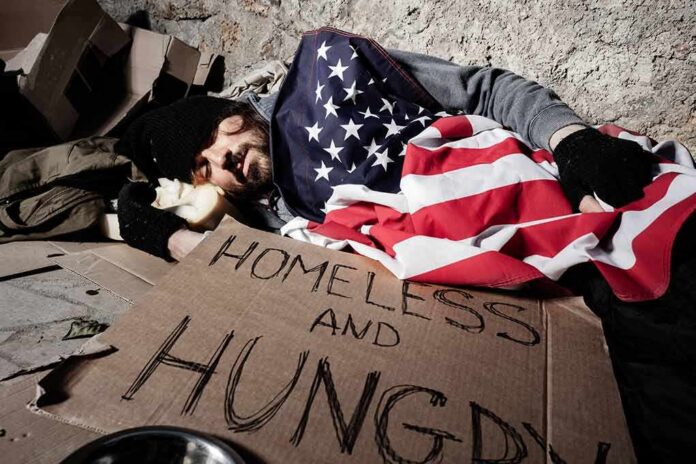
Federal data show homelessness rose over the long run even as Washington poured in billions and added beds, raising hard questions about where the money went.
Story Highlights
- Homelessness rose 27% since 2013 while taxpayer-funded beds jumped 151% nationwide.
- On one night in 2025, 266,320 people lived on the street out of 745,652 homeless.
- Audits in Los Angeles found weak tracking and missing records for billions in spending.
- The Department of Housing and Urban Development (HUD) suspended LA’s lead agency amid an investigation.
Federal Numbers Show Growth Despite Massive Spending
The U.S. Department of Housing and Urban Development (HUD) reported 745,652 people were homeless on a single night in January 2025, including 266,320 living on the street. That reflects a 27% rise in homelessness since 2013, even as taxpayer-funded beds increased 151% and Continuum of Care grants grew sharply over the same period. The Congressional Research Service echoed the snapshot, listing 479,332 sheltered and 266,320 unsheltered people on that night in 2025, underscoring the stubborn scale of street homelessness.
HUD’s Annual Homelessness Assessment Report is the government’s official benchmark to Congress. It compiles local counts and system data to track trends over time. The 2025 release confirms more capacity was built, yet the street crisis persists. Advocates argue the Point-in-Time method is only a single-night snapshot and cannot capture all dynamics. Researchers have documented those limits, but the measure still sets the nation’s yearly scoreboard and guides policy debates in Washington and state capitals.
Audits Expose Oversight Failures in Major Hubs
City and county reviews in Los Angeles found gaps big enough to hide billions. A court-mandated audit said missing records and poor systems blocked a clear view of how nearly $2.3 billion was used, making results hard to judge. A separate report described chronic problems tracking vendors and enforcing contracts. Those findings match a longer pattern of weak controls noted by watchdogs across years. The effect is simple: taxpayers cannot see cause and effect, and people on the street do not see change.
Federal officials have moved from warnings to action. The Department of Housing and Urban Development announced an immediate suspension of the Los Angeles Homeless Services Authority while the HUD Office of Inspector General investigates alleged false statements and financial mismanagement. The suspension put hundreds of millions under review and signaled a tougher stance on accountability. The order cited years of concerns about controls and spending outcomes that failed to match the growth in annual budgets.
What Congress Is Asking Taxpayers Deserve to Know
House investigators and budget hawks are pressing basic questions: Is the program working, and can anyone trace dollars to measurable results on the street? The federal homelessness system relies on layered delivery through city, county, and nonprofit partners. When oversight breaks, the links fail. That is why lawmakers of both parties have called for clear metrics and public reporting on placements, exits, and returns to homelessness. Without that, more money can move with little proof of impact.
🚨 BREAKING LOS ANGELES: LAHSA Fraud Investigation Escalates — DOJ Charges Four in $130M Scheme
Federal prosecutors have charged four people connected to homeless services fraud in Southern California, part of a broader HUD probe into LAHSA — the agency that helps coordinate…
— Elizaa (@ElizaaaSwan) September 16, 2026
Conservatives back a simple standard: fund what reduces street homelessness, and cut what does not. Families want safe sidewalks, open parks, and accountable programs. The data show progress claims ring hollow when the unsheltered count stays high. The solution starts with honest numbers, clean books, and consequences for failure. HUD’s national report sets the trend line; local audits show where the system breaks. Congress is right to demand proof before writing another billion-dollar check.
Sources:
youtube.com, laist.com, nlihc.org, policymap.com, pjmedia.com, nypost.com