
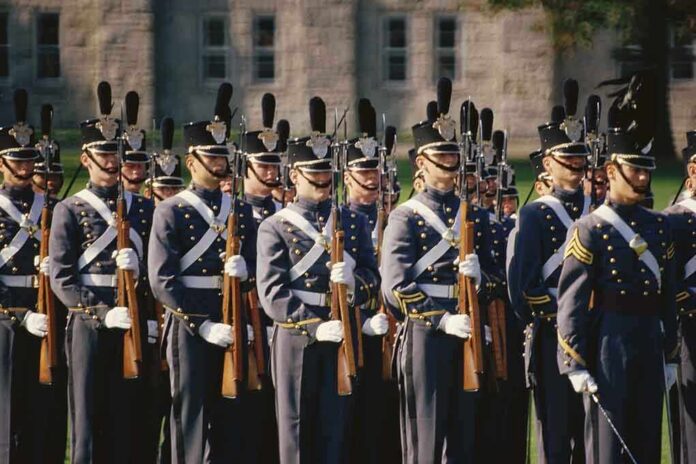
Defense Secretary Pete Hegseth ended new civilian tenure at America’s service academies to refocus classrooms on warfighting, not campus politics.
Story Highlights
- Hegseth ordered West Point, the Naval Academy, and the Air Force Academy to stop granting tenure to new civilian professors.
- The memo says tenure fuels “academic stagnation” and mission drift away from training future officers.
- Current tenured civilians keep their status; the change applies to future appointments.
- Critics warn recruiting scholars may get harder, but the Pentagon wants faster, mission-first hiring.
What Hegseth Ordered And Why It Matters
Defense Secretary Pete Hegseth signed a directive telling the military academies to stop appointing civilian faculty to tenured positions right away. He framed the move as a warfighting reform to keep the schools laser-focused on building lethal, ready officers. The memo links tenure to academic stagnation, faculty complacency, and curriculum drift from the mission. It directs services to design hiring that values flexibility and direct support to military needs.
The order addresses future appointments only. Reporting says current tenured professors will keep their tenure, which limits disruption and legal risk. The academies already can fire civilian staff under existing authorities, which undercuts claims that tenure is the only way to manage quality. The Pentagon’s aim is faster course updates, clearer accountability, and staff who adapt to emerging threats without years of committee delay.
How The Change Fits The Mission
The Defense Department says the academies must prize lethality, readiness, and mission alignment. Leaders argue fixed lifetime appointments can slow needed change when adversaries move fast. Ending new tenure is meant to speed curriculum shifts in cyber, space, drones, electronic warfare, and great-power competition. The directive pushes managers to hire and retain teachers for what they add to the warfighter’s tool kit, not for academic fashions common on civilian campuses.
Academies rely on civilian experts to teach areas like English and the humanities alongside science and engineering. Supporters of the change say those subjects should still sharpen critical thinking and ethics for combat leaders, but must stay tied to combat realities and the laws of war. They argue civilian academic norms have, at times, pulled courses toward social debates that do not train platoon leaders to win and bring troops home safe.
What Critics Say About Recruiting And Academic Freedom
The American Association of University Professors argues the policy will make it harder to recruit top scholars and could expose faculty to political pressure. The group’s president warned that ending tenure might chill speech and weaken independent judgment in the classroom. Some academy leaders have also described tenure as a helpful recruiting tool and part of academic progression for civilians, saying it supported long-term development and retention.
Those concerns deserve a fair hearing. But the Pentagon’s stated focus is on accountability and speed. The order does not remove current tenure, and it does not ban civilian scholars. It changes how new roles are structured. The department can still offer multi-year contracts, competitive pay, and research support. The key test will be whether updated hiring plans keep high standards while preventing classes from sliding away from officer training priorities.
Limits, Unknowns, And The Road Ahead
Public reports quote key lines from the memo but do not show the full text, legal citations, or detailed implementation steps. The directive does not spell out the exact contract models that will replace tenure for future hires. No released data yet proves that tenure directly caused weaker warfighting outcomes, which means results will need tracking as the change rolls out. Congress and watchdogs may seek more documents and testimony to evaluate progress.
🚨 BREAKING: Hegseth ends civilian tenure at U.S. service academies
• Memo halts new tenure for civilian professors at West Point, Annapolis, Air Force Academy
• Goal: keep focus on warfighting — not "academic stagnation"
• Existing tenured faculty keep status — per CBS pic.twitter.com/MDQVc2xJBl— WATCHMAN 🚨 (@WatchmanAlertUS) September 30, 2026
For now, the bottom line is clear: the Trump administration’s Pentagon wants academies to move at the speed of threat. That means classrooms built around mission, merit, and adaptability. Families who send sons and daughters to serve expect leaders trained for victory, not steeped in fads. If the policy boosts accountability and keeps curricula combat-relevant, it will mark a win for readiness. If recruiting lags, leaders will need to adjust quickly while keeping the warfighter first.
Sources:
washingtontimes.com, militarytimes.com, thehill.com, cbsnews.com, wtop.com, audacy.com