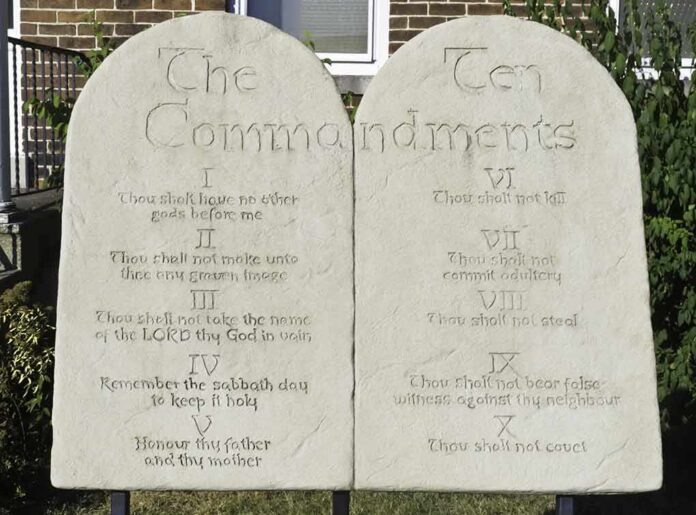
The American Civil Liberties Union is asking the Supreme Court to strike down Texas’s Ten Commandments classroom law after a near-split appeals court said the law is constitutional, setting up a nationwide test of faith, history, and school authority.
Story Snapshot
- Texas won a 9-8 appeals court ruling upholding classroom Ten Commandments displays.
- The American Civil Liberties Union petition asks the Supreme Court to take the case.
- Supporters cite history-and-tradition and say displays are not coercive.
- Opponents point to the 1980 Stone v. Graham school precedent against postings.
Appeals Court Greenlights Texas Classroom Displays
The United States Court of Appeals for the Fifth Circuit ruled 9-8 that Texas Senate Bill 10 does not violate the First Amendment, reversing a district court that blocked the law and allowing schools to display the Ten Commandments in each classroom. The court said the law fits within the Constitution’s text, history, and tradition. The opinion rejected claims of coercion on the law’s face and dismissed Establishment Clause and Free Exercise Clause challenges brought by families represented by the American Civil Liberties Union.
Texas Attorney General Ken Paxton told school districts not covered by injunctions to comply with the statute and display qualifying posters. He argued the Ten Commandments are part of America’s legal and moral heritage and said districts must accept suitable donated displays to meet the law’s terms. The narrow appeals margin underscores the stakes. A single vote decided whether Texas could proceed, which fuels interest for Supreme Court review and shapes how other states may act next.
American Civil Liberties Union Seeks Supreme Court Review
Families represented by the American Civil Liberties Union, the American Civil Liberties Union of Texas, Americans United for Separation of Church and State, and the Freedom From Religion Foundation asked the Supreme Court to take the case and strike down the law. Their request argues that the classroom is a sensitive setting where government endorsements carry weight. They highlight an older Supreme Court decision, Stone v. Graham, which invalidated a similar classroom posting requirement in 1980 and found no valid secular purpose for such displays.
The petition arrives after a year of fast legal swings. A district court first blocked the law at the American Civil Liberties Union’s urging, then the appeals court reversed and dismissed the claims. The Supreme Court faces a choice: treat Stone as controlling in schools, or lean into the recent history-and-tradition approach applied in other religion cases. A grant of review would set up a direct test of how far that newer method reaches inside public classrooms.
History-and-Tradition vs. Schoolhouse Coercion
Supporters argue the display is a passive nod to history that students are not forced to read or recite. They link the policy to Supreme Court decisions that favor a history-and-tradition analysis for public religious expression and say Texas’s law fits that path. They stress that the text hangs on the wall like other civic displays and claim it does not compel belief or worship. The Fifth Circuit’s opinion closely tracks that logic and treats the setting as constitutionally permissible.
Opponents counter that the schoolhouse is different. They cite Stone v. Graham, where the Supreme Court struck down a near-identical posting rule in classrooms. They argue young students face pressure to conform and may see state-approved religious text as a command, not a lesson. They say the appeal court’s approach conflicts with decisions that treat school religion as uniquely sensitive, and that the earlier Supreme Court ruling should control here.
What This Means for Parents, Teachers, and Local Control
Texas districts not under injunctions face a clear directive to display compliant posters, including accepting qualifying donations if needed. Administrators will need rules for placement, size, and content that match the statute, while addressing parent concerns inside their communities. If the Supreme Court takes the case, districts could see another shift. A ruling could either affirm the appeals court’s path or restore a bright-line bar in classrooms under Stone.
Supreme Court asked to hear case on Texas law requiring Ten Commandments in schools https://t.co/zNngNHW91r
— On Line English (@OLE_Marjory) August 18, 2026
For conservatives, the case tests whether common-sense tradition can still guide public life. Many parents want schools to teach respect, truth, and responsibility. Texas leaders say the Ten Commandments reflect those values without forcing faith. The American Civil Liberties Union says any state posting in class is government endorsement. The Supreme Court will decide how our Constitution balances those claims in the place where it matters most for kids: the classroom.
Sources:
reason.com, foxnews.com, cbsnews.com, nytimes.com, scotusblog.com