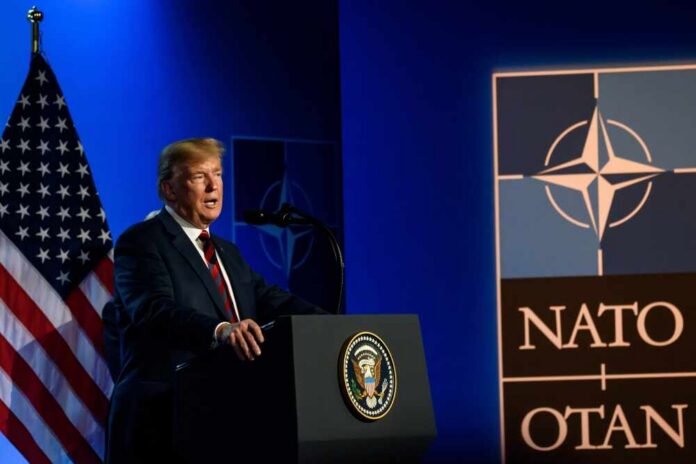
Trump’s public NATO meltdown after the Iran ceasefire wobble is forcing a question Washington has dodged for decades: what, exactly, are Americans still paying for?
Quick Take
- President Trump publicly blasted NATO for not backing the U.S. during the Iran conflict and again floated a possible U.S. exit.
- NATO’s latest strain follows U.S. military action against Iran that, according to commentary sources, occurred without NATO consultation and left allies on the sidelines.
- Supporters of a reduced U.S. global footprint say the episode exposes an expensive alliance model that no longer matches post–Cold War realities.
- Critics warn a U.S. break with NATO could destabilize Europe and weaken deterrence, with Iran and energy shocks adding pressure.
Trump’s NATO Rebuke Collides With the Iran War Fallout
President Donald Trump’s second-term foreign policy faced a new flashpoint in April 2026 as the Iran ceasefire was reportedly violated and U.S. forces stayed postured in the Persian Gulf. After meeting NATO Secretary General Mark Rutte, Trump intensified his long-running complaint that NATO “wasn’t there” when the U.S. needed it and said he is strongly considering withdrawing from the alliance. The message landed during a moment of heightened uncertainty, not a calm strategic review.
The immediate context matters because it shapes how both supporters and skeptics interpret Trump’s posture. The available research is heavily opinion-driven and does not include a detailed, official NATO or U.S. government readout of the Iran operations or alliance deliberations. Still, multiple sources agree on the broad outline: the U.S. acted forcefully against Iran, allies stayed largely out, and Trump framed that absence as proof NATO is a bad deal for America.
Why NATO’s “Burden Sharing” Argument Is Back—Again
NATO was created in 1949 to deter Soviet expansion, but it stayed in place after the Cold War ended in 1991, expanding its footprint and expectations even as America absorbed the bulk of the military burden. In the research provided, this history is central to the case that NATO is structurally outdated: a permanent alliance built for a vanished threat now draws the U.S. into open-ended commitments. Trump’s critics call his approach destabilizing, but his complaint resonates with voters tired of paying for commitments that look one-sided.
One former U.S. NATO ambassador described the Iran as the alliance’s worst crisis in decades and said European allies increasingly doubt America’s reliability under Trump. That point cuts both ways. From a conservative, limited-government perspective, alliance “credibility” can become a blank check—one that expands the national security state without clear authorization or measurable wins. From a traditional alliance-management perspective, credibility is the whole point of deterrence, and public threats to exit can unravel it fast.
Europe’s Reluctance Shows the Limits of U.S.-Led Intervention
It indicates European NATO members avoided the Iran fight partly due to economic exposure, energy costs, and war fatigue. That reluctance is not shocking in a continent where voters have already absorbed years of inflation pressure, migration shocks, and internal political fragmentation. When the U.S. undertakes major military action and allies balk, the alliance starts looking less like collective defense and more like an American platform that others can use—or ignore—depending on domestic convenience. For taxpayers, that raises a hard question: if “together” disappears during crisis, why keep paying for the structure?
At the same time, critics argue that a weaker NATO could leave Europe more vulnerable and invite opportunism from adversaries. The sources also raise fears of deeper polarization and radicalization in Europe if war-driven energy shocks intensify. That is plausible as a general risk, but it does not supply concrete economic figures, casualty estimates, or official assessments tying a specific Iran-war timeline to specific European domestic outcomes. What it does show is a widening gap between U.S. action and allied willingness to share consequences.
The Fiscal Fight Behind the Foreign-Policy Fight
The sharpest pro-withdrawal argument is fiscal: advocates contend the U.S. could save roughly $500 billion a year by shrinking overseas commitments, closing far-flung bases, and reducing the scale of the “Warfare State.” This aligns with a core conservative concern—debt, inflationary pressure, and government bloat—especially after years of public frustration over overspending at home and abroad. However, it provides this savings figure as an advocacy claim rather than a documented budget analysis, so readers should treat it as an estimate, not a verified accounting.
The bigger political significance is that NATO is becoming a proxy battle over whether America’s default setting should be intervention or restraint. Many on the right want secure borders and energy independence before new foreign commitments; many on the left distrust Trump’s motivations and fear reduced U.S. involvement will harm allies and minorities abroad. Yet both sides increasingly share a basic suspicion: institutions in Washington and beyond can become self-perpetuating machines that outlive their purpose, funded by ordinary people who get little say.
What to Watch Next: Withdrawal Threats, Alliance Repair, and Unanswered Questions
Three near-term developments will shape whether this becomes a real break or another cycle of brinkmanship. First, watch for any formal steps toward withdrawal, not just rhetoric after tense meetings. Second, watch whether NATO leadership offers concrete burden-sharing changes or operational commitments that address Trump’s “they weren’t there” critique. Third, watch what new information emerges about the Iran ceasefire violation and the ongoing maritime posture, including whether the Strait of Hormuz remains open and how long any blockade-like measures persist. Those details will determine whether “NATO wasn’t there” is a political line—or an enduring strategic rupture.
For Americans already convinced the federal government serves elites first, this reads like a familiar pattern: big decisions, unclear objectives, and the bill landing on the same middle-class households squeezed by prices at home. It does not prove NATO is finished, and it does not confirm worst-case claims like a Greenland move beyond speculation. What it does confirm is a reality voters can see: when war comes, alliances can fracture quickly, and Washington’s promises—on both spending restraint and foreign restraint—are tested in real time.
Sources:
Trump’s Iran Fiasco’s Silver Lining – The End of NATO
Will Iran War End NATO Alliance