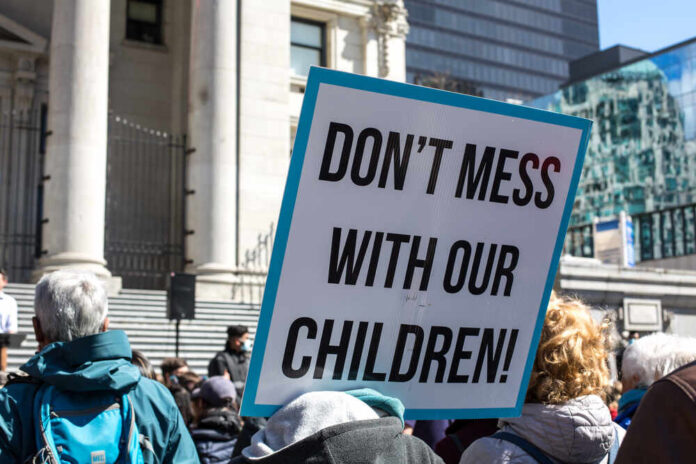
The Supreme Court delivered a decisive blow to California’s scheme of hiding children’s gender transitions from their parents, reinstating constitutional protections for families against state-sanctioned secrecy in public schools.
Story Highlights
- Supreme Court’s 6-3 emergency order reinstates injunction blocking California policies that concealed students’ gender transitions from parents
- Ruling emphasizes parental rights under First and 14th Amendments, protecting religious families’ authority to direct children’s upbringing
- California schools must now notify parents when children express gender dysphoria or transgender status at school
- Victory follows federal finding that California violated FERPA by pressuring schools to withhold critical mental health information from families
Supreme Court Restores Parental Authority Over State Overreach
The Supreme Court issued an emergency order on March 2, 2026, blocking California’s controversial policies that prevented schools from notifying parents about their children’s expressed transgender status without student consent. The 6-3 decision reinstates a lower court injunction, halting what legal advocates called state-facilitated deception of families. The ruling applies specifically to parents’ claims, ensuring schools must inform families when children experience gender dysphoria or request gender transitions at school. This represents a significant check on California’s attempt to insert itself between parents and children on fundamental questions of identity and mental health.
Religious Liberty and Constitutional Rights Prevail
The case originated when Escondido teachers Elizabeth Mirabelli and Lori Ann West, devout Catholics, challenged California’s student privacy policies in 2023, later joined by religious parents in Pasadena and Clovis. U.S. District Judge Roger Benitez ruled the policies unconstitutional in December 2025, finding they violated parental rights to direct their children’s education and religious upbringing. The Supreme Court determined California’s policies “substantially interfere” with fundamental parental authority, particularly for families with sincere religious beliefs about biological sex and gender. This builds on precedent from Mahmoud v. Taylor, where the Court applied strict scrutiny to protect parental rights against school policies conflicting with religious convictions.
Federal Government Backs Parents Against California
The Trump administration’s Department of Education strengthened parents’ position by issuing a January 28, 2026, finding that California violated the Family Educational Rights and Privacy Act. Federal officials determined the California Department of Education pressured schools to conceal gender identity information, threatening the state’s education funding. California Attorney General Rob Bonta sued the federal government on February 13, 2026, defending the state’s position that AB 1955 balances student privacy with parental rights. However, the law’s practical effect created systematic concealment of mental health issues from families, undermining both federal law and constitutional protections for parental involvement in children’s wellbeing.
Nationwide Implications for Family Rights and Education Policy
Thomas More Society attorney Paul M. Jonna described the ruling as a “watershed moment,” declaring schools “cannot secretly transition a child.” Becket Fund attorney Mark Rienzi emphasized that “parents’ rights don’t stop at the schoolhouse door,” noting this case involves greater government intrusion than previous disputes over curriculum content. The decision sets precedent limiting states’ ability to facilitate gender transitions without parental consent, protecting families’ authority over critical decisions affecting their children’s mental and physical health. California schools must now implement notification procedures, potentially influencing K-12 education policies nationwide as other states face similar challenges balancing student privacy claims against fundamental parental rights and children’s welfare.
The ruling underscores a core conservative principle: parents, not government bureaucrats, hold primary authority over their children’s upbringing. California’s attempt to exclude families from knowledge about their children’s mental health struggles represents the kind of government overreach that erodes family bonds and constitutional freedoms. By concealing gender dysphoria—a serious psychological condition requiring parental guidance and potentially medical intervention—schools positioned themselves as superior decision-makers to mothers and fathers. This Supreme Court decision reaffirms that state employees cannot usurp parental authority under the guise of protecting children, particularly when policies actively deceive families about issues central to their values and their children’s development.
Sources:
Supreme Court Says California’s Secret Gender Transition Policies Likely Violate Parental Rights
Supreme Court: California parents may be told about their transgender child at school
Supreme Court Backs Parents in School Gender Disclosure Fight
Supreme Court blocks law on schools outing transgender students