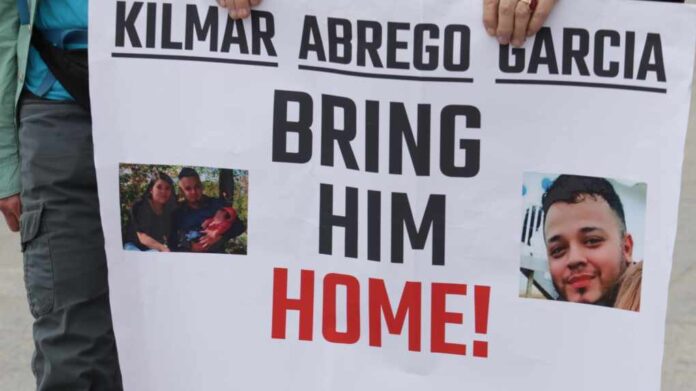
The Trump administration is moving forward with plans to deport Kilmar Abrego Garcia, a Salvadoran national, to Liberia. This decision follows the refusal of Uganda, Eswatini, and Ghana to accept Garcia, who has no known ties to Liberia. The case has sparked debate regarding due process and the scope of executive power in immigration enforcement.
Story Highlights
- The Trump administration intends to deport Kilmar Abrego Garcia to Liberia after other nations declined to accept him.
- Garcia has no established connection to Liberia, raising questions from legal and advocacy groups.
- Federal judges and advocacy organizations are scrutinizing the administration’s use of third-country deportations and the implications for due process.
- The case is seen as reflective of the administration’s broader immigration policies, which prioritize aggressive enforcement.
In October 2025, the Department of Justice formally announced its intention to deport Kilmar Abrego Garcia to Liberia. This action comes after Uganda, Eswatini, and Ghana declined to accept Garcia, a Salvadoran national. The administration states that this removal is a lawful exercise of executive authority aimed at enforcing immigration laws and prioritizing national security.
Trump Admin Seeking to Send Kilmar Abrego Garcia to Liberia https://t.co/nOZHxrSYxN via @BreitbartNews
— 💜Naddez💜 (@Naddez1) October 25, 2025
Garcia was granted legal status after arriving in Maryland in 2011, and a 2019 court order prohibited his removal to El Salvador due to a documented threat of persecution. Despite these protections, he was mistakenly deported to El Salvador in March 2025, an error that led to his imprisonment before a federal judge intervened to secure his return. Following his release from jail on unrelated charges, U.S. Immigration and Customs Enforcement (ICE) again detained Garcia, seeking alternative destinations for his deportation. The administration’s pursuit of third-country removals, particularly when the individual lacks ties to the designated country, has set a controversial precedent in immigration policy.
Judge Paula Xinis, who is overseeing Garcia’s legal proceedings in Maryland, has temporarily blocked his deportation to Liberia, pending further review. This judicial intervention underscores ongoing discussions about due process and constitutional protections for non-citizens. Simon Sandoval-Moshenberg, Garcia’s attorney, has described the administration’s actions as “punitive, cruel and unconstitutional,” arguing that sending his client to Liberia without clear legal grounds violates established legal standards. Senator Chris Van Hollen (D-Md.) has also expressed concerns, stating that the administration is “shopping for faraway countries” to potentially circumvent judicial scrutiny and deny Garcia his rights. These legal challenges highlight the tension between executive enforcement priorities and the judiciary’s role in safeguarding legal protections.
As legal proceedings continue, Garcia remains detained in Pennsylvania awaiting formal notification of his potential deportation. Costa Rica has reportedly offered him refugee status; however, the Department of Justice has not engaged with Costa Rican officials, opting instead to pursue the Liberia option. The administration maintains that Liberia is a “thriving democracy” and a close U.S. partner, suggesting that Garcia’s safety can be assured. However, legal filings and advocacy statements continue to question the humanitarian implications and the precedent set by such removals, particularly for vulnerable immigrant populations.
The Garcia case is viewed as representative of the Trump administration’s broader immigration agenda, which includes expanded detention, aggressive enforcement, and reduced access to humanitarian relief. Recent legislation, referred to as the “One Big Beautiful Bill Act,” has reportedly increased funding for detention and enforcement while limiting due process and benefits for lawfully present immigrants. Supporters of these measures argue they are necessary to enhance border security, uphold the rule of law, and protect American communities. Critics, conversely, express concerns that such policies may erode constitutional rights and establish precedents for executive overreach.
For some, the administration’s actions reinforce a commitment to strong borders, national sovereignty, and law enforcement. The scope of third-country deportations raises questions about constitutional safeguards and the balance of power between the executive branch and judicial oversight. As the Garcia case progresses, lawmakers, advocacy groups, and the public are expected to continue debating the long-term implications for immigration policy, individual rights, and the U.S. legal system.
Watch the report: Trump reacts to Kilmar Abrego Garcia’s ICE arrest
Sources:
Kilmar Abrego Garcia Deportation: Liberia, Trump Administration
Justice Dept. Seeks to Deport Kilmar Abrego Garcia to Liberia
Trump, Kilmar Abrego Garcia, DOJ, Liberia
Van Hollen Statement on Administration’s Intent to Send Kilmar Abrego Garcia to Liberia
Kilmar Abrego Garcia Would Be Deported to Liberia Under Trump Administration Plan