A leaked Pentagon memo is floating the idea of “suspending” Spain from NATO—an attention-grabbing threat that exposes how fragile allied cooperation can become when America goes to war.
Quick Take
- A leaked internal email tied to Pentagon policy chief Elbridge Colby proposed punitive options against allies—especially Spain—after disputes linked to U.S. operations against Iran.
- Spain hosts major U.S. military facilities but reportedly denied certain access, basing, and overflight rights connected to the Iran campaign.
- NATO’s founding treaty has no expulsion or “suspension” mechanism, making the proposal largely symbolic and legally difficult to execute.
- The flare-up revives a long-running Trump-era argument: allies must meet higher defense spending and provide baseline operational support, not just political solidarity.
What the leaked email proposed—and why Spain is the headline target
Reporting in late April said an internal Pentagon email described possible steps to penalize NATO allies that refused access, basing, and overflight rights during U.S. military operations against Iran. Spain drew special attention because it hosts key U.S. bases, including at Rota and Morón, yet still resisted supporting offensive operations tied to the Iran conflict. That combination—strategic geography without full operational cooperation—appears to be what elevated Spain from a general frustration to a named example.
The timing matters. The air war against Iran began in late February 2026, and reporting indicates the Strait of Hormuz closed, raising the stakes for U.S. force posture and logistics. When access questions arise during a high-intensity operation, the Pentagon tends to view them as more than diplomacy; it becomes a readiness issue that affects aircraft routing, refueling plans, and rapid reinforcement. That helps explain why the memo framed access and overflight rights as a baseline expectation rather than a discretionary favor.
NATO can’t “kick out” a member—so what does a “suspension” threat really do?
The practical roadblock is structural: NATO’s North Atlantic Treaty does not include an expulsion clause. The treaty’s exit language centers on voluntary withdrawal, not forced removal, and it requires formal notice and a waiting period. Analysts cited in coverage described the “suspension” idea as effectively impossible under NATO’s rules, which is why the episode reads less like imminent policy and more like leverage—an attempt to increase pressure on governments that want NATO’s security umbrella without accepting operational or budgetary obligations.
That distinction also matters for American voters who want accountability but not empty theatrics. If the alliance cannot legally enforce expulsion, then the real policy question becomes what the United States can do unilaterally: adjusting bilateral defense cooperation, renegotiating base terms, shifting deployments, or conditioning future support on measurable commitments. Those steps can be consequential, but they are different from the emotionally satisfying “boot them out” talk that headlines often imply—and they carry their own strategic costs if handled recklessly.
Spain’s response: loyalty to NATO, limits on offensive operations
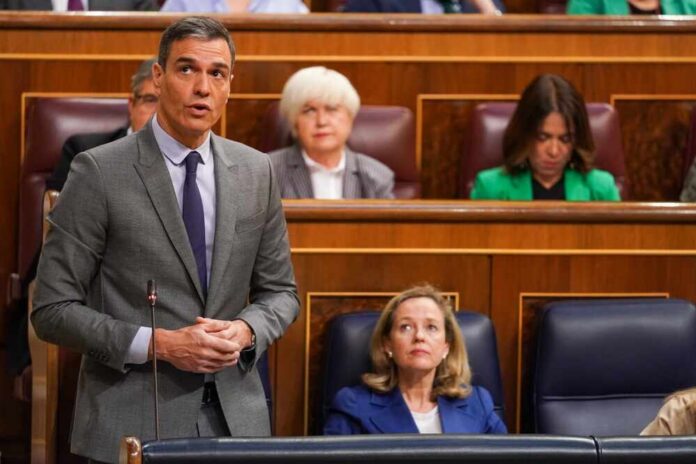
Spain’s government pushed back publicly after the leak. Prime Minister Pedro Sánchez emphasized Spain’s loyalty as a partner and argued that Madrid is fulfilling responsibilities while prioritizing international law. That position reflects a common European political constraint: leaders want to remain inside NATO’s security framework, especially with global instability rising, but also want distance from U.S.-led offensive campaigns that are unpopular at home. Spain also pointed to its defense spending level—reported around 2.1% of GDP—as evidence of meeting obligations, even as Washington pushes for more.
The spending dispute predates the Iran operation. NATO leaders set a long-term target of 5% of GDP by 2035 at a 2025 summit in The Hague, and President Trump has repeatedly argued that burden-sharing cannot be a one-way street. From a conservative “limited government, strong defense” perspective, that argument resonates: taxpayers should not be asked to bankroll global security while affluent allies underspend and then selectively opt out when access and overflight are needed most. The counterargument from allies is that sovereignty and domestic law constrain what they can approve.
What this episode signals about Trump’s second-term alliance strategy
Pentagon Press Secretary Kingsley Wilson echoed the underlying frustration, saying allies were not “there for us” and signaling interest in stronger guarantees of access. Even if the suspension concept goes nowhere legally, the message is not subtle: future U.S. defense cooperation may be treated as conditional. That fits a broader second-term pattern in which the administration uses leverage—budgets, basing, and public pressure—to force clarity on what alliance membership practically means during wartime, not just during summit communiqués.
Why a Leaked Pentagon Memo Just Proposed Suspending Spain From NATO — and Why It Will Almost Certainly Not Happenhttps://t.co/4jqUaFCa3q
— 19FortyFive (@19_forty_five) April 24, 2026
The risk for NATO is that symbolic threats can become political accelerants on both sides. In the United States, voters already distrust “elite” institutions that feel unaccountable and expensive, and alliance burden-sharing fights feed that skepticism. In Europe, aggressive rhetoric can strengthen anti-American factions and complicate cooperation even where interests overlap. The immediate reality is that no formal process is underway and the memo remains an internal proposal—but the underlying dispute over access and spending is not going away.
Sources:
Pentagon email raises the possibility of suspending Spain from NATO due to Iran disagreements
Petty Donald Trump Plots to Snub NATO Allies Like Spain and the UK Over Iran Response
Pentagon considers suspending Spain from NATO, leaked email says