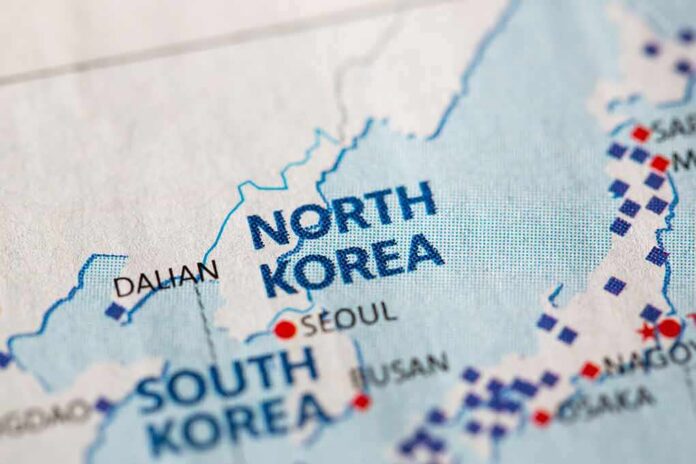
North Korea launched another ballistic missile toward the sea, and South Korea’s military says it is only the latest in a fast-growing string of tests aimed at rattling Seoul, Tokyo and Washington.
Quick Take
- South Korea’s Joint Chiefs of Staff confirmed North Korea fired a ballistic missile into eastern waters.
- Kim Jong Un has personally overseen recent tests of cluster warheads and hypersonic missiles.
- The pace of launches has picked up sharply, with multiple tests already logged in 2026.
- President Trump has kept the door open to talks even as Pyongyang keeps building its arsenal.
South Korea’s Military Confirms Another Launch
South Korea’s Joint Chiefs of Staff reported that North Korea fired what appeared to be a short-range ballistic missile into the waters off its eastern coast. The missile flew roughly 434 miles after launching from an inland site, according to the military’s assessment reported by NBC News. It marks yet another entry in a launch log that has grown steadily longer under Kim Jong Un’s rule.
South Korean officials track these launches almost as routine business now. Detection comes fast, usually within minutes, but full details on missile type and range often take hours or days to confirm. That process has played out the same way for years, no matter which system North Korea tests.
Kim Jong Un Keeps Expanding His Arsenal
Kim Jong Un personally supervised a test of upgraded short-range ballistic missiles fitted with cluster and fragmentation warheads in April 2026, according to North Korea’s state media, KCNA. Analysts warned these weapons could threaten Seoul and nearby American bases. Just months earlier, in January 2026, Kim oversaw a hypersonic missile test that struck targets more than 620 miles away, timed to coincide with South Korean President Lee Jae Myung’s travels.
That same week in April, North Korea ran a separate series of ballistic missile launches toward the sea, its seventh known launch event of the year, according to South Korea’s Joint Chiefs of Staff. Each new test adds another data point to a weapons program that keeps pushing for longer range, bigger warheads and faster missiles that are harder to shoot down.
A Pattern That Won’t Slow Down
Tracking groups that log North Korea’s missile activity say these tests have become frequent enough to blur together for casual observers, a pattern stretching back years across multiple U.S. administrations. That steady drumbeat is exactly why conservatives have long argued that talk alone never worked with Pyongyang. Only strength, readiness and reliable allies keep the regime in check.
President Trump has renewed calls for dialogue with Kim even as joint military drills with South Korea continue, with U.S. Indo-Pacific Command confirming it is closely watching the launches. Trump’s approach mixes an open hand with a firm military posture alongside Seoul and Tokyo, a stance conservatives credit for keeping Pyongyang from crossing bigger red lines during his first term.
South Korea and Japan continue to share intelligence on every launch, a coordination effort that has become more important as North Korea diversifies its arsenal beyond simple short-range rockets. Cluster warheads, hypersonic weapons and submarine-launched missiles all now sit in Kim’s toolkit, forcing allies to constantly update their defenses. For American families watching from home, the message is simple: a nuclear-armed regime keeps testing weapons built to threaten U.S. troops and allies, and only a strong, unapologetic American military posture keeps that threat from growing worse.
Sources:
reuters.com, dw.com, bbc.com, globalnation.inquirer.net