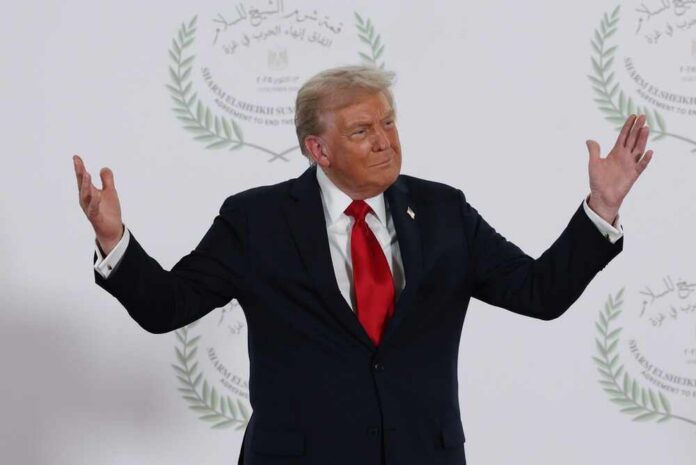
While Americans fight and die in another Middle East war, suspicious trading patterns surrounding Trump’s military decisions are raising serious questions about who’s profiting from the bloodshed—and whether insiders are turning national security into a cash cow.
Story Snapshot
- Suspicious trading activity has surged around major White House decisions, including war declarations and policy shifts, with patterns suggesting insider knowledge.
- Oil futures trading spiked just before Trump’s public posts about Iran negotiations, raising red flags about potential leaks from within the administration.
- The epidemic of market manipulation includes spoofing, wash trading, and insider trading schemes that have cost retail investors billions while enriching connected elites.
- Regulators are deploying AI surveillance to detect abuses, but high-frequency trading and algorithmic schemes make enforcement increasingly difficult in 2026’s complex markets.
War Profiteering Raises Eyebrows
Trading patterns surrounding Trump’s Iran war decisions have triggered alarm bells among watchdogs and frustrated Americans who voted against endless conflicts. Oil futures experienced unusual surges just before the President publicly announced developments in Iran negotiations, suggesting someone with advance knowledge capitalized on information unavailable to ordinary citizens. This follows a disturbing trend where major policy announcements—from tariffs to military strikes—are preceded by suspicious market movements that benefit well-connected traders while Main Street investors get left holding the bag. For conservatives who demanded an end to swamp corruption, these patterns represent exactly the kind of insider dealing that undermines faith in both markets and government.
The Mechanics of Market Manipulation
Market abuse takes multiple forms, from classic insider trading using material nonpublic information to sophisticated algorithmic schemes like spoofing and layering. Spoofing involves placing fake orders to deceive other traders about supply and demand, then canceling those orders after prices move favorably. Wash trading creates artificial volume through coordinated buy-sell transactions that give false impressions of market activity. These practices exploded after 2008 as high-frequency trading now comprises 50-70% of market volume, providing cover for manipulation that’s harder to detect. The rise of derivatives and cryptocurrency markets has opened new frontiers for abuse, with pump-and-dump schemes targeting retail investors who lack the resources to compete with institutional players deploying advanced technology.
Billion-Dollar Penalties Fall Short
High-profile cases illustrate the scope of the problem and the inadequacy of current enforcement. Steve Cohen’s SAC Capital paid $1.8 billion in 2013 for wire fraud involving insider tips, while Raj Rajaratnam received ten years in prison for exploiting nonpublic information about earnings and mergers through his Galleon Group hedge fund. The SEC and FCA can impose fines up to $25 million on firms and $5 million on individuals, with lifetime trading bans for egregious violations. Yet these penalties often pale compared to profits earned through illegal schemes, creating a cost-of-doing-business mentality among Wall Street’s elite. Retail investors—the hardworking Americans trying to build retirement savings—bear the real cost through distorted prices and eroded market confidence that makes fair participation nearly impossible.
AI Surveillance Versus Sophisticated Cheaters
Regulators are fighting back with artificial intelligence systems designed to detect atypical behavior, such as trades placed immediately before major announcements or rapid order cancellations characteristic of spoofing. Compliance firms report that AI can identify roughly 80% of spoofing attempts by analyzing cancellation patterns within seconds. AUSTRAC and other agencies flag suspicious indicators like unemployed individuals executing high-volume trades or complex layering schemes that suggest coordination. However, the same technology enabling detection also empowers increasingly sophisticated evasion tactics. The anonymity of high-frequency trading platforms and the global nature of modern markets create enforcement challenges that allow many manipulators to operate with impunity, particularly in less-regulated cryptocurrency spaces where American investors are especially vulnerable.
"An epidemic of suspicious trading has emerged around President Trump's most consequential decisions — each time, just minutes or hours before he rattles global markets, according to exchange data." ~ Axioshttps://t.co/AAcAQqhqQ6
— Mary Ellen Klas (@MaryEllenKlas) March 25, 2026
The epidemic of suspicious trading represents a fundamental threat to market integrity and the American principle of equal opportunity. When insiders profit from information unavailable to ordinary citizens—especially information related to war and national security—it corrupts both capitalism and democracy. For Trump supporters who expected transparency and an end to elite privilege, these trading patterns demand serious investigation and accountability. The technology exists to detect and prevent most abuses, but enforcement requires political will to take on powerful financial interests. Until penalties genuinely deter wrongdoing and surveillance systems close loopholes exploited by algorithmic traders, retail investors will continue facing a rigged game where their savings fund the profits of those with access and connections they’ll never have.
Sources:
Insider Trading Examples – ZLK
Types of Market Abuse – SIX Group
Five Prominent Market Abuse Behaviours and How to Spot Them – Steel Eye
Indicators of Suspicious Activity in Securities and Derivatives Sector – AUSTRAC
Market Abuse and Insider Trading – Financial Crime Academy
Explainer: Insider Trading and Prediction Markets – NC State