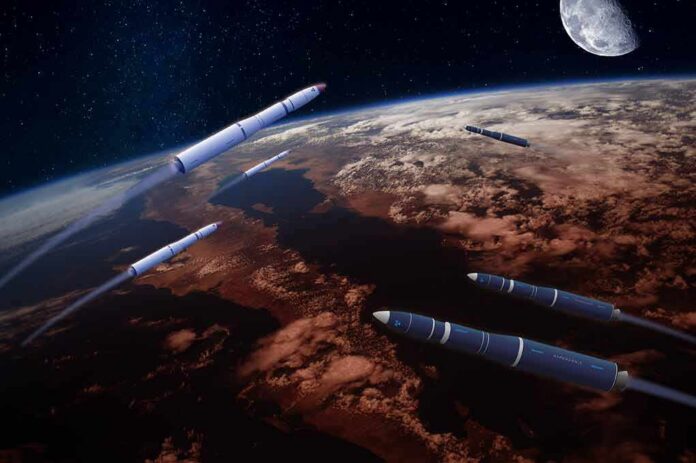
SpaceX’s latest Starship “Flight 13” just proved that American-led private innovation is pushing the frontier of space while Washington debates how to spend your tax dollars on everything but real progress.
Story Snapshot
- SpaceX launched Starship on its 13th test flight from Texas, flying an upgraded Version 3 system with both stages splashing down in the ocean.
- The mission deployed 20 next-generation Starlink V3 satellites on a short suborbital path, a key test for future space-based internet and defense capabilities.
- Flight 13 continued a clear pattern: each Starship test adds new reusability and payload features, moving closer to fully reusable heavy-lift rockets.
- This private progress contrasts sharply with years of bloated government programs and climate crusades that sidelined real engineering and American leadership in space.
Starship Flight 13: What Just Happened Over Texas
SpaceX launched its giant Starship rocket on the 13th test flight from its Starbase site in South Texas, sending the nearly 400-foot-tall system on a suborbital mission that lasted about an hour. The Super Heavy booster lifted the Starship upper stage off Pad 2, then headed for a splashdown in the Gulf of Mexico, while Starship itself continued on a trajectory toward the Indian Ocean for its own controlled splashdown. This flight used the upgraded “Version 3” Starship-Super Heavy stack, only the second time this newest design has flown.
Launch coverage described Flight 13 as one of the most ambitious tests yet, with liftoff during an evening window that opened at 5:45 p.m. Central time at Starbase. Before launch, SpaceX completed a static fire test of all 33 engines on Booster 20, proving the power system needed for the mission. After a scrubbed attempt and a weather delay earlier in the week, the company finally got the vehicle off the pad, reinforcing the message that Flight 13 was about gathering data and checking upgraded hardware under real flight conditions.
Testing Reusability and New Starlink V3 Satellites
SpaceX set clear goals for Flight 13 that go beyond simply getting a rocket off the ground. One major objective was to deploy 20 production Starlink V3 satellites from the Starship upper stage, the first time operational next-generation satellites had flown on this system. These satellites were designed to extend solar arrays, deploy antennas, and attempt laser links with the existing Starlink network, even though the short suborbital path meant they were expected to burn up on reentry about twenty minutes after deployment. The point was to prove the deployment hardware and in-flight behavior, not to keep the satellites in long-term orbit.
On the vehicle side, Flight 13 carried out controlled splashdowns of both the booster and the ship, continuing a series of tests meant to make the huge rocket fully reusable. A previous Version 3 test in May showed a controlled splashdown in the Indian Ocean but a missed booster landing target, and Flight 13 was built to improve on that performance. Each test like this gives SpaceX engineers real-world data on how the rocket behaves from liftoff to reentry, the kind of detailed engineering feedback that big government programs often talk about but rarely deliver on schedule.
A Pattern of Iterative Progress, Not Media Hype
Since 2023, Starship has flown a dozen times before this test, with both successes and failures, by design. Earlier missions focused on reaching orbital speed, testing payload doors, and proving the basic architecture of a huge, reusable rocket, even when some vehicles broke up during reentry or splashed down off-target. SpaceX itself has consistently framed each flight as a step toward “reuse of the entire system,” treating every launch as a data run rather than a media event. Coverage of Flight 11, for example, stressed that all major goals were met before the company moved on to the upgraded Version 3 hardware.
Flight 13 fits that same pattern. Reports called it a test of “an array of onboard capabilities,” including Starlink deployments and controlled splashdowns, not a victory lap. That matters for conservatives who care about results, not slogans. While many legacy outlets still focus on risk and past explosions, the hard facts show steady progress: more engine reliability, better splashdowns, and now real satellite deployment tests that tie directly into America’s future communication and defense needs. This is iterative engineering at work, the opposite of the one-and-done, photo-op style projects that wasted billions under earlier left-leaning administrations.
Why This Matters for American Strength and Sovereignty
SpaceX’s Starship is not just a big rocket for science fiction fans. The system is central to plans to land American astronauts on the moon, expand secure broadband through Starlink, and eventually put large numbers of advanced satellites in orbit, including ones that can process artificial intelligence tasks for defense and commerce. The ability to launch heavy payloads on a reusable American-built system protects our country from depending on foreign rockets or globalist launch partnerships that often come with strings attached.
For years, Washington poured money into climate symbolism, diversity mandates, and overseas projects while letting core engineering programs slip behind. Now, under President Trump’s second-term leadership, the regulatory environment for private spaceflight is far more focused on safety and results instead of woke messaging. SpaceX’s aggressive test schedule, including Flight 13, shows how American companies respond when government steps back from micromanaging and lets innovators compete. For readers worried about national strength, secure borders, and freedom from global tech control, Starship’s progress is a concrete example of the kind of real-world capability that keeps America first in space and beyond.
Sources:
spacex.com, reuters.com, nbcnews.com, npr.org, bbc.com, youtube.com, wired.com, cnn.com, cnbc.com