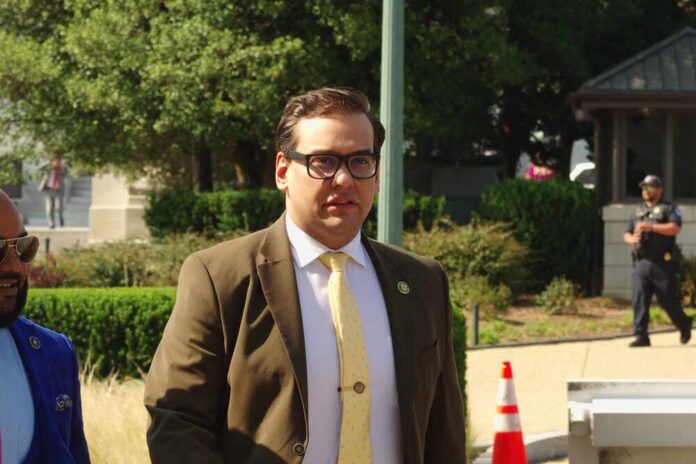
An NPR reporter says George Santos snarled “a gun in your face” during a heated confrontation, igniting another credibility brawl between a disgraced ex-lawmaker and the legacy media [2].
Story Highlights
- NPR-affiliated report alleges George Santos used the phrase “a gun in your face” toward a reporter [2]
- Coverage leans on Santos’ broader pattern of volatility and legal troubles to frame the claim [3]
- The episode reflects a wider media-politics cycle where allegations outpace verifiable evidence [2]
Allegation: Reporter Says Santos Used Violent Phrase
NPR-affiliated coverage claims former Representative George Santos threatened the reporter who broke a separate story about him, allegedly using the phrase “a gun in your face” during a heated exchange [2]. The report presents the encounter as aggressive and volatile, casting Santos as the instigator. The allegation arrived alongside renewed scrutiny into Santos’ activities, amplifying its impact. Because the phrase is serious, the claim demands corroboration beyond headlines. At this stage, the NPR-linked write-up is the central published account [2].
The NPR item packages the reporter’s account as a “violent threat,” using that framing to shape audience perception quickly [2]. The piece arrives as part of continuing media attention around Santos’ controversies, including prior ethics and criminal issues that color how new allegations land with readers [3]. The wording reported is clear and provocative, which explains the headline’s traction. However, clarity of allegation is not proof of occurrence. The strength of this story rests on what evidence exists beyond the reporter’s description [2].
Evidence Gap: No Public Recording Or Transcript
The current public record shows no verified transcript, audio, or video of the confrontation to confirm the exact words attributed to Santos [2]. That gap matters. In high-conflict press encounters, disputed phrasing often becomes the point of contention, and the absence of a recording makes independent verification difficult. Without primary documentation, the story hinges on credibility comparisons rather than hard evidence. Conservative readers should separate the gravity of the phrase from the evidentiary standard needed to substantiate it [2].
Available sources do not provide a direct, on-the-record rebuttal from Santos addressing whether he used the specific phrase “a gun in your face” during the exchange [2]. While Santos has a public history of blasting opponents and threatening retaliatory complaints in other contexts, that pattern does not prove the wording in this instance [1]. Evaluating the claim therefore requires resisting narrative shortcuts—neither assuming guilt based on past behavior nor dismissing a reporter’s account without fair review. The missing primary-source record remains the decisive limitation [2].
Context: Media Framing Meets A Controversial Figure
The Daily Beast and similar outlets have long framed Santos through his expulsion and criminal troubles, which heightens attention to every fresh dispute surrounding him [3]. That background can predispose audiences to accept new allegations quickly. The NPR-linked article situates the confrontation amid ongoing investigative angles into Santos, ensuring the claim travels farther and faster than any evidentiary follow-up might [2]. Speed and framing beat substance when recordings are not available, and that bias shapes public understanding.
I wrote about George Santos. Then he made a violent threat and lied about it – NPR https://t.co/HLIJef24vK
— Sheryl Messenger (@SherylMessenger) June 5, 2026
Conservative readers see a familiar dynamic: institutions amplify sensational allegations while proof lags, and reputations are tried in headlines. The right response is consistent—demand documentation, insist on due process norms, and hold everyone to the same standard. If a threat occurred, law enforcement processes exist. If it did not, a high-profile accusation without corroboration erodes trust. Either way, transparency and evidence—not partisan spin—should settle disputes where speech and public safety intersect [2].
What To Watch Next: Verification, Statements, and Lawful Channels
First, watch for primary evidence—any audio, video, or third-party eyewitness account that can confirm or refute the precise phrase attributed to Santos [2]. Second, look for an explicit, detailed statement from Santos addressing the wording and context of the encounter, rather than broad denials or counterattacks unrelated to the claim [1]. Third, monitor whether a formal complaint is filed, creating a factual record. These steps protect free speech, deter intimidation, and prevent trial-by-headline from substituting for proof.
Sources:
[1] Web – Reporter Says Former GOP Congressman Threatened Him With ‘A Gun in …
[2] YouTube – George Santos threatens to file ethics complaints against …
[3] Web – I wrote about George Santos. Then he made a violent threat and lied …