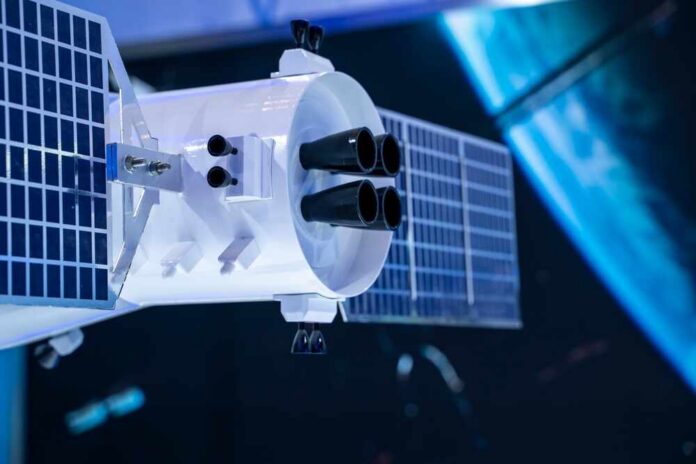
As China sends a fresh crew toward its Tiangong space station, Beijing is turning outer space into another arena where American leadership and security are quietly being challenged.
Story Snapshot
- China is launching the three-person Shenzhou-23 mission to its Tiangong space station for a six‑month rotation, with one astronaut expected to stay a full year in orbit.[2][3]
- The mission showcases growing Chinese military‑civil space capabilities, backed by state media narratives and limited outside transparency.[1][2][3][6]
- Technical details like launch time, crew names, and mission goals are clear, but key documents and independent verification remain sparse.[1][2][3][6]
- For Americans, the flight underscores why a strong, focused United States space program matters for national security and economic strength.
China’s Shenzhou‑23 Crew Heads for Tiangong
China is moving ahead with the Shenzhou‑23 crewed launch to its Tiangong space station, sending three astronauts on a mission expected to last roughly six months in orbit.[2] State media and international outlets report that liftoff is scheduled for 23:08 Beijing time, corresponding to 15:08 Coordinated Universal Time, from the Jiuquan Satellite Launch Center in the Gobi Desert using a Long March 2F rocket.[2] The flight is China’s next regular crew rotation to its permanently occupied space outpost, which has hosted astronauts continuously since 2022.
Multiple outlets describe the Shenzhou‑23 crew as commander Zhu Yangzhu, pilot Zhang Zhiyuan, and payload specialist Lai Ka‑ying, who is expected to become the first astronaut from Hong Kong to fly in space.[2] The China Manned Space Agency publicly confirmed that three astronauts would fly the mission and replace the current Tiangong crew, continuing China’s pattern of relatively short pre‑launch disclosure.[2][3][6] Live video feeds and press conferences have heavily promoted the moment as another milestone in China’s rise as a space power.[3][6]
Mission Profile, One‑Year Stay Plan, and Information Gaps
Shenzhou‑23 is planned as a six‑month stay at Tiangong, but officials and reporting agree that one astronaut is expected to remain aboard for around one year to study long‑duration spaceflight.[1][2] Chinese media also emphasize that the crew will carry out more than one hundred scientific and technology experiments, covering space life sciences, materials, microgravity fluids, medicine, and new technologies, though no public manifest lists them in detail.[3][6] The mission will dock with the Tianhe core module and continue China’s step‑by‑step build‑up of its independent orbital laboratory.[2]
At the same time, the public evidence still leans heavily on state‑linked reporting and live‑updated summaries rather than hard technical documents. Launch timing, crew structure, and basic objectives are consistent across, Chinese press conferences, and international coverage, but independent confirmation of liftoff and orbital insertion is not yet broadly available.[1][2][3][6] Confusingly, some transcripts and articles show mismatched or garbled crew names, highlighting how translation noise and rapid updates can muddy the record even when the core facts are correct.[3][6]
What Tiangong Says About China’s Strategy—and Why Americans Should Care
Tiangong itself is the result of a decades‑long program to field a permanent, crewed Chinese space station in low Earth orbit, with a planned design life of at least ten years and space for three to six astronauts at a time.[3] While Chinese officials stress peaceful scientific goals, the station is run by the China Manned Space Agency and built by the China Aerospace Science and Technology Corporation, both deeply tied into the country’s broader state‑directed industrial and defense system.[3] Every successful crew rotation strengthens Beijing’s technical base, launch cadence, and experience operating a sovereign outpost independent of international partners.
Watch China launch Shenzhou 23 astronauts to its Tiangong space station on May 24 – Space https://t.co/VPfssJy6mk
Follow @NewsHubGlobe for 24/7 breaking news from around the world. pic.twitter.com/8Lg2MX3Yc0
— News Hub (@NewsHubGlobe) May 24, 2026
For American readers, especially those worried about national decline, Shenzhou‑23 is another reminder that China is not slowing down while Washington debates budgets and identity politics. Beijing is pouring resources into rockets, stations, and dual‑use technologies that will matter for communications, surveillance, and future resource extraction, even as United States leaders argue over climate pledges and new bureaucracies. Conservative priorities of strong defense, limited but focused government, and real economic productivity line up with the need to keep American space leadership ahead of authoritarian rivals.
Sources:
[1] Web – China to launch Shenzhou 23 crew to Tiangong space station
[3] YouTube – Live: China’s Shenzhou-23 crewed mission members meet the press
[6] YouTube – Live: Special coverage of press conference on China’s Shenzhou …