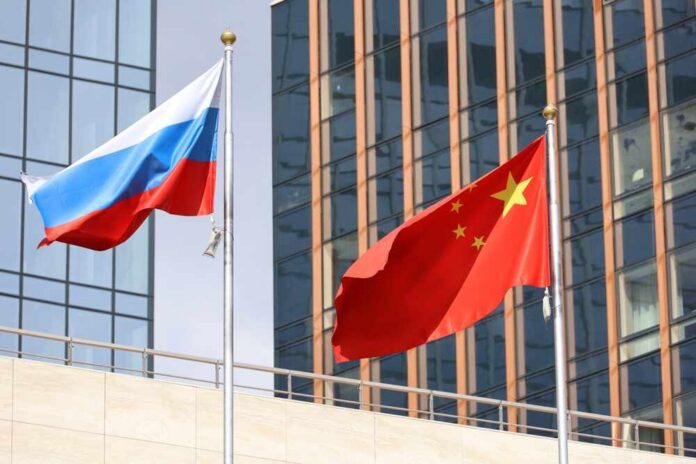
China and Russia’s new “Joint Sea-2026” war game near China’s coast is another clear move to harden a de facto naval alliance aimed at pushing the United States out of key Pacific waters.
Story Snapshot
- China and Russia are running their latest “Joint Sea” naval drill off China’s coast, followed by a Pacific patrol, under the banner of “security threats” and “regional peace.”
- Beijing calls the exercise routine and “not aimed at any other nation,” but locations and timing fit a long pattern of drills near U.S. allies and contested seas.
- U.S. and NATO reports now describe China‑Russia exercises as a growing military partnership meant to counter American power in the Indo‑Pacific.
- Live‑fire drills, air defense, and anti‑ship training make these events rehearsals for real war at sea, not simple “search and rescue” practice.
China’s New Drill: What “Joint Sea‑2026” Really Means
China’s Ministry of National Defense says the “Joint Sea‑2026” naval drill near Qingdao, followed by patrols in the Pacific, is part of an annual plan to “jointly respond to security challenges and safeguard regional peace and stability.” Officials stress that the event is “not directed against any other nations,” repeating language used in earlier years. On paper, the theme is a joint response to maritime security threats, with phases for ship assembly, port planning, and at‑sea operations such as submarine rescue, air defense, and anti‑ship maneuvers. Yet the statement leaves out hard details like the exact size of the forces or specific patrol routes, describing only “relevant areas of the Pacific Ocean.”
Past “Joint Sea” drills show why this vagueness matters. Since 2012, China and Russia have held these exercises every year, moving from China’s coastal waters into the South China Sea, the Sea of Japan, the Baltic Sea, and other sensitive regions. In 2016 and 2024, joint drills took place in the South China Sea itself, a busy trade route and a flashpoint where China disputes territory with U.S. partners. The 2019 edition even circled Japan’s main island through Japanese territorial straits, sending warships close to a key American ally. These choices are not random. Analysts tracking the series say the drills are designed to show power near U.S. friends and contested chokepoints, not just to chase pirates.
From “Routine Exercise” to De Facto Anti‑U.S. Alliance
China insists these are “routine” events meant to deepen a “comprehensive strategic partnership” and improve joint responses to security threats. But U.S. and European research paints a harder picture. A Congressional Research Service report finds Russia and China conducted eleven combined exercises and patrols in 2024 alone, the highest on record, and says both sides use these high‑profile drills mainly to signal the strength of their defense ties. A separate military study notes that since 2012, the main “Joint Sea” series has grown more complex, adding air defense, anti‑submarine warfare, and escort missions, turning exercises into a core tool to institutionalize defense cooperation without a formal alliance. U.S. defense assessments now openly describe this cooperation as a de facto military partnership aimed at countering the United States in the Indo‑Pacific.
Russia’s need for this partnership has only increased since its full‑scale invasion of Ukraine. With Western sanctions biting, Moscow leans on Beijing for economic support and military cover. Analysts say Russia uses these drills to prove it can still project power, including into African and Asian waters, while China uses them to normalize deployments of the People’s Liberation Army Navy far from home ports. The United States Defense Intelligence Agency’s 2026 threat review warns that Russia “relies on China as its key partner in countering the United States in the Indo‑Pacific region” and will “almost certainly” deepen combined patrols and technical cooperation. For American readers, that means each new “Joint Sea” cycle is part of a long‑term plan, not a one‑off stunt: these navies are training together regularly to fight together if the day ever comes.
War‑Fighting Skills Behind the “Peace and Stability” Talk
Even when China labels the drills “defensive” and “peace‑preserving,” the skill sets on display are straight from a modern naval battle plan. Joint Sea‑2025 in the Sea of Japan included submarine rescue, anti‑submarine operations, air defense, missile defense, and broader maritime combat exercises, with Chinese destroyers and Russian ships working as one group. A Russian Defense Ministry release on another exercise detailed joint air defense drills, anti‑submarine training using naval aviation, and at‑sea rescue missions, all with crews from the Pacific Fleet and the Chinese navy. Reuters reporting on “Maritime Cooperation‑2024” confirms live artillery firing and missile training during China‑Russia naval maneuvers off Zhanjiang. These are the building blocks of real war at sea—tracking submarines, shooting down incoming missiles, and coordinating complex fire missions—not simple patrols against smugglers.
At the same time, China and Russia now pair these drills with regular joint patrols across the western and northern Pacific, including the Philippine Sea, another area vital to American and allied forces. Defense officials state that these patrols “do not target any third party,” but U.S. Navy tracking and think‑tank reports show routes that pass near Japan, South Korea, and other partners. Washington’s own analysts warn that combined exercises are “foundational” for deeper security ties because they force partners to share tactics and procedures and build trust. For a Trump‑era America trying to restore military readiness after years of liberal underfunding and globalist distractions, the message is stark: while our politics fought over pronouns and climate slogans, China and Russia spent a decade quietly rehearsing high‑end naval warfare together.
Sources:
feedpress.me, english.aawsat.com, globaltimes.cn, youtube.com, news.cgtn.com, facebook.com, chinarussiareport.substack.com, legis1.com, mwi.westpoint.edu, everycrsreport.com, uscc.gov