Cuba’s communist president is accusing the United States of “genocide” and a plot to seize the island, after President Trump’s tougher sanctions and oil embargo drove the regime’s worst crisis in decades.
Story Snapshot
- Cuban leader Miguel Díaz-Canel claims U.S. sanctions are “political genocide” meant to seize Cuba.
- President Trump’s administration has tightened a long‑running embargo and imposed an oil blockade on the regime.
- Cuba is suffering long blackouts, fuel shortages, and deep economic pain, which Havana blames on Washington.
- U.S. policy frames the pressure as lawful sanctions against a hostile communist government that backs America’s enemies.
Díaz-Canel’s fiery speech and “genocide” charge against the U.S.
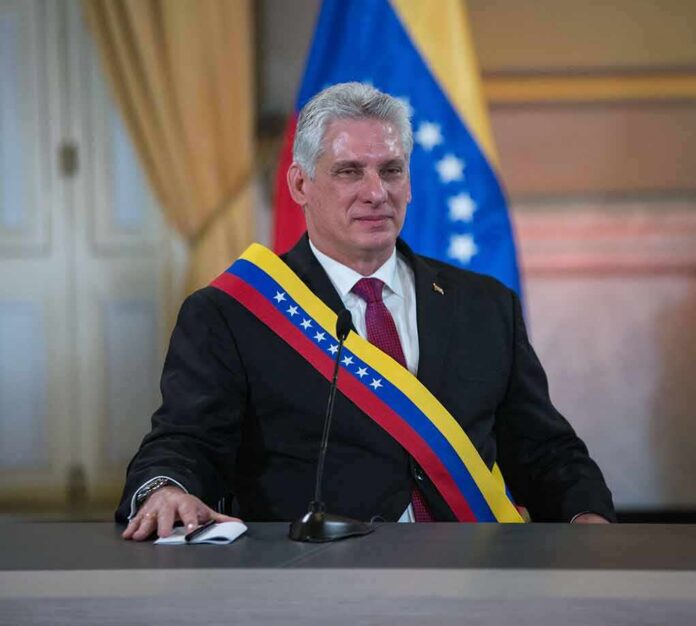
On July 26, Cuba’s president Miguel Díaz‑Canel spoke at a rally marking the start of Fidel Castro’s 1953 revolution and launched one of his harshest attacks yet on the United States. He claimed Washington is carrying out a “cold‑bloodedly calculated genocide” against the Cuban people and said the goal is “to suffocate an entire people in order to appropriate the country.” His comments turned a national holiday into a platform to blame the U.S. for every hardship now hitting the communist island.
Díaz‑Canel tied his accusations to real pain on the ground, pointing straight at President Trump’s oil embargo and expanded sanctions. He described regular power cuts that can last more than twenty hours a day, forcing factories to halt and workers to lose income. He said shortages of water, medicine, and fuel are crushing daily life and argued that these problems are not the result of socialist mismanagement, but of “economic strangulation” by the U.S. government. The embargo, he claimed, is a weapon of war meant to break Cuban society.
Trump’s tougher line: embargo, oil blockade, and new sanctions
The United States has kept an economic embargo on communist Cuba since the early 1960s, originally imposed after the Castro regime seized U.S. businesses and property. Under President Trump’s second term, that long‑running embargo has been tightened with new steps aimed at Cuba’s main sources of cash and fuel. The administration has moved to block oil shipments to the island, including by threatening tariffs and penalties on third countries and companies that try to sell Havana badly needed fuel. This has effectively created what critics and the United Nations call a “fuel blockade.”
Recent sanctions reach beyond energy. New U.S. measures revealed in late July target Cuba’s overseas medical missions, a program that sends doctors abroad and brings home vital foreign currency. Earlier rounds included sanctions on Cuban officials, the main intelligence service, banks, and firms tied to the regime. A Trump executive order on Cuba’s government branded it a security threat and gave legal cover to widen financial and trade pressure. Supporters of this tougher stance argue that a hardened communist state, closely linked to Russia and China, just ninety miles from Florida, cannot be ignored.
Cuba’s claims of a takeover plot versus U.S. regime‑pressure strategy
Díaz‑Canel and other senior Cuban officials now insist Washington is not only trying to weaken their economy, but also preparing to “destroy the constitutional order” and take control of the country by force. They describe sanctions and the oil blockade as “collective punishment” and a “fraudulent case” built to justify future military action. Cuban leaders warn of a “bloodbath” if the U.S. attacks and promise “impregnable” or “unbreakable” resistance, framing the conflict as a fight for national survival against imperial aggression.
U.S. policy documents, however, frame the same moves as sanctions, emergency measures, and embargo enforcement against a hostile regime, not a plan to annex the island. Declassified records and expert analysis show Washington has long used economic pressure to try to push political change in Havana, aiming at “hardship” and “disenchantment” that could lead to the government’s downfall. That is regime‑pressure, not territorial seizure. The Trump administration’s focus on Cuba’s ties to America’s enemies and alleged military capabilities continues that pattern, even as rhetoric on both sides has grown more extreme.
What this means for American conservatives and constitutional values
For U.S. conservatives, Díaz‑Canel’s “genocide” charge is a familiar tactic from a socialist regime that has crushed free speech, private enterprise, and genuine elections for decades. His government wants to shift blame for blackouts and shortages away from failed central planning and corruption, and onto the United States. At the same time, President Trump’s use of sanctions and embargo tools fits a long‑standing conservative belief that America should confront hostile communist states with economic and diplomatic pressure instead of rushing to war or endless foreign aid.
The stakes reach beyond Cuba’s borders. A poorer, desperate regime ninety miles off our coast, backed by Russia and China, raises real security questions for American families. Strong sanctions signal that the U.S. will not reward a government that jails dissidents and helps U.S. adversaries. But they also raise debates at home about how far emergency powers and extraterritorial tariffs should go before they start to look like global economic overreach. For now, Cuba’s leader is shouting “genocide,” while Washington is quietly tightening the screws on a longtime communist foe.
Sources:
insiderpaper.com, aljazeera.com, dw.com, thehindu.com, cnbc.com, cbsnews.com, abcnews.com, youtube.com, bbc.com, usatoday.com, ipe-berlin.org, nsarchive.gwu.edu, revolutionarycommunist.org, wola.org, britannica.com, cfr.org