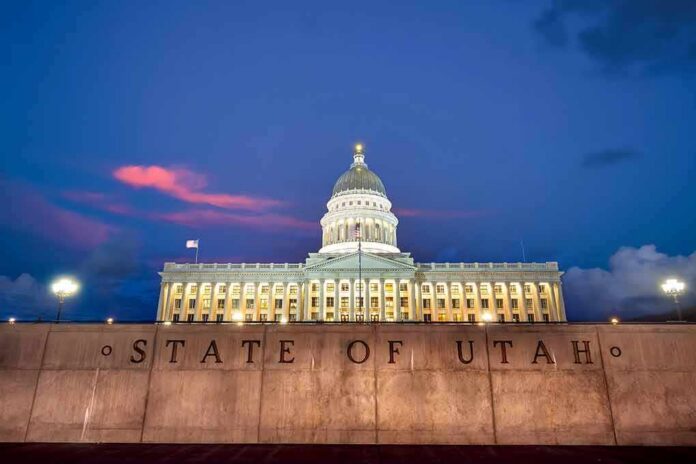
Utah’s emergency fireworks ban shows how fast “public safety” can turn into statewide government control just days before Independence Day.
Story Snapshot
- Utah’s governor declared a state of emergency and banned personal fireworks statewide through July 5 as record wildfires rage.[3][10]
- More than 353 wildfires have burned over 141,000 acres, including the Cottonwood Fire at over 70,000 acres with zero containment.[3]
- Nearly 80% of Utah’s fires this year are human‑caused, and officials blame fireworks along with vehicles, debris burns, and target shooting.[3]
- A fireworks business owner says the order is likely unlawful and “no municipality can enforce this,” vowing to keep selling without limits.[11]
Emergency order brings sweeping fireworks ban and expanded state power
Governor Spencer Cox declared a statewide emergency and ordered a temporary ban on personal fireworks until July 5, citing unprecedented wildfire danger across Utah.[3][10] His executive order lets the state forester block fireworks not only in rural lands, but also in cities and suburbs that previously had more local control.[8] This means families who have safely celebrated the Fourth for years now face a one‑size‑fits‑all rule from Salt Lake City politicians, even if their own town has managed risk responsibly.
Governor Cox defended the ban by pointing to firefighting limits and the sheer number of fires statewide.[10] State leaders say Utah has set aside about $120 million for fire suppression and land repair, while the Federal Emergency Management Agency (FEMA) will cover most suppression costs on federal lands.[3] Even with that money, Cox warned that type one hand crews, which are elite ground teams, are already tied up, leaving no top crews ready if more large fires break out at once during the holiday rush.[3]
Historic wildfire conditions and a rare “particularly dangerous” warning
Utah’s fire season has exploded, with more than 353 wildfires burning over 141,000 acres so far.[3] Two blazes are especially serious: the Cottonwood Fire has burned more than 70,000 acres with zero containment, while the Iron Fire has scorched around 37,000 acres and remains only partly controlled.[3][6] Many of these fires are being pushed by strong winds and bone‑dry fuels, making it easy for even a small spark to race across grasslands, chaparral, or forest before crews can respond.[4][13]
State Forester Jamie Barnes reports that nearly 80% of Utah’s fires this year are human‑caused, tied to common activities like vehicles dragging chains, debris burns, target shooting, and fireworks.[3][4] All 29 counties are under drought, and 22 are in extreme drought, with low snowpack and forecasted winds up to 50 miles per hour and single‑digit humidity.[3][4][13] The National Weather Service issued a rare “particularly dangerous situation” red flag warning, the first ever from its Salt Lake City office, signaling that any ignition could quickly become a life‑threatening blaze.[1][8][12]
Business pushback and questions about legality, enforcement, and liberty
Not everyone accepts the governor’s move. Brian Leahy, a co‑owner of a personal fireworks company, publicly questions whether the executive order is lawful and says lawyers are reviewing it.[11][14] He argues that “no municipality can enforce this,” insisting his company will keep selling fireworks without new limits. That stance highlights a key issue: a ban on use does not automatically stop sales, and local police may struggle to ticket families or visitors in crowded neighborhoods on a busy holiday night.
Leahy and other critics warn that blocking fireworks in neighborhoods may push people to drive into remote desert areas to light them anyway.[11][14] Fires started far from town can be harder to reach and fight, which could make the overall risk worse even as officials claim to be protecting communities. Some lawmakers have also voiced concerns about the order, noting that it temporarily overrides a 2024 law that had restricted the forester’s power to impose bans in urban zones.[8][13] That expansion of emergency authority worries conservatives who have seen “temporary” powers linger after past crises.
Western drought pattern and the balance between safety and freedom
Utah’s emergency fireworks ban fits a broader trend across the West, where governors have used drought and fire conditions to justify sharp limits on ignition sources.[1][5] Since 2000, at least 14 Western states have adopted similar bans in bad years, with three to five states doing so in the worst drought seasons.[1] More Americans now see extreme weather like wildfires and drought as growing threats, but that concern often feeds support for fast government action that can sideline personal responsibility and local choice.[5][16]
JUST IN: Mayor Mark Anderson announced Logan City’s full support for the statewide fireworks ban implemented yesterday by Utah Governor Spencer Cox. Personal fireworks are prohibited July 2–5, but the city's July 3 professional fireworks show will go on as planned. pic.twitter.com/xbct2duxsM
— KSL 5 TV (@KSL5TV) June 26, 2026
At the same time, science is clear that drought and wind do raise fire danger.[12][15][17] Dry soils and plants become easier to ignite, and once a fire starts, strong gusts can drive it for miles.[12][15] The real policy question is not whether fire risk is serious, but how far state leaders should go in limiting everyday traditions like Fourth of July fireworks. Many conservatives agree we must protect lives and property, but they also expect government to use targeted rules, clear evidence, and respect for local control rather than broad bans that fall hardest on law‑abiding families and small businesses.
Sources:
[1] Web – Utah declares state of emergency — and restricts fireworks as US …
[3] Web – Utah governor restricts fireworks as largest U.S. wildfire surges …
[4] Web – Utah governor restricts fireworks as largest US wildfire surges …
[5] Web – Utah Governor Restricts Fireworks as Largest US Wildfire Surges …
[6] Web – Utah declares a state of emergency and restricts fireworks as US …
[8] Web – Utah declares state of emergency, restricts fireworks as US largest …
[10] Web – Utah restricts fireworks, declares state of emergency as largest US …
[11] Web – Utah restricts fireworks, declares state of emergency as largest US …
[12] Web – Utah governor declares state of emergency banning fireworks for …
[13] Web – Drought and Wildfire Management Impacts – Drought.gov
[14] Web – Current Map | U.S. Drought Monitor
[15] Web – Heat, wind and drought conditions spark wildfires in US West
[16] Web – Droughts and Wildfires in Western U.S. Rangelands – ScienceDirect
[17] Web – From wildfires to drought, Mountain West states share U.S. concerns …