Hakeem Jeffries is turning up the heat on MAGA, and his latest speech has set off another fight over political language, extremism, and who is really stoking division.
Quick Take
- Jeffries called MAGA Republicans “extremists” in a recent speech and backed that label with sharp attacks on Trump’s agenda.[1]
- Conservative outlets blasted his language as a dangerous escalation, not normal political debate.[2]
- Jeffries also used other public appearances to attack Trump’s economy, immigration policy, and national security record.[1][3]
- Supporters of MAGA reject the “extremist” label and say the movement reflects mainstream conservative voters.[10][11]
Jeffries Escalates His Attack on MAGA
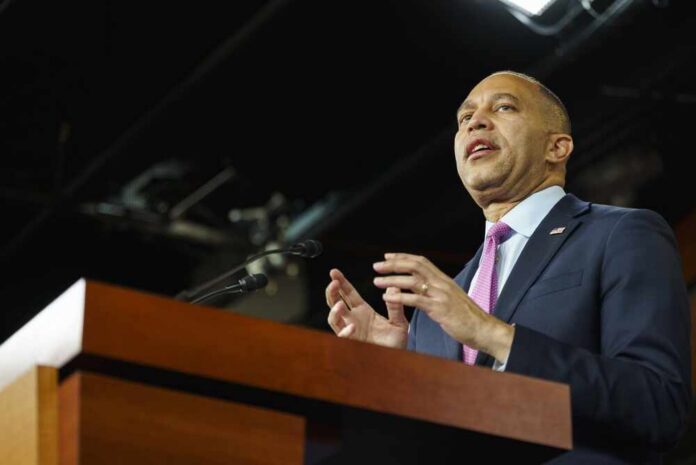
Jeffries used a House speech to frame MAGA Republicans as a threat to the country, not just a political rival.[1] He told lawmakers that Republicans were pushing extremist politics while he presented Democrats as the party of restraint. That message matters because it turns a policy fight into a moral fight. It also raises the temperature in a country already worn down by years of partisan hostility.
Jeffries has repeated that line in other public appearances this month, including remarks aimed at Trump’s economy, immigration agenda, and foreign policy.[1][3] In those settings, he described Trump-era decisions as costly and reckless, and he accused Republicans of putting ideology ahead of results. He also argued that Democrats must respond forcefully. For conservatives, the larger issue is simple: this kind of rhetoric treats millions of voters as a problem to be crushed, not citizens to be persuaded.
Why Conservatives See a Double Standard
Jeffries’ critics say the word “extremist” has become a political weapon, not a careful label. Fox News highlighted his “break the spirit” language and cast it as a violent-sounding attack on ordinary Americans who support Trump.[2] That reaction is easy to understand. In a free republic, elected leaders should debate ideas, not speak as if they are trying to demoralize half the country. Conservatives see that as part of a wider left-wing habit of demonizing dissent.
At the same time, the research package does not prove that Jeffries’ label is always false. Some studies cited in the background materials link approval of extreme right-wing groups with support for political violence.[20] Other research says extremist ideas spread faster through social media and partisan echo chambers.[21][22] But those findings do not prove that every MAGA voter fits that description. The gap between a serious warning and a sweeping political insult remains the core dispute.
MAGA Supporters Push Back on the “Extremist” Label
Counter-research in the package describes MAGA as a broad Republican movement tied to the American dream, economic strength, and traditional values.[10][14] One source says a large share of Republicans now identify with MAGA, which argues against the idea that it is some fringe faction.[10] Another study says many supporters see the movement as a way to recover honor, respect, and status, not as a call for chaos.[11] That distinction matters to voters who back Trump for results, not rage.
The deeper problem is that both sides now speak in totalizing language. Democrats call MAGA “extreme.” Republicans call Democrats “socialists,” “communists,” or worse. The result is a politics of total suspicion, where each side assumes the other means harm. For readers who want secure borders, lower costs, and a stable country, the spectacle is exhausting. The real test is whether leaders still know how to argue without treating their opponents like enemies of the nation.
Sources:
[1] Web – Hakeem Jeffries Calls Trump and MAGA ‘Extremists’ As Democrats Welcome …
[2] Web – Hakeem Jeffries says Dems need to ‘break’ MAGA’s spirit – Fox News
[3] Web – House Minority Leader Hakeem Jeffries (D-NY) on … – Instagram
[10] Web – MAGA movement | Meaning, Beliefs, Origins, Donald Trump, & Facts
[11] Web – The Symbolic Politics of Status in the MAGA Movement
[14] Web – What MAGA means to Americans – The Conversation
[20] Web – Approval of extreme right-wing organizations and social movements …
[21] Web – Social Media and Political Extremism | VCU HSEP
[22] Web – How Misinformation and Disinformation Fuel Online Radicalization