Sen. Chris Murphy took his anti-Trump message to Europe—warning foreign activists that America is sliding into “totalitarian takeover”—and the move is reigniting a familiar question at home: who is Washington really trying to persuade?
Quick Take
- Sen. Chris Murphy (D-CT) delivered a speech in Barcelona on April 18, 2026, accusing President Trump of an ongoing “totalitarian takeover” and “oligarchic capture” of U.S. institutions.
- Murphy’s Barcelona remarks closely track arguments he made in an October 2025 Senate floor speech describing a five-step plan he says Republicans are following.
- Supporters of Trump see Murphy’s overseas rhetoric as partisan internationalizing of U.S. politics; Murphy frames it as a pro-democracy warning with global stakes.
- Key allegations Murphy cites—about law enforcement, media pressure, federal spending leverage, and election rules—remain politically contested, with limited independent verification in the provided record.
Murphy’s Barcelona speech exports a U.S. political fight
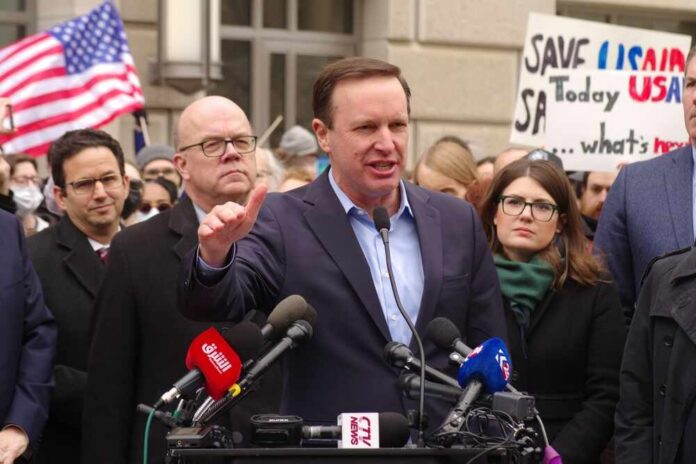
Sen. Chris Murphy spoke at the Global Progressive Mobilisation Summit in Barcelona on April 18, 2026, telling an international audience that the United States is in the middle of a “totalitarian takeover” and what he called “oligarchic capture” of core institutions. Murphy argued the alleged threat extends across courts, law enforcement, media, and elections, and he urged progressive coordination beyond U.S. borders. The speech stands out because it places American partisan conflict into a global political campaign.
For many conservatives, the overseas venue is itself the point: when a sitting U.S. senator warns foreign activists about his own country’s leadership, it can look less like oversight and more like seeking outside pressure against a democratically elected administration. For many liberals, the setting reinforces Murphy’s framing that democratic backsliding is an international pattern requiring international solidarity. Either way, the Barcelona appearance signals that the battle lines are not just domestic—and that messaging is aimed at more than American voters.
The “five-step” narrative traces back to Murphy’s 2025 Senate warning
Murphy’s Barcelona message builds on an October 8, 2025, Senate floor speech in which he laid out what he described as a step-by-step blueprint for authoritarian control. In that earlier speech and related materials, Murphy cited themes including politicization of the justice system, pressure on media, a more militarized approach to law enforcement, using federal spending as leverage over opponents, and efforts to shape election outcomes. The core storyline has stayed consistent, suggesting a deliberate effort to keep Democrats unified around a single frame.
The difficulty is trying to separate rhetoric from reality is that much of this argument depends on interpreting intent and connecting multiple events into one coordinated plan. The research provided shows Murphy’s claims repeated across his own official communications and coverage, but it does not include a detailed, independent evidentiary record adjudicating each allegation. That leaves Americans with the same trust problem that drives today’s politics: many citizens assume elites spin narratives to keep power, while everyday families absorb the costs of dysfunction.
Concrete examples Murphy cites—and what can be verified from the record here
Murphy and related reporting point to specific episodes as evidence, including the indictment of former FBI Director James Comey, alleged regulatory pressure affecting a late-night TV program, a claim that New York Mayor Eric Adams received favorable treatment in exchange for loyalty, and federal grant cancellations targeting Democratic-led states. He also referenced National Guard deployments to states such as Illinois, Oregon, and California over objections from governors. Within this dataset, those examples are presented largely through Murphy’s descriptions rather than outside documentation.
That limitation matters because Americans across the political spectrum increasingly believe government is failing them—often because leaders appear to use institutions as weapons instead of tools for public service. Conservatives are especially sensitive to narratives that normalize federal pressure on speech, political opponents, or state authority, because those are classic pathways to bigger government and weaker individual liberty. Liberals, meanwhile, hear the same examples as proof that power is being centralized and used against dissent. The shared concern is institutional trust, even when the diagnoses differ.
Why the overseas pitch lands differently in a second Trump term
Trump’s second term, with Republicans controlling both chambers of Congress, has intensified Democratic incentives to fight in the court of public opinion—and, as Barcelona shows, in international forums. Murphy’s critics call the language hyperbolic and insulting; Murphy insists the threat is historic and urgent. What is clear from the available sources is that Murphy is attempting to define the entire era in one phrase—“totalitarian takeover”—and to recruit allies for that framing. That approach can mobilize supporters, but it can also harden polarization and deepen cynicism.
Repugnant Liar Sen. Chris Murphy (D-Bag) Went Overseas to Blast Trump's 'Totalitarian Takeover' https://t.co/MPyShBLRL4
— Joe (@JoeC1776) April 19, 2026
The bigger takeaway is not whether partisan labels are thrown around—Americans are used to that—but how quickly U.S. politics now resembles an ongoing legitimacy battle, with each side arguing the other is corrupt, captured, or lawless. For conservatives who already feel Washington is dominated by careerists and bureaucracies, Murphy’s international messaging may look like another example of elites prioritizing power struggles over inflation, border security, energy prices, and everyday stability. For liberals, it reads as alarm over civil liberties and fair competition. The country remains stuck with a system that struggles to deliver confidence, even when it delivers wins.
Sources:
Murphy: Trump authoritarian takeover of government
Murphy: Trump’s “authoritarian takeover isn’t coming — it’s here”