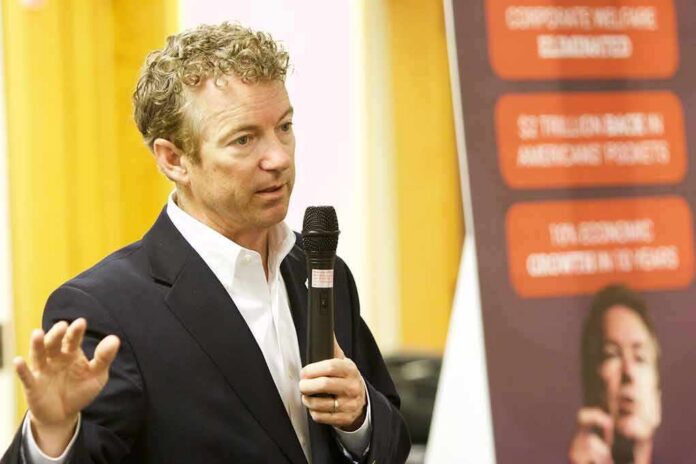
Senator Rand Paul is warning that President Trump’s Iran war is leaving America weaker, poorer, and less free — and that Congress let it happen without doing its job.
Story Snapshot
- Rand Paul says the Iran war has made the United States “worse off” and “not good for America.”
- He argues the Constitution was ignored because Congress never voted to authorize the conflict.
- He is the lone Republican backing measures to limit Trump’s war powers on Iran.
- Paul warns the war is driving up gas prices, debt, and could even cost Republicans future elections.
Paul Says Iran War Leaves America ‘Worse Off’
Senator Rand Paul of Kentucky has become the loudest Republican voice against President Donald Trump’s war in Iran, and his message is blunt: America is losing ground. On CNN, Paul said, “I think, by any objective measure, we’re worse off than we were before the war,” calling the campaign “not a success” and stressing he has opposed it “from the beginning.” In interviews, he adds that the conflict is “not good for America” and should never have started in the first place.
Paul ties his criticism to real costs that ordinary families feel. He warns that the fighting in Iran is pushing gas prices higher at a time when inflation is already squeezing household budgets, saying the war will hit Americans “even harder at the pump” as prices climb past earlier highs. He also points to rising national debt and new Pentagon requests for tens of billions more for the Iran operation, calling that kind of extra war spending “fiscally irresponsible” when the country is already deeply in the red.
Constitutional Clash Over War Powers
Beyond money and security, Paul’s sharpest concern is constitutional. He argues that the United States went to war with Iran without the clear vote the Constitution demands. He says presidents are not supposed to “bomb countries just when they feel like it” and must first seek permission from the people through their representatives in Congress. Paul notes there was no full public debate or formal declaration of war before troops deployed, and he calls that a violation of the separation of powers that protects American freedom.
This fight over war powers is not new, but Paul has taken an unusually firm stand inside his own party. He was the only Republican senator to support a resolution aimed at limiting President Trump’s ability to continue military action against Iran without congressional approval. After that measure failed, he blasted his colleagues, saying “this Congress should be ashamed of how it has allowed this unilateral march to war,” and warning that once combat begins, it becomes “very hard” for lawmakers to claw back authority they gave up.
A Rare Republican Voice for Restraint
Paul’s opposition fits his long record as a constitutional conservative who favors a smaller federal government and less foreign intervention. He often warns that endless wars in the Middle East weaken the United States instead of making it stronger, pointing to past conflicts in Iraq and Afghanistan as costly mistakes that did little to improve American security. He argues war should always be a last resort, used only after other options fail, and that launching what he calls “wars of choice” is reckless with both lives and liberty.
Rand Paul slams Pete Hegseth for asking for $1.5 trillion.
"We currently spend a trillion. He wants $1.5 T. That's $500B increase. The biggest threat we have right now is our debt. We are more in danger of devaluing our currency than Iran invading the United States."
"The… pic.twitter.com/mzUFLcVjhC
— Reggie B. (@reggiebblue) July 22, 2026
That stance puts Paul at odds with many Republicans who back Trump’s harder line on Iran, but he insists his objections are rooted in core conservative values. He stresses that the primary job of the federal government is national defense, not nation-building abroad, and says the greatest security threat now is towering debt and a government that ignores constitutional limits. For right-leaning voters frustrated by years of bloated spending, foreign entanglements, and executive overreach, Paul’s warnings about the Iran war highlight a risk that goes beyond one battlefield: a slow erosion of the checks and balances that keep Washington in its place.
Sources:
thehill.com, huffpost.com, time.com, newsweek.com, youtube.com, newsbreak.com, thedailybeast.com, cbsnews.com, wsj.com, coloradopolitics.com, politico.com