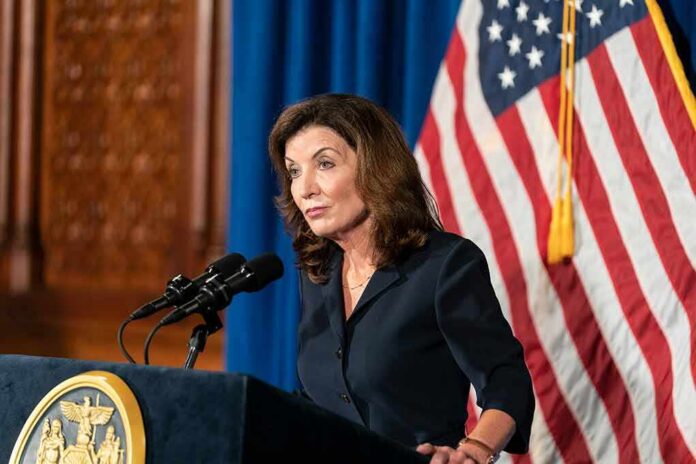
A federal judge has just blocked New York’s attempt to unmask federal immigration agents, delivering a sharp rebuke to Governor Kathy Hochul’s latest anti-enforcement push.
Story Snapshot
- A federal judge halted New York’s ban on masks and ID rules for federal immigration agents.
- The court said New York likely violated the U.S. Constitution by trying to control federal officers.
- The ruling is a win for President Trump’s Justice Department, which sued to protect officer safety and federal authority.
- New York can still block local police from signing cooperation agreements with immigration authorities.
Judge Says New York Has ‘No Authority’ Over Federal Agents
U.S. District Judge Mae D’Agostino, sitting in Albany, issued a preliminary injunction blocking New York’s new law that banned federal immigration agents from wearing masks and required them to show individual identification while on duty. In a 51-page ruling, she found that the state is likely violating the Supremacy Clause of the U.S. Constitution, which makes federal law and federal operations supreme over state rules. The judge wrote that New York cannot impose its own “uniform requirements” on federal agents just because it disagrees with federal immigration policy.
The ruling came after President Trump’s Department of Justice sued New York, arguing the mask and ID rules were unconstitutional and dangerous for officers enforcing federal immigration law. Court filings show the Department of Justice said New York has no more right to tell federal agents what face coverings or gear to use than to demand that they “wear pink.” Judge D’Agostino agreed that forcing agents to uncover their faces and display unique identifiers could chill federal law enforcement by exposing them to extra risk.
What Hochul’s Law Tried To Do
Governor Kathy Hochul signed the mask ban and related measures as part of a broader immigration package earlier this year. The state law required “all law enforcement agents working in New York—regardless of whether they are local, state, or federal officers”—to keep their faces visible and wear clear identification when dealing with the public, with only narrow exceptions. Hochul publicly argued that masked immigration operations were a “fear tactic” and said she wanted to stop federal agents from “disguising themselves” while carrying out arrests. Supporters framed the package as a transparency and civil rights measure in response to past incidents involving masked agents.
The same New York law also attacked cooperation between local police and immigration authorities. It barred formal “287(g)” agreements in which county sheriffs and local departments help enforce federal immigration law inside jails and communities. Under the statute, counties must dissolve any existing 287(g) agreements by late August. Hochul and Attorney General Letitia James said this would keep “local law enforcement focused on local matters” and stop New York taxpayers from paying for federal immigration work. That part of the law remains in force despite the judge’s ruling on masks and identification.
Court Backs Federal Power, Warns Of Safety Risks
Judge D’Agostino’s decision tracked a growing line of cases across the country. Federal courts in Virginia and California have already blocked similar state laws that tried to ban masks or control identification for immigration agents. In the New York case, D’Agostino said “the individual choices of some federal officers” to wear masks do not give states an opening to directly regulate federal law enforcement operations. She warned that New York’s mask ban could interfere with officer safety and have a “chilling effect” on enforcing federal law.
𝐅𝐄𝐃𝐄𝐑𝐀𝐋 𝐉𝐔𝐃𝐆𝐄 𝐁𝐋𝐎𝐂𝐊𝐒 𝐇𝐎𝐂𝐇𝐔𝐋'𝐒 𝐀𝐍𝐓𝐈-𝐈𝐂𝐄 𝐌𝐀𝐒𝐊 𝐁𝐀𝐍 — 𝐂𝐈𝐓𝐄𝐒 𝐓𝐇𝐄 𝐒𝐀𝐌𝐄 𝐂𝐎𝐍𝐒𝐓𝐈𝐓𝐔𝐓𝐈𝐎𝐍𝐀𝐋 𝐂𝐋𝐀𝐔𝐒𝐄 𝐓𝐇𝐀𝐓 𝐒𝐀𝐍𝐊 𝐕𝐈𝐑𝐆𝐈𝐍𝐈𝐀'𝐒 𝐕𝐄𝐑𝐒𝐈𝐎𝐍
New York's 𝐅𝐚𝐜𝐞 𝐂𝐨𝐯𝐞𝐫𝐢𝐧𝐠 𝐚𝐧𝐝… pic.twitter.com/9P3efJ1O6X
— M.A. Rothman (@MichaelARothman) August 3, 2026
The ruling is a clear win for the Justice Department under President Trump, which has pushed back hard on blue-state efforts to undercut federal immigration enforcement. At the same time, the judge declined to block New York’s ban on 287(g) cooperation agreements, saying the state has a legitimate interest in deciding how to use its own resources and local officers. That split outcome means federal agents keep control over their own gear and identification, but they will get less formal help from New York police and sheriffs going forward.
What It Means For Immigration Enforcement And State Power
This fight fits a larger pattern where progressive state leaders try to limit how federal immigration officers operate inside their borders, and the federal government answers by pointing to the Supremacy Clause and long-standing immunity for federal operations. California, Virginia, and now New York have all tested how far they can go in forcing federal officers to uncover their faces or change how they identify themselves. So far, judges have mostly sided with federal authority when states try to control masks and ID, while sometimes allowing state limits on local cooperation to stand.
For conservative readers, the stakes are clear. New York’s law would have made it easier for activist groups to track, target, and pressure individual immigration agents by name and face as they carry out lawful arrests, which raises real safety and privacy concerns for officers and their families. The preliminary injunction is not the final word, but it signals that courts are ready to push back when states try to micromanage federal law enforcement tools and tactics instead of focusing on crime in their own communities.
Sources:
redstate.com, reuters.com, spectrumlocalnews.com, nytimes.com, politicsny.com, cbsnews.com, youtube.com, news10.com, governor.ny.gov, politico.com, wamc.org, syracuse.com, news.meaww.com