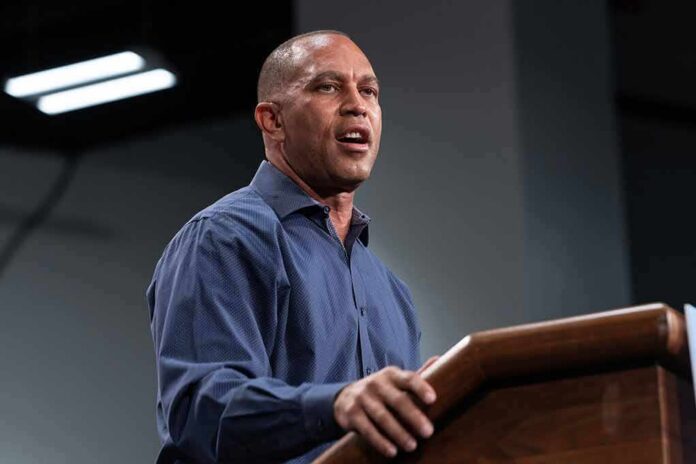
House Democrats signaled they will prioritize a sweeping status plan for undocumented immigrants, reviving an amnesty fight conservatives have warned about for years.
Story Highlights
- Hakeem Jeffries pledged early action on the American Dream and Promise Act in the next Congress.
- The bill creates a path from conditional status to green cards for DACA, Temporary Protected Status, and other groups.
- Opponents say the plan amounts to amnesty for more than 4.4 million and risks blocking enforcement.
- A discharge petition was reportedly one Republican signature short of forcing a House vote.
Jeffries’ Pledge Sets Immigration Showdown
House Democratic Leader Hakeem Jeffries said Democrats will move the American Dream and Promise Act early in the next Congress, framing it as a way to restore protections for Deferred Action for Childhood Arrivals and Temporary Protected Status recipients. He made the commitment after signaling immigration would be a priority if his party controls the floor. His public statements point to a clear first step and a defined target group, setting the stage for a major fight over border and interior enforcement.
Reporting around the House shows a procedural path is already in motion. A discharge petition led by Representative Sylvia Garcia was described as one Republican signature short of forcing a vote. Jeffries said Democrats would act early even if the petition fell short, keeping pressure on moderates and Republicans from swing districts. That route could bring a floor vote without the usual scheduling power of the majority leadership.
What the Bill Does and Who It Covers
The American Dream and Promise Act of 2025 sets eligibility rules instead of blanket legalization. It requires arrival as a minor, continuous presence since January 1, 2021, a background check, and education or related milestones. It offers conditional permanent residence for up to ten years and a later path to lawful permanent residence for those who meet added requirements within a set window. It also covers qualified holders of Temporary Protected Status and Deferred Enforced Departure under specific categories.
Earlier versions share the same basic structure. The 2023 and 2021 texts outline staged status, screening, and time limits. The 2021 bill also restricted disclosure of applicant information for immigration enforcement, which proponents framed as a safeguard for applicants during screening. Supporters argue that these limits help honest applicants come forward, while keeping dangerous criminals out through explicit exclusions stated in hearing records and bill text history.
The Scale Fight: Amnesty Claims and Enforcement Risks
Opponents argue the plan is far broader than a narrow DACA fix. The Senate hearing record for the 2021 version cited testimony that the approach could create a pathway to citizenship for more than 4.4 million people nationwide, raising workload and capacity questions for United States Citizenship and Immigration Services and even federal courts. Skeptics warn that a status promise on this scale would pull resources from enforcement and screenings.
Rep. Hakeem Jeffries (D-NY) said in a press conference that as soon as Democrats take control of Congress they will move to vote for the Dream and Promise Act to give amnesty to DACA and TPS migrants. pic.twitter.com/qRmCCM0JP5
— CRAZY_BITCH_FROM_THA_MEGA_MAGA_SLAPAHOE_TRIBE 𖧶🪓 (@TRUMPGIRL_STL) November 19, 2026
An advocacy analysis of the 2025 bill labels it amnesty and says it would also chill interior enforcement for millions who appear eligible on its face. That view argues the bill’s protections, combined with staged status, would slow removals and invite fraud if screening is not airtight. Backers do not dispute that the bill leads to permanent status for many; they answer that standards remain strict and exclude criminals. That factual divide over scale and enforcement drives today’s messaging battle.
Open Questions: Cost, Capacity, and Administration
Key implementation details remain unclear in public materials. There is no current Congressional Budget Office score for the 2025 bill. There is no published government plan that explains screening steps, fraud controls, staffing, or timelines for adjudication. Without those details, cost, capacity, and error risks are unknowns that matter for taxpayers, communities, and the rule of law. That information gap gives critics room to define the likely price tag and workload burden.
President Trump’s administration continues to press for border security, faster removals for criminal offenders, and strict interior enforcement. If Democrats force a vote, the administration and House conservatives will likely demand verifiable screening, tighter dates, strong fraud checks, and clear triggers to stop abuse. Conservatives will also seek hard budget numbers before any floor action. Until those facts are on the table, the bill will read to many as legalization first and enforcement later.
Bottom Line for Constitutional Conservatives
Jeffries’ promise turns a long-running debate into an immediate test of priorities. The bill’s supporters say it is earned legalization with defined rules. Its critics say it is amnesty that could cover millions, strain agencies, and weaken enforcement at a time of high costs and security concerns. The next steps will show whether Democrats back a measured plan with real guardrails, or a broad status push that risks inviting more illegal entry and shifting costs onto American families.
Sources:
redstate.com, congress.gov, jeffries.house.gov