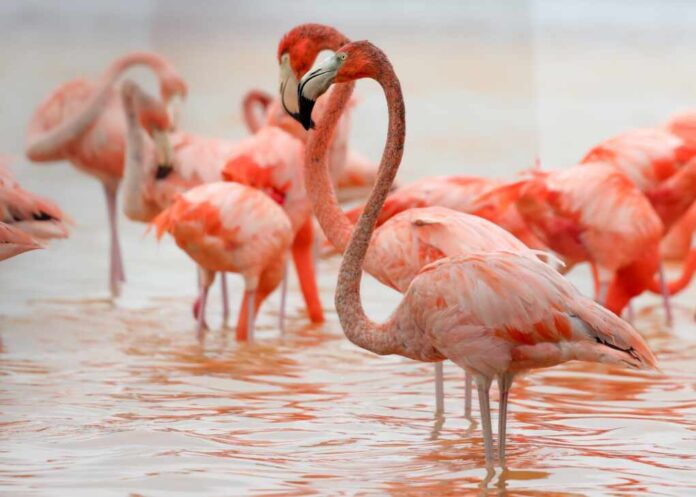
Migratory flamingos age more slowly than resident ones, a finding that challenges the notion of aging as a fixed biological process.
At a Glance
- Migratory flamingos age 40% more slowly than resident flamingos.
- Data spans 44 years from the Camargue region in France.
- Aging rates can be altered by behavior and environment.
- Lifestyle choices may shape longevity in other species.
Flamingos Rewrite the Rules of Aging
A study in Proceedings of the National Academy of Sciences tracked nearly 2,000 flamingos from 1977 to 2021. Researchers discovered that migration delays both the onset and pace of aging.
Resident flamingos thrived early with higher reproduction and survival rates but paid with faster senescence. Migratory flamingos traded early gains for longer life.
Watch now: Can Flamingos Outsmart Aging?
The work challenges the assumption that aging speed is locked into DNA. Migration appears to bend the biological clock, offering a natural experiment in longevity.
The Evolutionary Trade-Offs at Play
The findings highlight a trade-off: early-life reproduction versus late-life survival. Resident birds invest fast and burn out sooner. Migrants sacrifice quick gains but reap longevity.
This balance echoes across biology. Evolution shapes whether species favor short-term fertility or long-term survival. Flamingos show that behavior can tip the scale.
The study shows aging is not uniform across populations. Instead, lifestyle choices push the pace up or down. That variability reframes how scientists view senescence.
Lessons Beyond the Wetlands
The research suggests aging is not rigid but plastic, open to change from environment and behavior. This idea may extend beyond birds.
For humans, the study hints that lifestyle factors can modulate how fast we age. Choices about stress, movement, and environment may matter as much as genes.
Biologists see parallels to medical science. Understanding how migration slows aging could inspire new approaches to human longevity. The bridge between ecology and medicine grows stronger.
A Roadmap for Future Research
Long-term data made the discovery possible. The 44-year dataset is rare, showing the value of patient fieldwork. Without it, the patterns would remain hidden.
Experts see fresh research avenues. Could other migratory species show similar aging delays? Could controlled experiments test lifestyle impacts on senescence?
For conservation, the findings matter too. Protecting migratory pathways may secure not only populations but also their age structures. Migration sustains more than movement; it sustains life span.
Sources
The Guardian
BBC News
Scientific American