

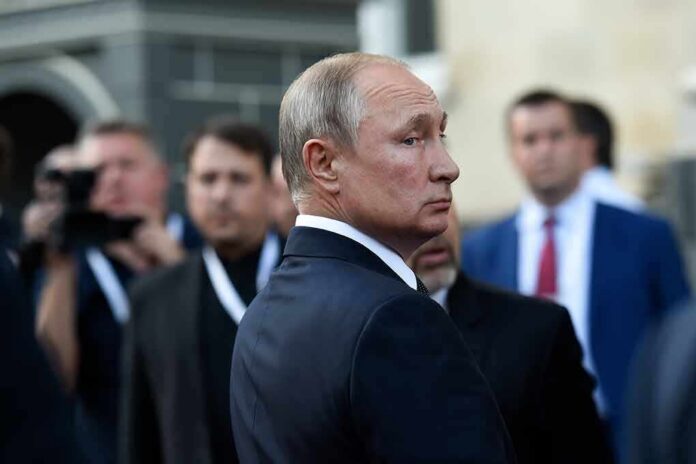
President Trump said Vladimir Putin can attend the U.S. G20 summit if he wants, setting up a high-stakes test of engagement versus isolation.
Story Snapshot
- Trump said Putin “certainly can” come to the Miami G20, while noting pushback is likely.
- Russia once sat with major powers in the G8 until a 2014 suspension over Ukraine.
- Bipartisan lawmakers urged Trump to rescind the opening to Putin before the summit.
- Trump framed inclusion as a way to talk, not a reward; Putin’s attendance remains uncertain.
Trump Opens the Door to Putin at the Miami G20
President Trump told reporters that Vladimir Putin “certainly can” attend next month’s Group of 20 summit in Miami, if the Russian leader chooses to come. Trump acknowledged that “some people wouldn’t like that,” but said keeping top rivals in the room can create paths to direct talks. The remark did not include a set agenda or confirmed bilateral meeting. Reporting described the comment as an on-the-record, contemporaneous statement from the President at an availability on November 27, 2026.
Trump’s stance comes as lawmakers press for the opposite path. Members of both parties urged the White House to pull the welcome. A House letter led by Representative Pat Ryan argued the invitation should be withdrawn. The letter, signed by a bipartisan group, framed Putin’s attendance as wrong during war and asked Trump to reverse course. The White House has not announced any change to the summit plan based on those letters as of press time.
What 2014 Taught the West About Seats at the Table
Western leaders suspended Russia from the Group of Eight in 2014 after Moscow’s actions in Ukraine. A joint statement by Canada, France, Germany, Italy, Japan, the United Kingdom, and the United States said they would halt G8 preparations. The statement tied the step to Ukraine’s sovereignty and called for conditions that allow “meaningful discussion” before resuming normal engagement. That record remains a key talking point for critics of renewed summit-level inclusion.
Supporters of engagement argue that hard topics demand face-to-face channels, even with adversaries. They say summit access is not a trophy, but a tool. The 2014 document actually used the language of “meaningful discussion” as a test, which cuts both ways: if the forum can drive talks that reduce risk or save lives, the seat has value; if it only offers optics, then it is not worth the cost. That is the line the administration must prove in Miami.
Congressional Pushback and the Limits of Symbolic Politics
Senators from both parties pressed the administration to bar Putin and any sanctioned Russian officials from U.S.-hosted G20 events. Their statement said Putin bears responsibility for the full-scale war and warned that presence on American soil could “normalize” Moscow’s conduct. The senators requested restrictions that would keep Putin out of the meetings entirely. Their argument centers on moral clarity and deterrence rather than dialogue and leverage.
House critics echoed that theme. They told Trump the invitation would embolden Russia and betray American service members. They called for talks with Russia only to end the war, not as part of routine economic discussions. Their case focuses on message discipline: deny Moscow the stage until its behavior changes. That approach aims to raise costs, but it may shrink channels for direct pressure or time-sensitive deals at a global forum with all major powers present.
What Conservatives Should Watch For at the Summit
The core question for readers is simple: does a seat at the G20 help America get results, or only give cover to a rival? Trump’s public line welcomes attendance but does not promise concessions. Any misuse of the summit to push anti-American narratives should be called out and blocked. Any effort that reduces battlefield deaths, secures hostages, stabilizes energy flows, or defends U.S. workers would show tangible upside from engagement without surrendering principle.
Donald Trump has said Vladimir Putin is welcome to attend the G20 summit in Florida next month despite urging him to stop his aggression against Europe during their recent talks in China. pic.twitter.com/qrXJEVl0Iq
— The Independent (@Independent) November 27, 2026
Practical guardrails matter. The administration can insist on strict security vetting, clear meeting rules, and a firm agenda centered on de-escalation, energy stability, and food security. It can also keep sanctions pressure intact while talks proceed. The history from 2014 explains why leaders walked away from the G8. The task now is to prove that controlled contact at the G20 serves U.S. interests, upholds sovereignty, and advances peace without rewarding aggression.
Sources:
kyivpost.com, timesofindia.indiatimes.com, news.liga.net, patryan.house.gov