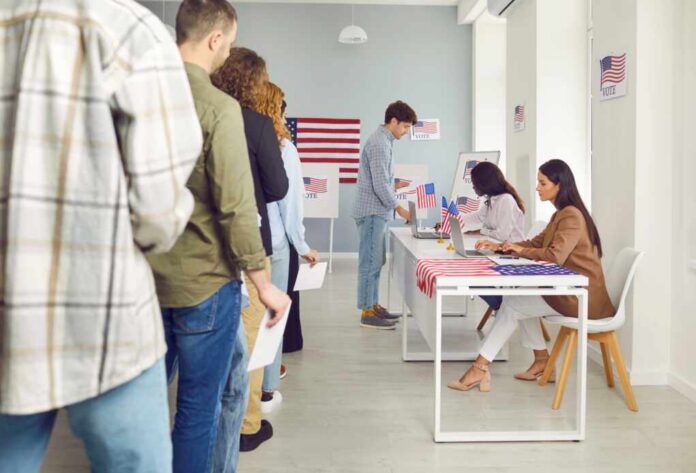
House Republicans are pushing forward with a nationwide voter ID bill that would require documentary proof of citizenship for federal voter registration, setting up a major election integrity showdown just months before the 2026 midterms.
Story Snapshot
- House Rules Committee advanced the SAVE America Act on February 10, 2026, with a floor vote scheduled for February 11
- Bill requires documentary proof of citizenship for voter registration and photo ID for voting in federal elections
- GOP leaders cite 83% public support for voter ID requirements and emphasize election security concerns
- Democrats and advocacy groups warn 21 million Americans lack required documents, risking widespread disenfranchisement
- Senate passage uncertain as Republicans need 60 votes or controversial filibuster workaround
GOP Advances Election Security Legislation
The House Rules Committee approved the SAVE America Act by a 9-4 vote on February 10, 2026, clearing the path for a full House vote. House Speaker Mike Johnson and Representative Chip Roy of Texas are spearheading this Republican effort to implement nationwide citizenship verification requirements. The bill mandates that Americans provide documentary proof of citizenship, such as a passport or birth certificate, when registering to vote in federal elections. Additionally, voters must present photo identification at polling places. This represents a significant shift from current federal election practices where states maintain varying requirements.
Building on Previous Legislative Efforts
The SAVE America Act evolves from the Safeguard American Voter Eligibility Act, introduced in January 2025 as H.R. 22. The House passed earlier versions twice in 2025 with some Democratic support, but the legislation stalled in the Senate due to the 60-vote filibuster threshold. President Trump has amplified pressure on Republicans to pass the measure, demanding action on election integrity and expressing concerns about mail-in voting practices. The current version distinguishes itself from previous iterations by eliminating repeated proof-of-citizenship requirements at polling places, instead requiring states to submit voter rolls to the Department of Homeland Security for verification.
Watch:
Strong Public Support Meets Fierce Opposition
Republicans point to compelling poll data showing overwhelming American support for their position. Gallup and Pew Research surveys indicate 83% of Americans favor requiring proof of citizenship and photo identification for voting. Speaker Johnson argues Republicans are standing with this overwhelming majority by demanding common-sense election security measures. However, the Brennan Center for Justice and Campaign Legal Center strongly oppose the legislation, warning that approximately 21 million Americans lack easy access to required documentation. These advocacy groups note that low-income citizens, rural voters, women who changed names after marriage, and minority communities face disproportionate barriers to obtaining birth certificates and passports.
Senate Battle Looms Over Election Integrity
The bill faces an uncertain future in the Senate where Republicans hold a majority but lack the 60 votes typically needed to overcome a filibuster. Senator Mike Lee of Utah is pushing for a talking filibuster strategy to bypass the traditional 60-vote threshold, though Senate Majority Leader John Thune remains cautious about this approach. Some Republican senators like Lisa Murkowski of Alaska oppose making major election changes so close to the midterms. Senate Minority Leader Chuck Schumer has labeled the bill “extreme” and predicted it will be dead on arrival. This sets up a potential showdown over both election policy and Senate procedural rules that could define the 2026 election landscape.
Constitutional Concerns and Voter Access
The legislation raises important questions about balancing election security with constitutional voting rights. While noncitizen voting remains exceedingly rare according to multiple sources, Democrats characterize the measure as voter suppression targeting the midterm elections. House Minority Leader Hakeem Jeffries called this version “worse than the last,” framing it as a deliberate strategy to discourage legitimate voters. The bill would also enable private lawsuits against election officials and force states to implement federal verification standards, potentially creating significant administrative costs. For conservatives who value both election integrity and individual liberty, this represents a test of whether security measures can be implemented without creating government obstacles that block eligible citizens from exercising their fundamental right to vote.
Watch:
Sources:
House to vote on the SAVE America Act as GOP makes election bill push – CBS News
Key House committee advances nationwide voter ID bill ahead of 2026 elections – Fox News
New SAVE Act Bills Would Still Block Millions of Americans from Voting – Brennan Center for Justice
The SAVE Act and Election Power Grab – Brennan Center for Justice
H.R.22 – Safeguard American Voter Eligibility Act – Congress.gov
Trump pushes Congress on SAVE America Act voter ID bill – Axios
S. 1383 – House Rules Committee
H.R.7296 – SAVE America Act Text – Congress.gov
League of Women Voters on the SAVE Act
Five Things to Know About the SAVE Act – Bipartisan Policy Center
What You Need to Know About the SAVE Act – Campaign Legal Center