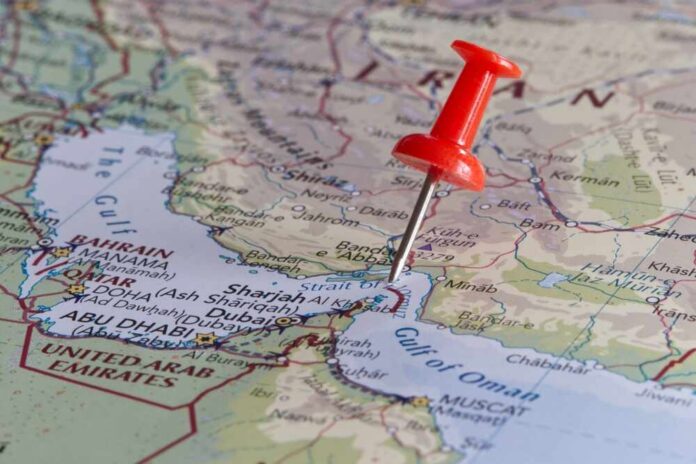
Iran’s bid to slap “environmental fees” on ships transiting the Strait of Hormuz is a toll-by-another-name scheme that threatens global energy flows—and the Trump administration says the waterway will stay open “one way or the other.”
Story Highlights
- Tehran’s proposed “environmental” tolls at Hormuz mirror revenue grabs that burden American drivers, risking higher fuel costs worldwide [3].
- Secretary of State Marco Rubio said allies have a contingency plan and the United States is prepared to be part of it [3].
- Rubio vowed the strait will remain open, signaling coordinated pressure but acknowledging talks are not finalized [2][3][5].
- Closing or taxing Hormuz threatens energy security and emboldens authoritarian leverage over free navigation [3].
Rubio Signals Allied Contingency To Stop Iran’s Toll Gambit
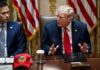
Secretary of State Marco Rubio told reporters that any Iranian move to charge or coerce shipping in the Strait of Hormuz would be met with an allied contingency plan, and that the United States is prepared to be part of that plan [3]. Rubio framed the situation as an immediate international security concern requiring coordination, emphasizing that “the world” needs a plan to confront it [3]. His message underscored that the Trump administration views freedom of navigation as nonnegotiable and is organizing partners accordingly [3].
Rubio also stated the Strait of Hormuz “will be open one way or the other,” a line that conveyed resolve while serving notice to Tehran that coercive tolling or closure will not stand [2]. He repeated that the strait must be opened immediately and that Iran’s actions are illegal and unacceptable, reinforcing the administration’s position that maritime chokepoints cannot become cash registers for authoritarian regimes [4]. The comments were calibrated to deter escalation while rallying allied resolve around a common plan [2][4].
“Environmental Fees” By Any Other Name Still Threaten Energy Security
Iran’s attempt to rebrand a toll regime as “environmental fees” echoes the revenue-first mentality Americans recognize from heavy-handed levies at home, but with global stakes. The Strait of Hormuz handles a significant share of the world’s seaborne oil; any charge or obstruction risks higher fuel prices for American families and businesses by disrupting supply and adding costs to every barrel moved through the channel [3]. Such maneuvers weaponize regulation to achieve geopolitical leverage under a green veneer [3].
Rubio’s remarks made clear the administration rejects conditioned access, side deals, or pay-to-pass schemes, describing Iran’s posture—shutdown threats and conditional offers—as unlawful and unsustainable [3][4]. He confirmed there is allied alignment on a path forward but stopped short of declaring a finalized agreement, indicating active, real-time diplomacy rather than a signed framework [3][5]. That transparency helps Americans separate firm red lines from negotiation noise while signaling to Tehran that delay tactics will not yield economic tribute [3][5].
Coalitions, Clarity, And The Limits Of Diplomacy-In-Progress
State Department readouts and on-camera comments show a coalition-oriented stance led by Washington, with Rubio stressing both preparation and partnership against Iranian coercion in Hormuz [3]. At the same time, public materials reflect talks still in motion, with progress described but no final multilateral text announced [3][5]. That dual reality—operational readiness paired with ongoing diplomacy—is common in crisis management, where governments deter aggression while leaving space for de-escalation without rewarding bad behavior [3][5].
For conservative readers, the stakes are straightforward: sovereignty, lawful commerce, and energy affordability. Allowing a hostile regime to tax a global artery invites future shakedowns, normalizes politicized “fees,” and punishes nations that play by the rules. Rubio’s insistence that the strait remain open aligns with core constitutional and economic values by defending free navigation and resisting government overreach dressed up as environmental policy. The administration’s message is simple: no green fig leaf justifies strangling a lifeline of global trade [2][3][4][5].
Sources:
[2] YouTube – Strait Of Hormuz Will Be Open ‘One Way Or The Other’
[3] Web – Secretary of State Marco Rubio Remarks to Press
[4] Web – Marco Rubio says Strait of Hormuz will be open ‘one way …
[5] Web – Rubio says Strait of Hormuz will stay open ‘one way or the …