
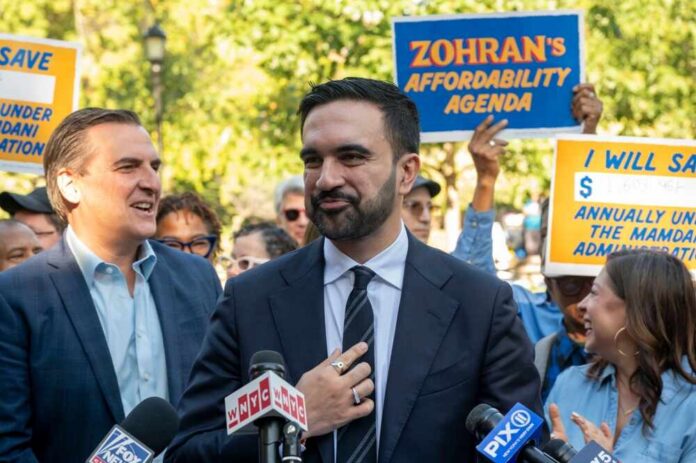
New York City’s hard‑left mayor is crying “historic budget crisis” while steering billions toward a homelessness machine that still cannot keep streets safe or taxpayers respected.
Story Snapshot
- Mayor Zohran Mamdani warns of a huge budget gap yet pushes massive homeless-services spending inside a $124–127 billion city budget.
- City financial plans already lean heavily on social programs, pensions, and debt, limiting room for new big-ticket priorities without tradeoffs.
- Evidence for a specific $4.2 billion homeless-services push is murky, exposing how activists use headline numbers without clear line-item details.
- Conservatives question whether New York is funding real solutions or feeding an expensive bureaucracy that leaves neighborhoods feeling less safe.
Mamdani’s Big-Government Vision Collides With Fiscal Reality
New York City’s own financial documents show a government already operating at massive scale, with the Office of Management and Budget describing a roughly $127 billion “All Funds” plan for Fiscal Year 2027 and openly acknowledging budget gaps and pressure on reserves [1]. Against that backdrop, Mayor Zohran Mamdani and his allies continue to prioritize expansive social spending, including homelessness services, even as they frame the city’s finances as being in crisis, demanding more sacrifice from taxpayers and fewer demands for accountability.
The Mamdani administration’s public messaging tries to have it both ways: City Hall press materials stress that he “inherited” a historic multibillion-dollar budget gap while touting a $124.7 billion executive budget that “restores” fiscal health through savings and higher taxes on top earners [2]. At the same time, the city’s broader financial plan shows that major spending areas such as education, social services, pensions, and debt service already consume most available dollars [1]. That structure leaves little room for large new initiatives without painful tradeoffs somewhere else.
Homelessness Spending Grows While Streets Stay Disorderly
The public debate over a reported $4.2 billion homelessness-services figure captures how New York’s left uses large numbers to signal compassion while avoiding closer scrutiny. The city’s budget materials clearly confirm that homelessness and related social services remain major, recurring expenses, and national coverage notes extremely high per-person costs in New York’s shelter system, often cited around tens of thousands of dollars annually. Yet there is still no clear, primary city document tying Mamdani personally to a precise $4.2 billion proposal for homeless services [1].
That evidentiary gap matters for conservatives who want to argue on facts rather than outrage. The preliminary budget summary details overall spending but does not break out a dedicated, Mamdani-branded homelessness package at that level [1]. Instead, advocates and partisan commentators toss around aggregate figures that sound enormous but rarely explain what they fund: shelter operations, hotel contracts, nonprofit providers, administrative layers, or permanent housing. Without that breakdown, taxpayers cannot know whether dollars are helping people off the streets or simply expanding a bureaucracy with little incentive to solve the underlying crisis.
Trump’s Federal Shift Versus New York’s Progressive Experiments
While the Trump administration in Washington shifts federal housing and homelessness policy toward tighter eligibility and greater emphasis on short-term shelter requirements, New York’s leadership is moving in the opposite direction. Reporting on federal policy indicates a rebalancing away from permanent housing subsidies and toward more conditional, temporary assistance, aimed at reintroducing expectations around work and participation in services [1]. That vision reflects a conservative belief that help should be a bridge to independence, not a permanent entitlement or lucrative industry for city contractors.
New York City under Mamdani appears determined to insulate its progressive homelessness model from that federal course correction. His administration highlights large capital and operating commitments to public housing and supportive programs, adding billions to the five-year capital plan and celebrating what it calls historic investments [2]. But when federal partners tighten standards and local officials expand promises, city taxpayers are left on the hook for the difference. For conservatives, this raises the core question: is New York solving homelessness, or just building a parallel welfare state that expects Washington—and ultimately all Americans—to subsidize its ideological experiments?
What Conservatives Should Watch As The Numbers Get Bigger
For readers who value limited government and safe, orderly neighborhoods, three guardrails are essential in this debate. First, demand hard documentation. The city’s own preliminary budget is public and lengthy, but it does not clearly show the specific $4.2 billion homeless-services push being attributed to Mamdani [1]. Until City Hall produces line items, program lists, and outcome metrics, any headline figure should be treated as a political talking point, not an established fact. Transparency is the prerequisite to any honest argument about priorities.
Second, insist on opportunity-cost thinking. Every billion dollars steered into a sprawling homelessness apparatus is a billion not available for policing, tax relief, infrastructure, or debt reduction. New York’s financial plan already warns that the city must draw from its Rainy Day Fund and Retiree Health Benefits Trust to stay balanced [1]. That is not what fiscal health looks like. Finally, measure success by results, not rhetoric. If billions more leave streets just as disorderly, the answer is reform—not another round of progressive spending on programs that protect ideology and payrolls more than vulnerable people or law-abiding taxpayers.
Sources:
[1] Web – [PDF] The City of New York Preliminary Budget Fiscal Year 2027 – …
[2] Web – Sam T. Pirozzolo | NYC Votes