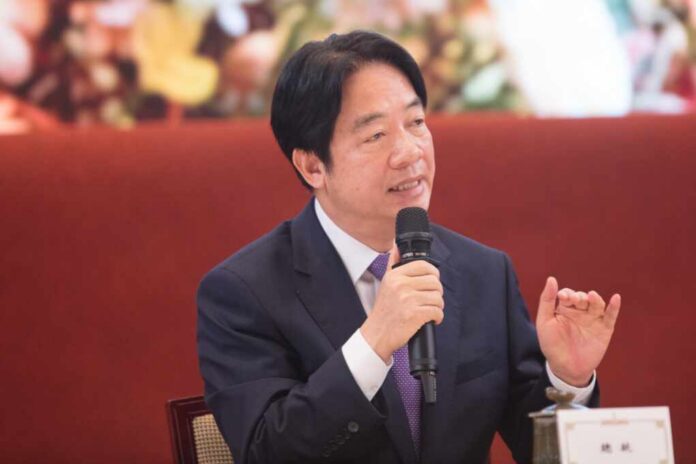
Beijing just branded Taiwan’s elected leader an “instigator of war”.
Story Snapshot
- China’s Foreign Ministry attacked Taiwan President Lai Ching-te after he warned that a Chinese takeover would endanger Japan, the Philippines, and the broader Indo-Pacific.
- Beijing’s spokesman Lin Jian called Lai a “saboteur of peace” and “instigator of war,” reiterating the “one-China” line and claiming reunification is inevitable.
- Taiwan is pushing a rapid defense buildup, including talk of a roughly $40 billion defense budget and expanded readiness for “anytime” aggression.
- Chinese air and sea pressure around Taiwan has surged in recent years, helping normalize coercion short of open conflict.
Beijing’s “War Instigator” Label Targets Taiwan’s Deterrence Message
China’s Foreign Ministry escalated its rhetoric on February 12, 2026, when spokesperson Lin Jian publicly labeled Taiwan President Lai Ching-te a “saboteur of peace, maker of crises and instigator of war.” Lin’s remarks followed Lai’s interview with AFP in which the Taiwanese leader warned that if China annexes Taiwan, Beijing’s next targets could include Japan, the Philippines, and the Indo-Pacific region’s security architecture. China used the episode to restate its one-China claim and condemn Taiwanese “independence” politics.
Lai’s comments were not framed as a call for conflict but as a warning about regional consequences if deterrence fails. That distinction matters for American readers: China’s official narrative regularly flips defensive messaging into “provocation,” then uses its own accusation as justification for more intimidation.
Watch:
https://www.youtube.com/watch?v=mb8Q-V6BBvI
Taiwan’s Defense Push Meets a Campaign of Constant Pressure
Taiwan’s government has emphasized faster military modernization and preparedness, with Lai advocating a major defense buildup and expressing confidence that Taiwan must be able to deter “anytime” aggression. That push comes as China expands routine operations around Taiwan. Research summaries cite a surge in PLA Air Defense Identification Zone activity to more than 300 incursions per month and 1,709 incursions in 2025, with the overall trend described as a steep increase over five years. The effect is persistent stress on Taiwan’s forces and decision-making.
Xi’s Military Purges Add Uncertainty, Not Reassurance
Another complicating factor is internal turbulence inside China’s military leadership. The research points to purges of senior PLA officers tied to Xi Jinping’s broader 2027 modernization goals, which outside analysts have linked to Taiwan contingency planning. Lai dismissed the purges as not changing the invasion risk, and the available sourcing does not prove a direct operational timeline. Still, sudden removals at the top can signal political consolidation, disruption in readiness, or both—none of which should comfort nearby U.S. allies.
Where the U.S. Fits: Allies, Arms, and the Cost of Mixed Signals
Lai’s interview also touched on confidence in U.S. support and continued arms cooperation—an area Beijing frequently attacks. For Americans who endured years of foreign-policy drift, the lesson is straightforward: deterrence relies on clarity and credibility, not fashionable slogans. The research does not provide new U.S. commitments tied specifically to this February 12 exchange, but it shows why Taiwan keeps asking for stronger capabilities. If China believes the West is distracted or divided, pressure campaigns become cheaper and more tempting.
China calls Taiwan’s leader a ‘war instigator’ https://t.co/qf8CErZGsk
— NA404ERROR (@Too_Much_Rum) February 12, 2026
Taiwan’s internal politics also complicate the picture. The opposition KMT continues engaging Beijing around the “1992 Consensus,” described in the research as “one China” with differing interpretations, while Lai’s DPP resists Beijing’s framing. Those divisions give China openings to claim it is dealing with “reasonable” voices while isolating elected leaders it dislikes. The bottom line for U.S. readers is not picking Taiwan’s parties; it is understanding that a free people’s political debate is being exploited by an authoritarian power to erode sovereignty.
Sources:
Foreign Ministry Spokesperson Lin Jian’s Regular Press Conference on February 12, 2026
Taiwan-China attack warning: Indo-Pacific security
China-Taiwan Update February 6, 2026
China calls Taiwan leader a ‘war instigator’
China calls Taiwan’s leader a ‘war instigator’
Taiwan Affairs Office Statement Repository