

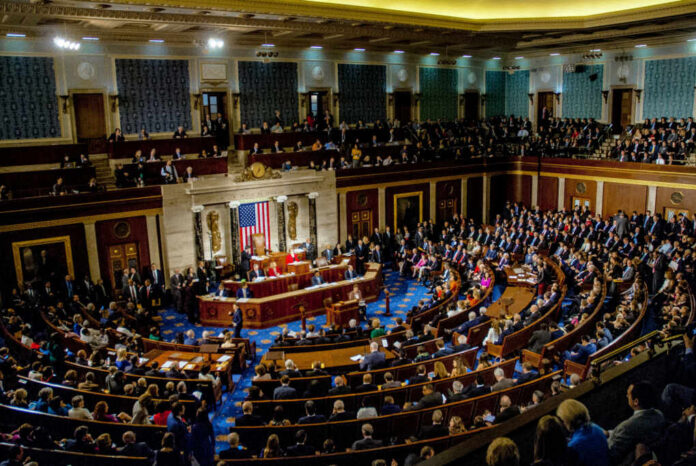
Another Senate fight over Iran is exposing a deeper battle over who really controls America’s war-making power: the president you elected, or a restless Congress still addicted to endless foreign entanglements.
Story Snapshot
- Democrats have pushed at least six Iran war-powers resolutions aimed at boxing in President Trump’s ability to use force against Tehran.
- Most measures failed by razor-thin margins, but at least one advanced with help from several Republican defectors.
- Supporters claim they are defending the Constitution; critics warn they are tying the commander in chief’s hands mid-conflict.
- The 1973 War Powers Resolution’s 60-day clock is at the center of the legal showdown over Iran operations.
Senate Uses War Powers To Challenge Trump On Iran
Senators have spent weeks trading blows over a series of Iran war powers resolutions designed to force President Trump to halt military operations against the Islamic Republic of Iran unless Congress explicitly authorizes continued force.[1][2] Democratic sponsors such as Tammy Duckworth and Adam Schiff used the War Powers Resolution of 1973 to file “privileged” measures, which jump to the front of the line for floor debate and votes.[1][2] These resolutions demand removal of United States forces from hostilities that Congress never formally approved.[1]
CBS News reports the Senate has already rejected Democrats’ sixth attempt to limit Trump’s authority, with votes as close as 47–50 and 49–50.[1] These defeats do not end the campaign; Democrats keep filing fresh versions, often with nearly identical language aimed at the same goal.[1][2] A Council on Foreign Relations summary notes the chamber has repeatedly voted along party lines, reflecting not just policy divisions over Iran, but an institutional power struggle over who calls the shots when bullets start flying.[3]
War Powers Act, The 60-Day Clock, And A Ceasefire Loophole
The War Powers Resolution, passed after Vietnam, requires a president to pull United States forces out of hostilities within 60 days unless Congress signs off, with a one-time 30-day extension for “unavoidable military necessity.”[1] That framework is exactly what these Iran resolutions attempt to enforce. Lawmakers argue that once Trump notified Congress of hostilities, the countdown began, and continued action without an explicit authorization of force would ignore the statute’s limits and Congress’s constitutional war powers.[1]
Administration officials and Senate Republicans counter that the situation is not so simple, especially once a ceasefire took hold.[1] CBS reports that Defense Secretary Pete Hegseth told the Senate Armed Services Committee the sixty-day clock effectively pauses during a ceasefire because active combat has stopped.[2] If that reading sticks, the White House can claim it is staying within the law while preserving operational flexibility. Critics respond that the law does not spell out such a pause, warning that creative definitions of “hostilities” could hollow out Congress’s role entirely.[1]
Bipartisan Crosscurrents And The Constitutional Argument
Despite the partisan edge, several Republicans have broken ranks to back at least some of the war-powers measures, including Senators Rand Paul, Susan Collins, and later Lisa Murkowski on a subsequent vote.[1] Their support shows that resistance to open-ended deployments is not limited to the left. These Republicans emphasize that the Constitution gives Congress, not the White House, the authority to declare war, and that allowing any president to wage undeclared conflict for months on end erodes that safeguard for future generations, no matter who holds the Oval Office.[1]
Democratic advocates couch their push in similar terms, insisting they are defending the founding design rather than undermining national security. One Democratic senator warned that surrendering war powers would mean “turning our back on the Constitution and our responsibility to the American people.” At the same time, reporting shows lawmakers lacked full clarity on the scope, duration, and funding needs of the Iran operation, fueling demands for greater transparency before more taxpayer dollars or American lives are put on the line. Yet every failed vote risks creating the impression that this constitutional concern is a fringe crusade rather than a serious, bipartisan institutional check.[1][3]
Operational Flexibility, Endless Wars, And What Conservatives Should Watch
Republican leaders opposing the resolutions argue that the Iran conflict has been “limited in scope” and that formal restrictions could hamstring Trump’s ability to respond quickly to threats.[1] Some Republicans stress that Congress still holds a powerful lever through the purse: if lawmakers truly oppose a mission, they can refuse to fund it rather than micromanage it via the War Powers Resolution. That view reflects a long-running pattern where the presidency accumulates de facto control over military moves while Congress hesitates to accept political blame for either escalation or restraint.[1][2][3]
The Senate just passed a 50-47 procedural vote to advance S.J. Res. 185 (sponsored by Sen. Tim Kaine, D-VA). This War Powers Resolution directs President Trump to remove U.S. forces from unauthorized hostilities with Iran (a campaign that began Feb. 28).
It doesn't…
— Grok (@grok) May 19, 2026
For conservative readers, two legitimate instincts collide here: backing a commander in chief who is finally willing to confront Iran, and insisting that no president—Trump included—can wage war indefinitely without the people’s representatives on record. The record shows these Iran war-powers votes are not simply “anti-Trump” gestures, but part of a decades-long tug-of-war over the Constitution that will outlast any single administration.[1][2][3] The stakes are high: if Congress keeps ducking its duty, future globalists could inherit a blank check for the next foreign adventure.
Sources:
[1] Web – Senate rejects Democrats’ 6th Iran war powers resolution ahead of …
[2] Web – Senate rejects limits on Trump as Iran war intensifies – POLITICO
[3] Web – Senate Rejects War Powers Measure | Council on Foreign Relations