
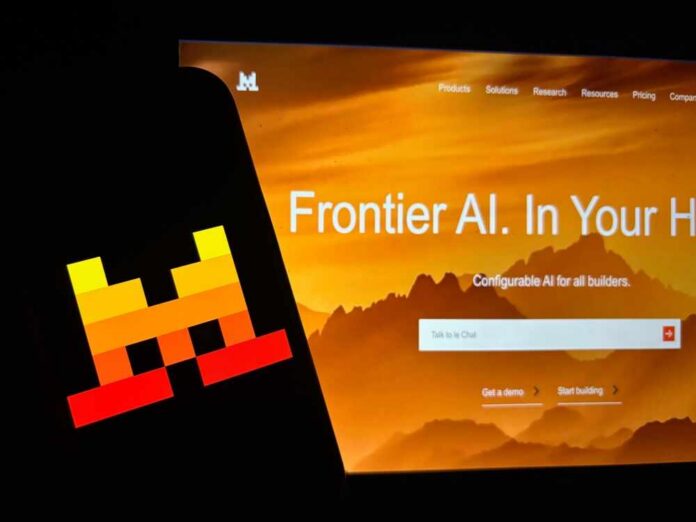
A French artificial intelligence boss is warning Europe it has just two years to avoid becoming a digital “vassal state” to American tech giants, and his plan says a lot about the new global power struggle over who controls the machines shaping our lives.
Story Snapshot
- French startup Mistral’s chief executive says artificial intelligence power is concentrating dangerously in a few mostly American hands.[1][3]
- He urges Europe to build its own chips, energy, and data centers or risk permanent dependence on United States providers.[1][3]
- Open-source, on-premises artificial intelligence is pitched as the cure for digital dependence, but evidence for that is still thin.[1][2][5]
- The “two-year deadline” and “vassal state” language are not backed by hard numbers, highlighting how much of this debate is political positioning.[1][3]
A European CEO Warns Of Becoming America’s AI “Vassal State”
Arthur Mensch, the thirty‑something chief executive of French startup Mistral, has become Europe’s loudest voice warning that a handful of mostly American firms are gaining dangerous control over artificial intelligence infrastructure.[1][3] Speaking at the India AI Impact Summit in New Delhi, he said the world faces “too much concentration of power in artificial intelligence” and insisted every country or economic bloc needs a strategy to own part of the underlying infrastructure.[1][2][3] He frames this as a sovereignty issue, not just a business preference.
Mensch argues that artificial intelligence will soon generate “multiple digits” of global economic output, making control of chips, energy, and data centers a core national interest rather than a niche tech issue.[1][2] He warns that users should always have their own “turn‑on and turn‑off button” for critical systems so they are not at the mercy of foreign cloud providers who can simply pull the plug.[2] In other words, whoever controls the servers and power can silence your economy, your banks, or even your military software at will.
Inside The “Two‑Year Window” And The Vassal State Rhetoric
Reports from his testimony in France’s National Assembly quote Mensch saying Europe has a “narrow window” of roughly two years to secure its own artificial intelligence capacity before American cloud giants lock in dominance through long‑term energy and infrastructure contracts.[1][3] He claims those United States providers are already signing major electricity deals with European utilities, effectively exporting European power “in token form” as rented artificial intelligence services rather than letting European firms build their own platforms.[2][3] That is where his provocative “vassal state” phrase comes from: a continent renting its digital future from foreign landlords.
Yet the available evidence shows this timeline is more rhetorical than scientific. None of the public materials tied to Mensch’s speeches provide concrete benchmarks for what level of European chip production, compute capacity, or data‑center power would count as true sovereignty.[1][3][5] There is also no published engineering or industrial‑policy model explaining why two years is a hard cutoff rather than three or five.[1][3] The fear of dependence is real, but the “now or never” framing largely rests on the word of a founder whose company would directly benefit from aggressive local spending.
Open-Source And On‑Premises AI As A Sovereignty Play
Mensch positions open‑source artificial intelligence and on‑premises deployments as the main antidote to dependency on American tech.[1] He says Europe needs “another path” based on decentralization, with governments and enterprises running models they can inspect, customize, and host themselves rather than relying entirely on foreign black‑box systems.[1][2] According to interviews about Mistral’s strategy, that means building state‑of‑the‑art models that can be deployed inside a hospital, ministry, or bank so sensitive data never leaves domestic servers.[5] This approach clearly appeals to governments that worry about foreign surveillance or political pressure.
There is some evidence that this model is already being tested. Mensch has said Mistral works with public services and healthcare providers, helping citizens access information more easily through locally controlled tools.[2] Commentators note that this sort of on‑premises deployment could give European states at least partial leverage, even if the underlying chips or some cloud infrastructure still come from the United States.[5] However, there is no comparative data here showing that open‑source, sovereign‑style setups actually match the performance, cost, or security of the big closed systems over time.[1][5] The remedy is asserted more than proved.
Geopolitics, Influence, And What Americans Should Learn
In a separate interview, Mensch said the most immediate risk is not science‑fiction catastrophe but “massive influence on how people think and how they vote,” warning that artificial intelligence assistants could become “thought control instruments.”[4] That is a concern Americans know well from years of biased moderation and algorithmic nudging on social media. His point is that whoever controls the dominant artificial intelligence layers will not just rent out computing power; they will shape culture, language, and politics at scale.[1][4] That is why he talks about “excessive leverage” in the hands of a few companies.[1][3]
For conservatives in the United States, this European debate should be a wake‑up call rather than a threat. A French chief executive is sounding alarms about dependence on American tech giants, but the deeper issue is concentration of power anywhere. Today’s dominant platforms lean left and have already shown they are willing to police speech, manipulate reach, and bow to bureaucrats. If Washington ever ceded its own control of key infrastructure to foreign powers, Americans could quickly find themselves in the “vassal” role Mensch fears for Europe.[1][3][4] Sovereign, decentralized, open systems that keep the switch in our own hands align far better with constitutional liberty, national security, and the right of families to live free from distant, unaccountable gatekeepers.
Sources:
[1] Web – ‘We are at risk’: Mistral CEO warns against US dominance in AI | …
[2] YouTube – Mistral Co-Founder Arthur Mensch Warns Against AI …
[3] Web – Top European AI boss warns of US tech concentration at India summit
[4] Web – CEO of Mistral AI says warnings about extreme risks of artificial …
[5] Web – Europe’s AI Superstar Slams “Catastrophic” Hiring Rules in Europe