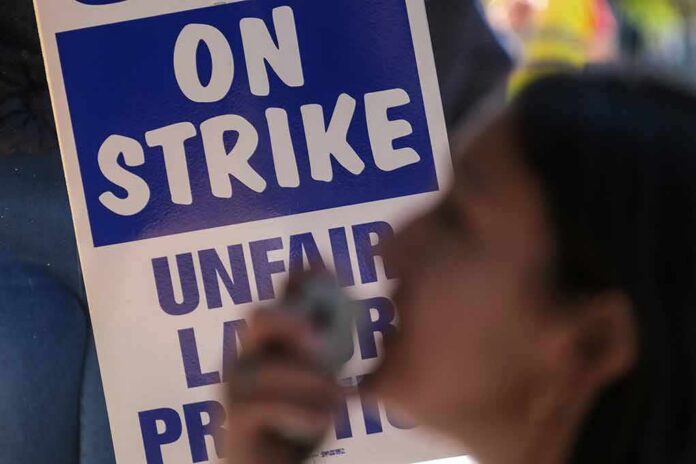
A politically protected transit bureaucracy and aggressive unions just brought America’s busiest commuter rail line to a standstill, leaving 300,000 riders caught in the crossfire of New York’s big-government mismanagement.
Story Snapshot
- Long Island Rail Road service is shut down by a strike, stranding roughly 300,000 daily commuters.
- Five unions walked after rejecting a package of 9.5% raises over three years plus a fourth-year offer below their 5% demand.
- The Metropolitan Transportation Authority warns that meeting union demands could mean steep fare hikes or service cuts.
- Governor Kathy Hochul urges “good faith” talks while taxpayers and workers shoulder the economic and personal fallout.
Strike Shuts Down America’s Busiest Commuter Rail Line
Long Island Rail Road service is now suspended systemwide after contract talks between the Metropolitan Transportation Authority and five unions collapsed, triggering a strike that immediately pulled about 3,500 engineers, trainmen, signal and electrical workers off the job.[1][2] The walkout halts trains that normally move roughly 300,000 commuters on a weekday, forcing families, small-business employees, and essential workers to scramble for alternative transportation or stay home.[1][3] For many, paychecks and appointments are on hold while government and union leaders argue over percentages.
The Metropolitan Transportation Authority had publicly warned that a strike would shut down all Long Island Rail Road trains if no deal was reached by the deadline, and that is exactly what has happened.[1][2] Limited shuttle buses and park-and-ride options are planned from select Long Island stations into Queens, where riders are expected to transfer to already crowded New York City subways.[1][3] Local officials on Long Island have cautioned residents to expect traffic gridlock on major roadways, longer commutes, and spillover delays as tens of thousands get pushed onto highways built for far lower volumes.[3]
What the Two Sides Were Fighting Over on Wages
The core dispute centers on the wage pattern for a four-year contract, not on whether workers should get a raise at all.[2][4] Both sides agreed to 9.5% in cumulative raises over the first three years, but clashed over the final year.[2][4] Union coalitions representing about half the workforce demanded a 14.5% total increase over four years and specifically sought a 5% raise in the fourth year, which they argue is necessary to keep up with inflation and align with an earlier Presidential Emergency Board recommendation.[2][4]
Metropolitan Transportation Authority negotiators instead offered a 3% raise in year four combined with a one-time lump-sum payment, which they claim would bring the effective value of that final year to around 4.5% without permanently locking in a higher wage base.[2][3] Union leaders rejected that structure, insisting on a larger percentage raise baked into salary rather than one-off payments, and publicly called Metropolitan Transportation Authority suggestions that a deal was “close” far-fetched.[2][3] That narrow but consequential gap over how the final-year increase is delivered ultimately pushed the parties past the deadline.
Political and Fiscal Stakes for Taxpayers and Riders
Metropolitan Transportation Authority leadership has argued that going beyond its current offer is not just a bargaining preference but a budget issue with real consequences for riders and taxpayers.[4] Agency officials warned that meeting the unions’ full wage demand could force an 8% fare hike next year, roughly double the 4% increase already built into plans, or require cuts to service levels if elected leaders refuse higher fares or taxes.[4][5] Those warnings line up with a broader Metropolitan Transportation Authority labor update that says exceeding budget targets would mean higher fares, higher taxes, or fewer jobs.[5]
Governor Kathy Hochul has tried to straddle both sides, publicly instructing the Metropolitan Transportation Authority to bargain “in good faith” while insisting that any agreement must “make sense for taxpayers and commuters” and not trigger higher fares or new taxes.[5] At the same time, her office has emphasized contingency planning and communications with union leadership, even as union members printed picket signs and prepared for a walkout in the days before the deadline.[5] That political balancing act leaves many riders feeling that those in Albany are more focused on optics than on preventing a shutdown that was clearly telegraphed well in advance.
Everyday New Yorkers Pay the Price for Elite Mismanagement
On the ground, the strike fallout looks less like a policy debate and more like everyday chaos for working families and small businesses.[1][3] Town officials in places like Huntington warn that cancelled trains will disrupt access to jobs, medical appointments, and essential services for residents who rely on the Long Island Rail Road, especially lower-income commuters who do not have flexible work-from-home options.[3] Local business groups have already raised alarms that a prolonged shutdown could hit the Long Island regional economy hard as employees arrive late, cancel shifts, or stay home entirely.[4]
Impeccable timing, @GovKathyHochul. With the LIRR on strike, commuters have no choice but to drive into Manhattan, right into your congestion tax trap. Talk about picking people's pockets when they're down. Voters won't forget this in November!https://t.co/gBLjM8yyRl
— United Bronx Residents (@FoilCorruption) May 16, 2026
While the unions argue they are simply fighting to keep wages aligned with inflation and national rail standards, and the Metropolitan Transportation Authority insists it must protect the system’s finances, the one group with no seat at the table is the commuting public.[2][4][5] Riders still paying high New York taxes and stiff fares are now told to sit in traffic or squeeze onto overcrowded buses because government-run transit and organized labor could not settle a dispute over the last one or two percentage points of a contract.[1][3][5] For many conservatives, this strike is another reminder that concentrated power in large public agencies often leaves taxpayers and families last in line.
Sources:
[1] Web – Possible LIRR strike and service shutdown on May – MTA
[2] Web – Planning for a possible LIRR strike. Here’s what to know – WSHU
[3] Web – LIRR Shuttle buses, contingency plans if service stops this weekend
[4] Web – Mta Officials Union Continue To Differ In Contract Talks As Lirr …
[5] Web – LIRR strike threat closes in on May 16 deadline – Amsterdam News