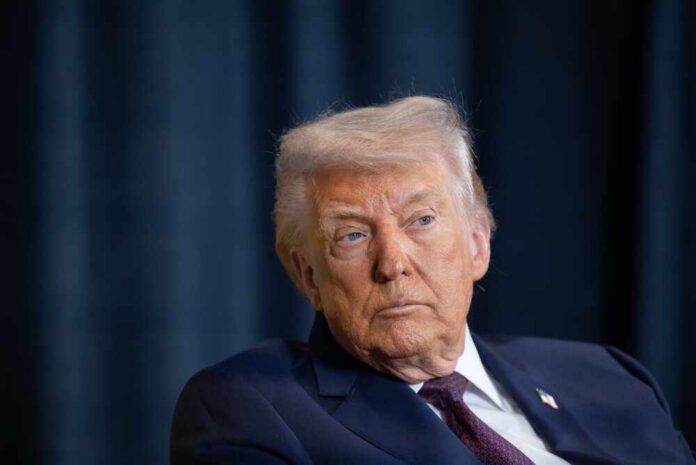
President Trump’s warning to Iran is simple: the U.S. military isn’t leaving the region until Tehran accepts a “real agreement” that blocks nukes and keeps the world’s most important oil chokepoint open.
Quick Take
- Trump said U.S. ships, aircraft, troops, and weapons will remain deployed “in and around Iran” until a deal is fully complied with.
- The message ties U.S. force posture to two outcomes: no Iranian nuclear weapon and an open Strait of Hormuz for global shipping.
- A two-week ceasefire reportedly began shortly before Trump’s strike deadline, with talks expected in Islamabad.
- Defense Secretary Pete Hegseth publicly backed the stance, saying U.S. forces are staying to enforce compliance.
Trump Links U.S. Presence to a “Real Agreement,” Not Just a Ceasefire
President Donald Trump posted on Truth Social on April 8 that all U.S. ships, aircraft, personnel, ammunition, and weaponry would remain deployed in and around Iran until a “real agreement” is reached and complied with. Trump paired that demand with two non-negotiables: Iran cannot obtain nuclear weapons, and the Strait of Hormuz must remain open. He also warned that if terms are not met, the next phase of military action would intensify.
The wording matters because it frames the U.S. posture as an enforcement mechanism rather than a temporary war-footing. Supporters see that as deterrence—clear red lines backed by credible capability. Critics see a risk of escalation if either side claims the other violated terms. What is clear from multiple reports is that Trump’s approach is designed to hold leverage after the shooting pauses, not to declare victory and depart.
A Fragile Two-Week Pause Sits Under Bigger Regional Pressures
Reporting around the ceasefire describes a two-week pause that began shortly before Trump’s strike deadline, with peace talks expected in Islamabad. At the same time, Iranian officials have cast doubt on permanent negotiations, calling further talks “illogical” in the context of ongoing Israeli operations in the region, including intense strikes on Lebanon reported to have killed more than 250 people. That regional backdrop complicates any U.S.-Iran pathway from ceasefire to durable agreement.
This is where many Americans—right and left—feel the familiar frustration: high-stakes foreign commitments collide with murky diplomacy, and ordinary citizens are left to guess how long deployments last and what “success” means. Trump’s statement attempts to answer that by defining measurable objectives (no nukes, open Hormuz) and tying force levels to compliance. The unanswered question is how compliance will be verified and adjudicated if the parties dispute facts on the ground.
Pentagon Operations Show the Scale of U.S. Capability—and the Cost of Staying Ready
The recent U.S. operational tempo illustrates why the administration believes it can enforce a deal from a position of strength. One report detailed a surge of more than 150 aircraft into Iran for a search-and-rescue mission involving a downed F-15E aviator. The operation also included the destruction of two stranded U.S. transport aircraft to prevent sensitive technology from being captured. Those details underscore both reach and risk in sustained regional operations.
Maintaining an “armada” posture in and around Iran also places pressure on U.S. resources: high-end assets, munitions stockpiles, and readiness for other threats. For fiscal conservatives already wary of open-ended commitments, the key issue becomes whether a defined, enforceable agreement can prevent a prolonged cycle of deployments and emergency operations. For voters focused on national security, the counterargument is that deterrence now is cheaper than a wider war later.
Hormuz and Energy Reality: Why the Strait Remains a Red Line
The Strait of Hormuz remains central because it is a critical corridor for global oil transit, and any disruption can ripple quickly into prices Americans feel at the pump. By explicitly linking U.S. deployments to keeping Hormuz open, Trump is tying security policy to economic stability. That also reflects a broader shift away from rhetoric-heavy diplomacy toward hard constraints: keep shipping lanes open, or the U.S. stays positioned to respond.
With Republicans controlling Congress and Trump in his second term, Democrats have limited ability to block force posture directly, but they can raise political costs through hearings, messaging, and challenges to war rationale. One of the sharpest factual tensions in the background reporting is the claim that briefings to Congress indicated no intelligence of imminent Iranian plans against U.S. assets prior to the buildup. That gap—if sustained—will remain a central point in debates over executive power, war decisions, and trust in federal institutions.
Sources:
US military to remain deployed around Iran until “real agreement” is complied with: Trump
Trump: U.S. Military Will Remain Deployed Near Iran Until a ‘Real Agreement’ Is Reached
Trump says US military to remain deployed around Iran until “real agreement” is complied with
US deployed more than 150 aircraft to rescue downed aviator in Iran
Iran war latest news: Trump, Nato members