
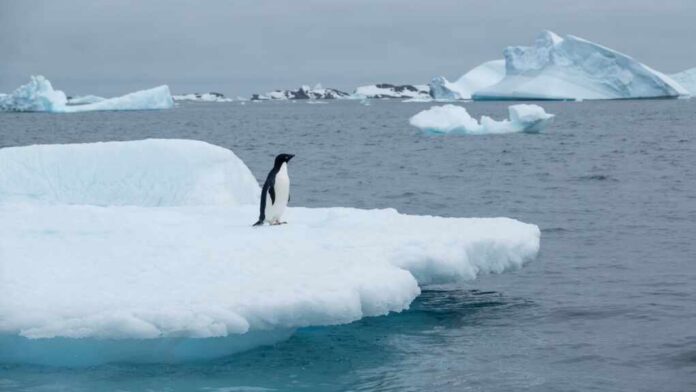
Melting Antarctic ice releases unusable iron, potentially crippling the Southern Ocean’s vital role as Earth’s CO2 sponge and accelerating global warming.
Story Highlights
- A new study in Nature Geoscience shows iron from West Antarctic Ice Sheet (WAIS) icebergs limits algae growth, reducing CO2 absorption contrary to green assumptions.
- WAIS thinning at 135 billion tons yearly mirrors past interglacials, depositing low-bioavailability iron south of Antarctic Polar Front.
- Researchers warn of amplified warming feedback, challenging overreliance on ocean sinks for net-zero dreams pushed by globalists.
- Antarctica’s ice loss fuels sea-level rise risks for American coasts, demanding practical energy policies over Paris Agreement failures.
Study Reveals Unexpected Climate Feedback
Torben Struve from University of Oldenburg led the February 4, 2026, Nature Geoscience study analyzing sediment cores over 500,000 years. These cores link WAIS retreats during interglacials, like 130,000 years ago, to high iceberg activity. Icebergs scraped weathered bedrock, releasing lithogenic iron unusable by algae. This suppressed phytoplankton growth south of the Antarctic Polar Front, where dust plays no role. Prior models assumed more iron boosted carbon uptake; this proves otherwise, exposing flaws in alarmist projections.
Melting Antarctic ice may weaken a major carbon sink: https://t.co/xbmRuFl136
— Ken Gusler (@kgusler) February 4, 2026
Historical Patterns Challenge Green Narratives
During glacial periods, continental dust fertilized algae north of the Polar Front, enhancing CO2 drawdown and cooling. South of it, WAIS icebergs dominated iron supply in warmer interglacials but delivered poorly bioavailable forms from ancient rock. Modern WAIS thinning echoes this, with Antarctica shedding 135 billion tons of ice annually. Gisela Winckler of Columbia Climate School notes ocean carbon absorption varies with iron quality, not quantity. This paleoclimate evidence demands skepticism of unproven globalist schemes.
Current Thinning and Expert Warnings
Struve states the ice sheet shows no imminent collapse but clear thinning that could lower carbon uptake. Winckler emphasizes iceberg iron’s lower bioavailability than assumed, altering Southern Ocean views. NASA data confirms ongoing mass loss, with models forecasting acceleration after 2060 under high emissions. The Pacific sector south of the Polar Front, a key carbon sink, faces reduced efficiency as marine-based glaciers retreat rapidly. Conservative energy independence offers real resilience against such feedbacks.
Stakeholders at Lamont-Doherty Earth Observatory provided geochemical analysis, influencing IPCC models through peer-reviewed work. No commercial motives drive this academic effort to refine predictions.
Watch:
https://www.youtube.com/watch?v=P6IhyM79HHI
Impacts on America and Global Stability
Short-term, algae suppression limits CO2 drawdown as WAIS thins, raising costs for coastal defenses. Long-term, weakened sinks amplify warming, with potential 20% Antarctic Circumpolar Current slowdown under high emissions. Sea-level rise from Antarctica could double by 2100 if unchecked, threatening U.S. cities. Ecosystems suffer marine life declines and invasive risks. Political pressure mounts on Paris Agreement enforcement, yet Trump’s fossil fuel revival prioritizes affordable energy over unreliable green fantasies.
Expert Bablu Gayen from University of Melbourne highlights ACC slowdown dangers. NSIDC and NASA affirm emission-dependent irreversible losses. Uncertainties persist in ACC response and exact projections, but paleodata robustly ties WAIS iron to low algae productivity.
Sources:
Melting Antarctic ice may weaken a major carbon sink – ScienceDaily
Unexpected climate feedback links Antarctic ice sheet to reduced carbon uptake – Phys.org
Unexpected climate feedback links Antarctic ice sheet to reduced carbon uptake – Lamont-Doherty
Why Ice Sheets Matter – NSIDC
Ice Sheets – NASA Science