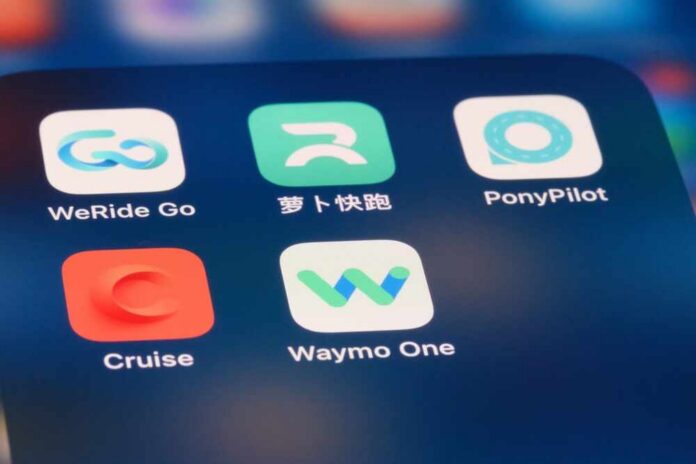
China’s state-backed robotaxi fleets are rapidly outscaling American competitors while Washington regulators drag their feet, threatening U.S. leadership in a trillion-dollar autonomous vehicle market that Beijing views as strategic national infrastructure.
Story Snapshot
- Chinese robotaxi fleets reached 8,000 vehicles in 2025 while U.S. operations remain confined to a handful of cities, exposing regulatory paralysis versus Beijing’s aggressive subsidies and fast-track permits
- WeRide and Pony.ai launched fully driverless services in Abu Dhabi, beating American firms to international expansion as China controls 70% of global electric vehicle production
- Goldman Sachs projects China will dominate 1.9 million robotaxis by 2035, capturing 25% of ride-hailing while 85% of Chinese consumers embrace Level 4 autonomy compared to just 30-40% in the U.S.
- Waymo remains the sole U.S. operator offering driverless paid rides, planning nationwide expansion in 2026 amid questions whether American innovation can overcome China’s manufacturing and policy advantages
China’s Supply Chain Dominance Fuels Robotaxi Surge
China controls 70% of global electric vehicle production and six of the world’s top-10 EV sellers are Chinese companies, according to International Energy Agency data. BYD alone outsold Tesla globally while building massive factories that churn out components at prices American manufacturers cannot match. This industrial base now powers robotaxi expansion, with firms like Baidu Apollo Go, Pony.ai, and WeRide deploying 8,000 autonomous vehicles across Chinese cities by 2025. Beijing provides subsidies, fast-track permits, and AV-suited infrastructure while over 60% of new Chinese cars already feature Level 2 driver assistance systems, creating a pipeline toward full autonomy.
Pony.ai CEO James Peng acknowledged American pioneers started earlier but noted China’s advantages are closing the gap fast. His company plans to triple its fleet to 3,000 vehicles by late 2027 through partnerships with Bolt, while also operating in UAE and Saudi Arabia. WeRide announced 1,600 autonomous vehicles including 750 robotaxis, launching fully driverless Uber service in Abu Dhabi—the first deployment outside the U.S. or China. The speed reflects government backing that treats autonomous vehicles as strategic national infrastructure, not experimental technology subject to endless regulatory review as in the United States.
American Leadership Confined to Limited Markets
Waymo operates the only driverless paid robotaxi service in America, confined to select cities while Chinese competitors blanket dozens of urban areas. The Alphabet subsidiary plans a 2026 nationwide rollout from San Diego to Washington D.C., partnering with Zeekr to build purpose-designed autonomous taxis. Yet regulatory hurdles and public skepticism slow progress—just 30-40% of Americans express comfort with Level 4 autonomy compared to 85% of Chinese consumers per PwC data. Zoox and Tesla run pilot programs but lag Waymo’s commercial scale. Western giants like Uber and GM already abandoned the autonomous vehicle “bloodbath,” leaving the field to better-funded competitors.
Harvard researcher Mark Fagan projects global robotaxi fleets will double to 18,000 vehicles in 2026, with most activity concentrated in China and emerging Middle Eastern markets where governments welcome the technology. U.S. expansion remains steady but not dramatic, hampered by fragmented state regulations and liability concerns that Beijing simply overrides through centralized directives. The contrast illustrates a familiar pattern: American innovation pioneers new technology while Chinese industrial policy and scale turn it into dominant market position, raising questions whether decentralized governance can compete with authoritarian efficiency in deploying transformative infrastructure.
Trillion-Dollar Market at Stake
Goldman Sachs forecasts China will operate 1.9 million robotaxis by 2035, capturing 25% of the ride-hailing market in a sector projected to reach trillion-dollar valuations. The China Society of Automotive Engineers predicts 20% of new vehicles sold domestically will be fully autonomous by 2030, creating a vast testing ground and consumer base unavailable to American firms. Chinese manufacturers already offer free advanced driver assistance systems in budget EVs from BYD, XPeng, Huawei, Xiaomi, and Alibaba, normalizing autonomous features while U.S. automakers charge thousands in premiums. This democratization builds public acceptance and data—two critical advantages in training AI systems for real-world conditions.
The shift from semiconductor competition to physical AI deployment in robotaxis reveals a deeper challenge for American competitiveness. While U.S. firms maintain technological leads in software and sensors, China’s control of battery supply chains, vehicle manufacturing, and supportive regulatory environments enables faster deployment of autonomous fleets at lower cost. Ride-hail workers face displacement, cities confront infrastructure changes, and Europe must choose between collaborating with American or Chinese systems. For conservatives and progressives alike frustrated by government dysfunction, the robotaxi race offers a stark lesson: Beijing’s coordinated industrial strategy is outmaneuvering America’s fragmented approach, threatening jobs and strategic industries while Washington’s entrenched bureaucracy protects its turf instead of the national interest.
Sources:
The Robotaxi Race: America vs China – Impakter
China vs US: Scale Faster WeRide Waymo – Road to Autonomy