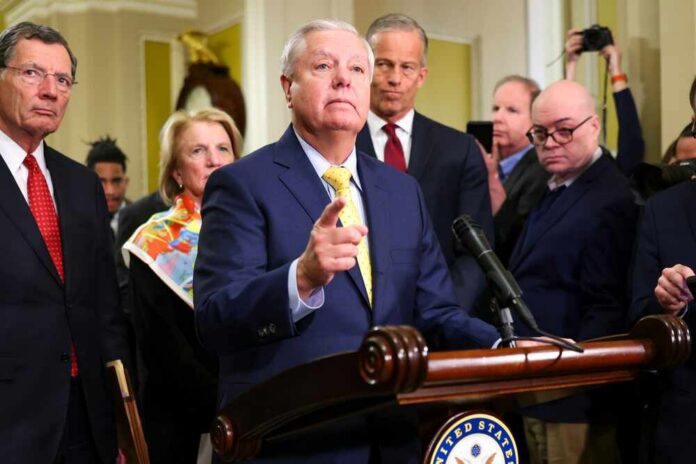
Sen. Lindsey Graham’s pitch for war with Iran now comes with a stunning caveat: don’t wreck the oil fields, because Washington may need them for the “after” picture.
Quick Take
- U.S.-Israel strikes on Iran began Feb. 28, 2026, after weeks of behind-the-scenes lobbying aimed at bringing President Trump fully into the campaign.
- Graham has argued the war’s massive price tag is worth it, while also warning against destroying Iran’s oil infrastructure to preserve a post-regime economy.
- Oil prices reportedly jumped about 27% in a week, fueling renewed anxiety at home about energy costs and the cost of foreign intervention.
- Graham has publicly pressured Gulf allies to participate, criticizing Saudi Arabia and others for staying on the sidelines.
Graham’s war message: go big, but protect the oil
Sen. Lindsey Graham has used the opening weeks of the U.S.-Israel conflict with Iran to argue for aggressive military pressure intended to break the regime’s power. At the same time, he has warned against crippling Iran’s oil sector, describing it as essential for a future Iran after the ayatollahs. That tension—maximum force paired with selective restraint—has become a defining feature of his public case as strikes continue into early March.
Reporting also describes a coordinated political effort behind the scenes. Graham traveled to Israel multiple times and worked closely with Israeli Prime Minister Benjamin Netanyahu on how to persuade President Trump to support strikes, after Trump initially leaned toward letting Israel handle the fight. By late February, Trump’s deployment of a second aircraft carrier signaled a larger U.S. role, and the U.S.-Israel campaign began Feb. 28.
Costs, casualties, and the “$1B a day” argument
The war is colliding with kitchen-table realities in the United States. One account cites oil prices rising roughly 27% in a single week, a sharp move that hits retirees and working families first through gasoline and shipping costs. The same reporting describes Graham defending a burn rate of about $1 billion per day and backing a major supplemental request—$50 billion—on top of an already enormous defense budget reported at $1.5 trillion.
Humanitarian reporting cited in the research paints a grim picture inside Iran, including claims of 1,255 deaths and more than 12,000 wounded, with a large share of reported fatalities described as civilians, including children. Those figures are difficult to independently verify in real time and can vary by source, but they underline how quickly modern air campaigns create moral and strategic complications. Americans have seen this pattern before: fast strikes, uncertain end states, and prolonged political fallout.
Pressure on Gulf allies exposes limits of “coalition” politics
Graham’s media push has also targeted America’s regional partners. He has criticized Saudi Arabia for refusing to join the fight and publicly questioned the value of U.S. defense commitments when wealthy allies stay out of the line of fire. Separate reporting describes pushback from the UAE sphere as well, including a prominent Emirati businessman rejecting Graham’s calls. The result is a familiar coalition problem: Washington carries the heaviest burden while allies calculate their own risks.
What’s solid, what’s disputed, and what remains unknown
Multiple outlets agree on key basics: Graham played a significant role in lobbying for action, the strikes began Feb. 28, and he has continued advocating escalation while trying to shape targeting choices—especially around oil facilities near Tehran. The underlying rationale is contested. Pro-war voices describe a campaign to eliminate a dangerous regime and neutralize proxies like Hezbollah; critics describe the war as unlawful, destabilizing, and economically punishing.
What remains unclear is the endgame. The research notes Graham dismissing the “Pottery Barn rule” logic that America must “own” what it breaks, arguing instead that the goal is regime collapse without open-ended nation-building. That is a serious promise with serious stakes: if the regime falls, a power vacuum could emerge; if it doesn’t, the United States could be locked into a costly pressure campaign with rising domestic backlash over prices, spending, and priorities.
Lindsey Graham Says 'There's No Reason' To Invade Iran – Except for Part of It https://t.co/HiiYy7WXqb
— Mediaite (@Mediaite) March 18, 2026
For conservatives who watched the prior administration push global commitments, massive spending, and policy drift at home, this moment is a stress test. The public argument coming from Graham emphasizes strength and deterrence, but the practical questions are the ones voters live with: how long, how much, and what measurable outcome justifies the cost. Until the administration defines a clear finish line, the war will remain vulnerable to the same “forever conflict” concerns that have exhausted Americans for decades.
Sources:
The Jerusalem Post – International (article-889482)
Truthout – Lindsey Graham Says ‘$1B a Day’ on Iran War Is ‘Best Money Ever Spent’
Politico – Lindsey Graham interview on Iran (March 4, 2026)